 Orcas Island Siding
 Why Eastsound Homes Wear Out Differently
Eastsound sits at the center of Orcas Island's exposure to everything the Salish Sea throws at it. Homes here deal with a combination most mainland contractors never have to think about: salt-laden air moving off the water, long stretches of driving rain funneled by the island's hills and channels, and shaded, damp corners where moss and algae get a permanent foothold. None of these factors is dramatic on its own. Together, over years, they're what separates a siding job that looks good for two decades from one that needs attention by year eight.
Salt air is corrosive to fasteners and finishes in ways that inland siding never has to withstand. Combine that with San Juan County's marine humidity, and you get a slow, steady moisture load that painted wood and many engineered wood products are not built to shed indefinitely. Add tree cover and north-facing walls that rarely see direct sun, and you have ideal conditions for moss, lichen, and mildew to take hold on siding, trim, roofing, and deck surfaces alike.
We work on Orcas Island regularly, which matters more here than in most places. Ferry schedules, limited material suppliers on-island, and the realities of getting a crew and equipment to a job site all shape how work gets scheduled and priced. A contractor who treats Eastsound as just another stop on a mainland route tends to underestimate lead times, weather windows, and the extra care that salt-air-exposed assemblies need. A crew that works the islands regularly plans around those realities instead of being surprised by them.
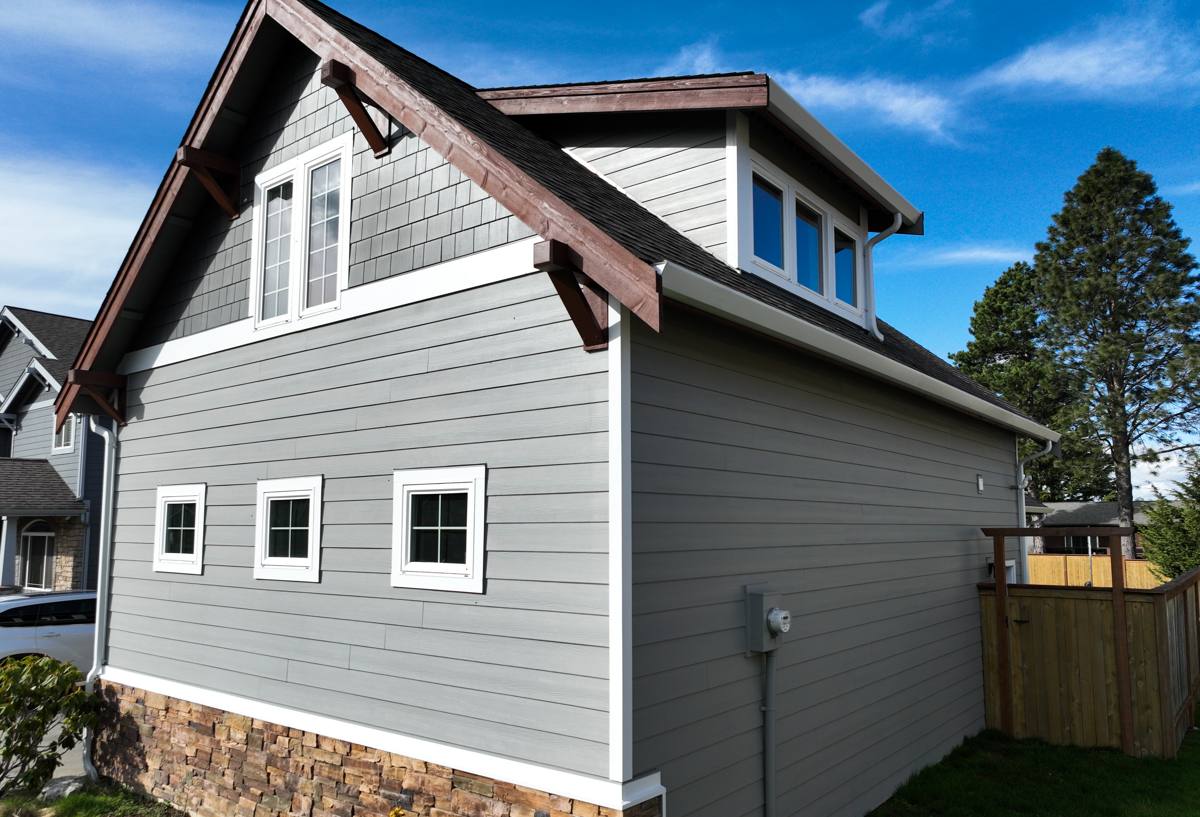
What Salt Air and Moisture Actually Do to Siding
Fastener and Finish Corrosion
Standard fasteners and lower-grade finishes degrade faster in salt-exposed marine air. Rust streaking, fastener backout, and premature finish failure show up years before they would on a comparable inland home. This is one of the most overlooked failure points on island construction — the siding material itself might be fine, but corroding fasteners or trim hardware compromise the whole assembly.
Moss, Algae, and Trapped Moisture
Moss doesn't just look bad. It holds moisture against the siding surface, which accelerates rot in wood-based products and can stain or degrade lower-quality finishes. Shaded walls, north exposures, and areas under tree canopy — common across Eastsound's wooded lots — are the first places moss establishes itself and the last places it dries out between rain events.
Driving Rain and Wind-Driven Water
Storms moving through the San Juans often bring rain sideways, not straight down. That means water gets forced up under laps, around trim, and into any gap in the water-resistive barrier that a hurried installation left behind. On this kind of site, correct flashing, lap spacing, and house-wrap detailing aren't optional refinements — they're the difference between a wall assembly that sheds water and one that slowly saturates from the inside.
Our Position: Why We Only Install James Hardie
We install James Hardie fiber cement siding exclusively. We don't install vinyl, LP SmartSide, Cemplank, Allura, primed spruce, or cedar, and we're upfront about why — because in a climate like Eastsound's, the trade-offs of those products stack up against the homeowner over time.
Vinyl
Vinyl is inexpensive and low-maintenance in mild climates, but it's a thin, flexible material that can warp under sustained UV and temperature swings, and its seams and J-channels give wind-driven rain more opportunities to find a way behind the cladding. In a driving-rain environment, that's a real liability.
LP SmartSide, Cemplank, and Allura
LP SmartSide is an engineered wood product — it performs well when detailing is followed exactly, but wood-based substrates are inherently more vulnerable to prolonged moisture exposure than fiber cement, and any lapse in caulking or flashing maintenance shortens its life faster in a wet, salt-air climate. Cemplank and Allura are both fiber cement competitors to Hardie, and they're reasonable products on paper — but we've standardized on one system so our crews install to one spec, source one set of accessories, and back one manufacturer's warranty, rather than splitting expertise across several product lines with different installation tolerances.
Primed Spruce and Cedar
Real wood siding has a genuine, warm look that some homeowners want, and we understand the appeal. But primed spruce and cedar both require an ongoing maintenance commitment — recoating, caulking, and moisture monitoring — that's demanding even in a dry climate. In Eastsound's combination of salt air, humidity, and moss pressure, that maintenance burden compounds, and the margin for deferred upkeep is thinner than most homeowners expect when they choose wood for its appearance.
Why Hardie
James Hardie fiber cement is non-combustible, dimensionally stable, and resistant to the kind of moisture-driven rot that wood and wood-composite products are vulnerable to. Its ColorPlus factory finish is baked on and warranted separately from the substrate, which matters in salt air where field-applied paint tends to fail first. Hardie also engineers regional HZ5 product lines specifically for wetter, harsher climates — which is a closer match to island conditions than a generic siding spec. It's also a widely available, well-established product, which means color and profile matching for future repairs or additions is realistic, not a guessing game.
How We Approach a Siding Job on Eastsound
Assessment
We start by walking the exterior and identifying the specific exposures on your lot — which walls take direct weather, where moss and algae have already established, where trim or flashing shows early wear, and whether the existing water-resistive barrier is intact. On wooded or shaded lots, we also look at how tree cover affects drying time after rain, since that changes how aggressive the moss and mildew pressure will be over time.
Installation Details That Matter Here
- Correct lap exposure and fastener placement per James Hardie's HZ5 specifications, not generic manufacturer defaults
- Corrosion-resistant fasteners appropriate for marine/salt-air exposure
- Careful flashing and kick-out details at rooflines, windows, and deck ledgers, where wind-driven rain finds gaps
- A continuous, properly lapped water-resistive barrier behind the cladding
- Rainscreen or ventilation gap detailing where the wall assembly and site conditions call for it
- Trim and caulking practices sized for a climate where UV and moisture cycles are constant
Working Around Island Logistics
We plan material delivery and crew scheduling around ferry timing and weather windows rather than treating them as afterthoughts. That means fewer surprise delays and a more realistic project timeline from the start — something that matters more on Orcas Island than almost anywhere else in the county.
Siding Product Comparison for Marine Climates
| Product | Moisture Resistance | Maintenance | Fire Resistance | Typical Lifespan in This Climate |
|---|---|---|---|---|
| James Hardie Fiber Cement (HZ5) | Strong; non-combustible substrate, factory finish | Low; periodic cleaning | Non-combustible | Decades with proper install |
| Vinyl | Moderate; seams vulnerable to wind-driven rain | Low, but can warp/fade | Combustible | Shorter in high-UV, high-wind exposure |
| LP SmartSide | Moderate; wood-based, needs intact sealing | Moderate; sealant/caulk upkeep | Combustible | Shorter if maintenance lapses |
| Cedar / Primed Spruce | Lower; absorbs moisture without upkeep | High; recoating and caulking cycle | Combustible | Shortest without consistent maintenance |
Roofing, Windows, and Decks: The Rest of the Envelope
Siding doesn't work in isolation. On a home exposed to Eastsound's rain and salt air, the roof, windows, and any exterior decking all share the same moisture load, and a weak point in one usually shows up as damage in another. We handle all four — siding, roofing, windows, and decks — because a wall assembly is only as good as the flashing where it meets the roofline, and a window is only as weather-tight as the trim and sealant around it.
Roofing
Roof-to-wall transitions are one of the most common sources of hidden water intrusion, especially where kick-out flashing is missing or undersized. When we address siding and roofing together, we can correct these transitions properly instead of patching around an existing flaw.
Windows
Older window installations on island homes often predate current flashing standards. Replacing siding is a natural point to also correct window flashing and trim details, since the wall is already open.
Decks
Deck ledger connections and the wall assembly behind them are a frequent moisture entry point, particularly on homes that have had a deck added after the original build. We check this connection as part of any exterior scope.
Signs Your Eastsound Home May Need Exterior Attention
- Persistent moss or algae growth that returns quickly after cleaning
- Soft or spongy siding, especially near ground level or under decks
- Peeling, bubbling, or chalking paint on wood or engineered wood siding
- Rust streaking around fasteners or trim
- Visible gaps or separation at trim, corners, or window/door surrounds
- Interior signs of moisture — musty smells, staining, or soft drywall near exterior walls
What to Expect From the Estimate Process
We walk the exterior with you, point out what we're seeing, and explain what's driving any wear we find — whether that's exposure, past installation shortcuts, or ordinary age. We'll give you a straightforward scope and cost range for James Hardie siding (and roofing, window, or deck work if it's part of the picture) with no pressure to sign on the spot. If your project needs to work around ferry logistics or a specific weather window, we'll factor that into the schedule up front rather than discovering it midstream.
If you're in Eastsound or elsewhere on Orcas Island and want a clear-eyed look at your home's exterior, reach out for a free, no-pressure estimate. We'll tell you honestly what we see and what we'd recommend.