 Orcas Island Siding
 Building Envelopes for West Sound's Marine Climate
West Sound sits along one of the quieter, more sheltered shorelines of Orcas Island, but "sheltered" is a relative term in San Juan County. Homes here still face the same core exposures that define exterior work across the San Juan Islands: near-constant marine humidity, salt-laden air drifting off the water, driving rain that comes in sideways during winter storms, and long stretches of shade and dampness that keep roofs, siding, and trim wet far longer than they'd stay wet on the mainland. Add in the tree cover that many West Sound properties enjoy for privacy, and you get an extended moss season that can run from fall through late spring.
None of this makes West Sound a hard place to live. It makes it a specific place to build and maintain a home. Materials and installation details that work fine in a dry inland climate can fail early here — not dramatically, but quietly, through slow moisture intrusion, coating breakdown, or wood that never fully dries out between rain events. Our approach to siding, roofing, windows, and decks on Orcas Island starts from that reality, not from a generic checklist.
What Salt Air Actually Does to a House
Salt air is corrosive and hygroscopic — it pulls moisture out of the atmosphere and holds it against surfaces longer than plain humid air does. Over years, this shows up in a few predictable ways on West Sound homes:
- Fasteners, flashing, and hardware corrode faster than published "coastal-rated" ratings sometimes suggest, especially where two dissimilar metals meet.
- Paint and factory finishes on siding chalk, fade, or lift at seams sooner than the same products would inland.
- Untreated or field-painted wood trim and fascia show early checking and rot at end grain and joints.
- Window seals and weatherstripping degrade faster when exposed to salt-tinged, damp air year-round.
The fix isn't one product — it's a combination of corrosion-resistant fasteners and flashing, a factory-applied finish rather than field paint wherever possible, and details (drip edges, kick-out flashing, proper caulking joints) that keep water moving away from the building instead of sitting against it.
Why Driving Rain Is a Different Problem Than "A Lot of Rain"
San Juan County doesn't get the heaviest annual rainfall in Washington, but West Sound's exposure to wind off the water means rain often arrives horizontally rather than straight down. That matters for siding and window installation specifically: a lap siding system with generous overlap and correctly lapped house wrap sheds wind-driven rain far better than a system that's only designed for vertical rainfall. The same goes for window flashing — a window that's simply caulked around the outside, without proper pan flashing and integration into the water-resistive barrier, is a likely leak point once wind-driven rain becomes routine rather than occasional.
Siding: Why We Install Only James Hardie Fiber Cement
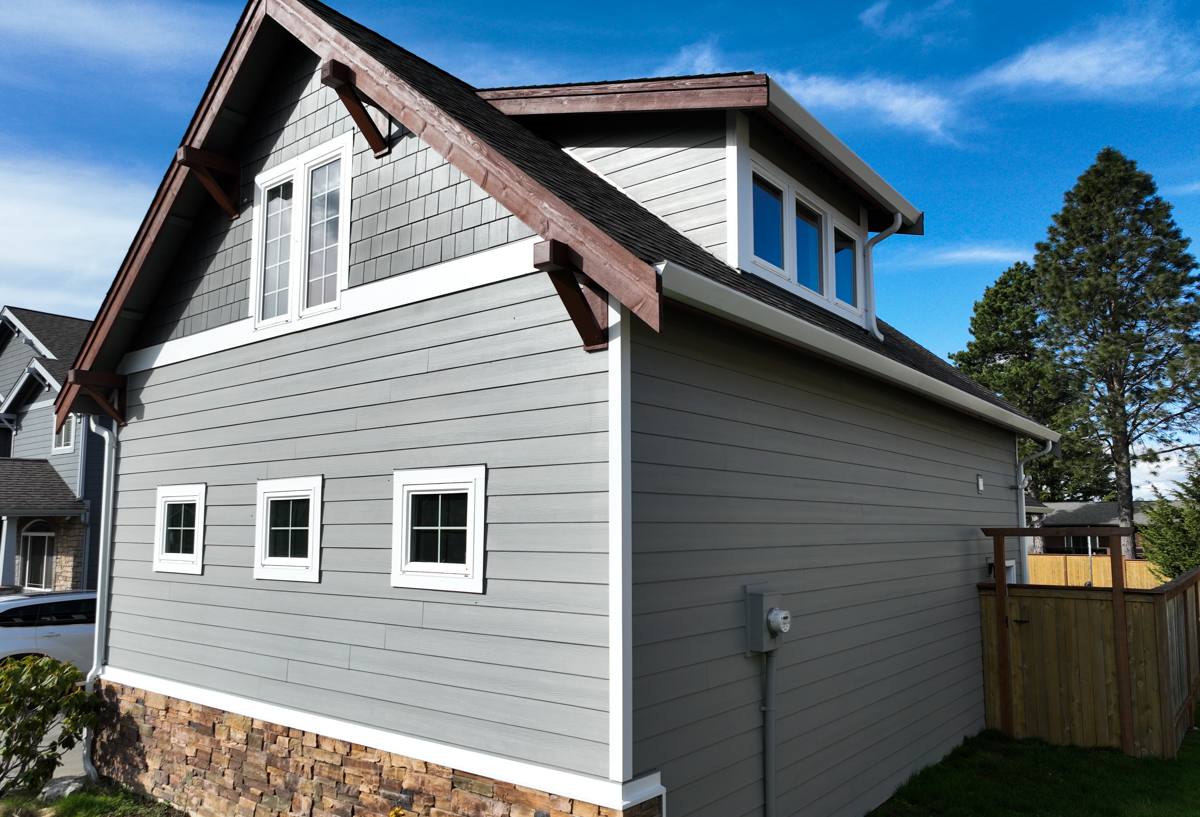
We install James Hardie fiber cement siding exclusively — not vinyl, not LP SmartSide, not Cemplank or Allura fiber cement, not primed spruce or cedar. That's a deliberate standard, not a default, and it's worth explaining honestly rather than just asserting it.
Vinyl siding is inexpensive and low-maintenance in the sense that it doesn't need painting, but it's also more prone to warping and cracking in temperature swings, and its seams and J-channels give wind-driven rain more opportunities to find a way behind the cladding over time. Wood siding — cedar or primed spruce — can look excellent when new, but it demands an ongoing maintenance commitment (recoating, caulking, moisture monitoring) that a lot of homeowners underestimate, and in a marine climate like West Sound's, that maintenance interval shrinks. Engineered wood products like LP SmartSide use a wood-strand substrate that performs well in many climates but is still wood-based, meaning it's more sensitive to sustained moisture exposure at cut edges and joints than a cement-based product. Other fiber cement brands, like Cemplank or Allura, are legitimate cement composite products, but we standardized on one manufacturer's system so our crews install to one set of specifications, one flashing detail set, and one warranty structure — consistency that matters more in a climate that punishes shortcuts.
James Hardie fiber cement is non-combustible, dimensionally stable across wet and dry cycles, and available with a factory-applied ColorPlus finish that's baked on and warranted separately from the substrate — which matters directly in a place where a field-applied paint job would be fighting salt air and damp shade from day one. Hardie also engineers climate-specific HZ product lines; for a wet, marine environment like Orcas Island, that means a formulation designed around moisture exposure rather than a one-size-fits-all board.
Hardie Product Lines We Commonly Use in West Sound
| Product | Best Use | Why It Fits This Climate |
|---|---|---|
| HardiePlank lap siding | Primary wall cladding | Deep shadow lines, factory finish, engineered for wet climates |
| HardiePanel vertical siding | Accent walls, gable ends | Clean modern look, fewer horizontal seams for water to test |
| HardieTrim boards | Corners, fascia, window trim | Won't rot or split like wood trim exposed to salt air |
| HardieSoffit panels | Under eaves and overhangs | Resists the sustained dampness common under tree-shaded eaves |
Roofing: The First Line of Defense Against Moss and Rain
On a tree-shaded, damp lot in West Sound, the roof does more work than almost anywhere else in the state. Moss doesn't just look bad — it holds moisture against shingles or shakes, lifts edges, and shortens roof life if left unchecked. We look at a few things specific to this environment on every roofing job:
- Ventilation — a roof deck that can't breathe stays damp longer and invites moss and rot from underneath, not just on top.
- Valley and flashing details — this is where wind-driven rain concentrates, and it's the most common leak point on older Orcas Island roofs we inspect.
- Underlayment quality — a synthetic, high-quality underlayment gives a real second line of defense under whatever roofing material sits on top.
- Edge metal and drip edges sized for wind-driven rain, not just gravity drainage.
Living With Moss Season
You won't fully eliminate moss on a shaded West Sound roof, and we're not going to pretend otherwise. What you can control is how much of a foothold it gets: proper ventilation, zinc or copper strips at the ridge where appropriate, and periodic gentle cleaning (not pressure washing, which damages shingle granules and shake surfaces) keep moss from shortening the roof's real service life.
Windows: Sealing Out Wind-Driven Rain
Window failures in this climate are rarely about the glass — they're about the installation. A window can carry a great energy rating and still leak if it isn't flashed correctly into the wall assembly. For West Sound homes, we pay particular attention to:
- Pan flashing at the sill, sloped to shed any water that gets past the window back out of the wall.
- Proper integration with the house wrap or weather-resistive barrier, lapped shingle-style so water always drains outward.
- Corrosion-resistant fasteners and flashing tape rated for long-term coastal exposure.
- Quality weatherstripping and glazing suited to sustained damp conditions, not just cold-weather performance.
Replacing old, leaking windows is also one of the more direct ways to stop hidden damage to the wall assembly behind them — by the time a window leak shows up as a stain on interior trim, it's often been feeding rot into the framing for a while.
Decks: Built for Wet, Shaded Ground
Decks in West Sound face a tougher moisture load than decks on a sunny, exposed lot — tree cover keeps decking wet longer after rain, and that accelerates wood rot and mildew growth on traditional wood decking. We talk through material trade-offs honestly with every homeowner:
| Decking Type | Maintenance Burden | Considerations for West Sound |
|---|---|---|
| Pressure-treated wood | High — regular sealing/staining | Needs consistent upkeep to resist rot in shaded, damp spots |
| Cedar | High — sealing, cleaning, moisture monitoring | Attractive but demands real commitment in this climate |
| Composite decking | Low — occasional cleaning | Resists moisture absorption well; good fit for shaded, wet lots |
Whatever material a homeowner chooses, the substructure details — joist protection, proper drainage, ledger flashing where the deck meets the house — matter as much as the decking surface itself in a climate this wet.
Why a Local, Ferry-Ready Crew Matters
Working on Orcas Island isn't the same logistics as working on the mainland. Materials, crews, and equipment move on a ferry schedule, and a contractor who doesn't plan around that ends up with delayed jobs, half-finished exteriors sitting exposed to weather longer than they should, or rushed work to make a return sailing. A crew based in and familiar with San Juan County plans deliveries and scheduling around the realities of island logistics, keeps a job weathertight at the end of every work day, and understands which details actually matter for West Sound's specific exposure rather than applying generic mainland practices.
Local experience also means recognizing the patterns particular to this area — which sides of a house typically take the worst wind-driven rain, where moss tends to establish first, which older siding and roofing systems are showing their age around the neighborhood. That pattern recognition comes from doing this work here, repeatedly, not from a general contracting background applied to a new location.
A Practical Exterior Checklist for West Sound Homeowners
- Walk the exterior after a hard windstorm and check for lifted siding edges, dislodged flashing, or new gaps around windows.
- Look at north-facing and shaded roof slopes each fall for early moss growth before it spreads.
- Check gutters and downspouts before winter rains start — clogged gutters push water back under roofing and siding.
- Inspect deck ledger boards and joists annually for soft spots, especially under tree cover.
- Watch for chalking, fading, or lifting paint on wood trim — an early sign the finish is losing its fight against salt air.
- Have window flashing and caulking checked every few years rather than waiting for a visible leak.
If you're weighing a siding, roofing, window, or deck project for a West Sound home, we're glad to walk the property with you and talk through what your specific exposure calls for. Reach out for a free, no-pressure estimate — there's a form below to get started.