 Orcas Island Siding
 Why Siding Problems Sneak Up on Orcas Island Homes
Siding failure rarely announces itself. It starts small — a soft spot behind a downspout, a seam that's opened a hair's width, a patch of paint that won't hold anymore — and by the time it's obvious from the driveway, the sheathing underneath has usually been wet for a season or two already. On Orcas Island, that timeline compresses. Salt-laden air off the water accelerates corrosion on fasteners and trim, driving rain off the Strait pushes moisture sideways into laps and seams that would stay dry in a calmer climate, and a long wet season means whatever gets damp in November may not fully dry until April. San Juan County's marine climate is part of what makes this place beautiful to live in, but it's also unforgiving toward siding that isn't holding up its end of the bargain.
This page is about catching the early signals — the ones you can spot from the ground with a flashlight and a screwdriver, before a small problem becomes a sheathing replacement. It applies whether your home is sided in cedar, primed wood, engineered wood, vinyl, or fiber cement. The signs differ a bit by material, but the underlying lesson is the same: siding's job is to shed water, and anything that interrupts that job is worth investigating right away.
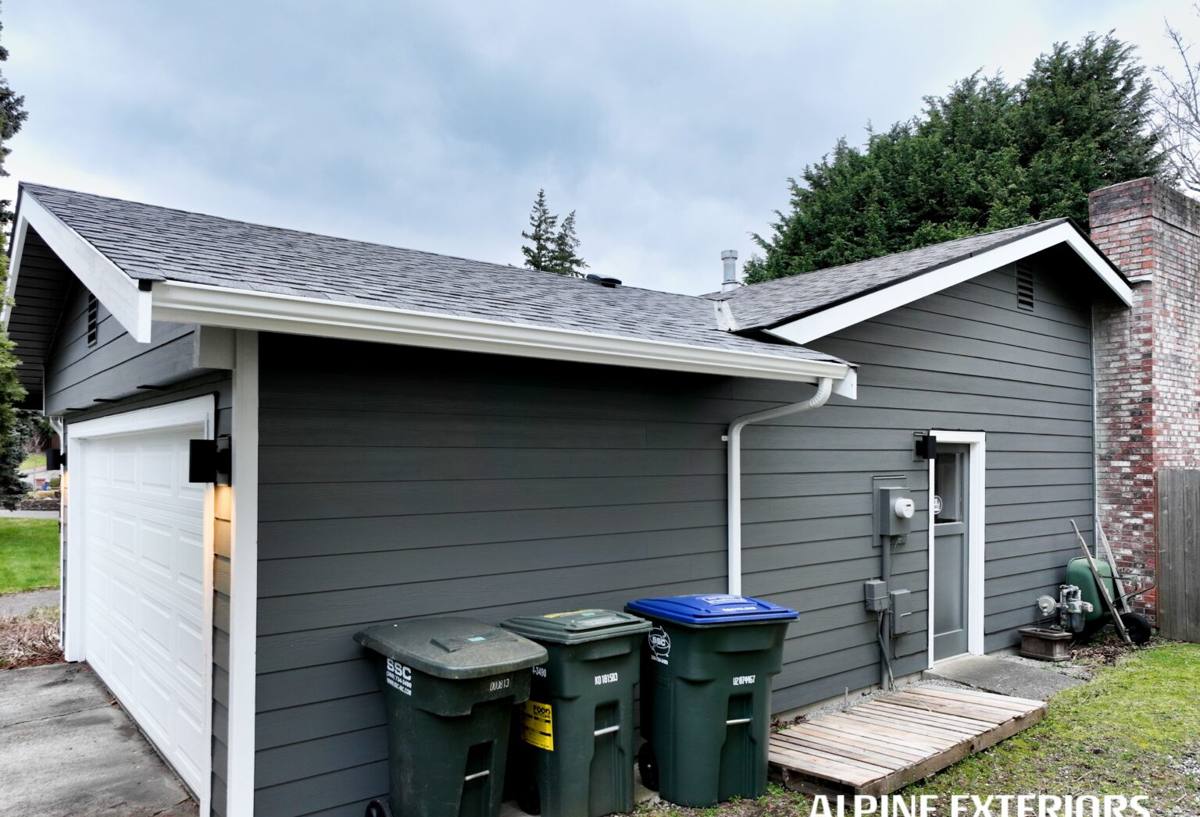
The Core Warning Signs, By Category
Soft or Spongy Spots
Press a gloved hand or the flat of a screwdriver against the siding near the bottom of walls, under windows, and around any penetration — hose bibs, dryer vents, light fixtures. If it flexes or feels spongy instead of solid, water has already gotten behind the surface and is softening either the siding itself or the sheathing behind it. This is the single most reliable sign that something needs attention now, not next season.
Paint or Finish That Won't Hold
If you're repainting the same wall every three to four years instead of every seven to ten, that's not a paint quality problem — it's a moisture problem. Paint fails fast on siding that's staying damp longer than it should, usually because of poor drainage, missing flashing, or a butt joint that's opened up and is wicking water into the substrate.
Cracking, Splitting, and Checking
Fine surface checking is cosmetic and common on painted wood. Cracks that run through the full thickness of a board, especially near fastener locations or panel edges, are a different story — they're entry points for water and they tend to widen with every freeze-thaw or wet-dry cycle.
Warping, Buckling, and Waviness
Siding that's visibly wavy when you sight down the wall, or panels that have started to cup or bow, means the material has absorbed moisture unevenly and is moving. Once a board or panel warps, it rarely lies back down flat — it's usually a replacement, not a repair.
Staining, Streaking, and Discoloration
Dark streaks running down from seams, nail heads, or trim joints are usually water tracking a path it shouldn't have. Rust-colored streaks specifically point to corroding fasteners — a common issue in salt air environments where standard fasteners weren't rated for coastal exposure.
Gaps, Separation, and Loose Panels
Caulk joints that have pulled apart, panels that have gapped away from the wall, or trim that's visibly separated from siding all mean the building's moisture barrier has a hole in it. Wind-driven rain, which this island gets plenty of, will find that gap eventually.
How Warning Signs Differ by Siding Material
The same underlying moisture problem shows up differently depending on what's on the wall. Knowing what to look for on your specific material saves time.
| Material | Earliest Warning Sign | What It Usually Means |
|---|---|---|
| Cedar (untreated or field-finished) | Graying, cupping boards, soft edges at butt joints | Finish has worn through; end grain is absorbing water |
| Primed Spruce/Pine Bevel | Peeling paint at the bottom edge of boards, swelling | Primer coat has failed at cut ends or fastener holes |
| LP SmartSide (engineered wood) | Dark swelling at panel edges, especially bottom edge | Edge seal has been compromised, strand board is absorbing moisture |
| Vinyl | Warping/wave pattern, brittleness, cracking in cold snaps | UV and thermal cycling have degraded the panel; joints may be loose |
| Fiber Cement (e.g., James Hardie) | Caulk joint failure, fastener corrosion staining | Usually a sealant or fastener issue, not the board itself |
That last row is worth noting: fiber cement is not immune to problems, but the failure modes tend to be at the joints and fasteners rather than the board material absorbing and swelling. That distinction matters when you're deciding whether a fix is a caulking job or a full panel replacement.
Where to Look First
Not every wall weathers the same. On Orcas Island, prioritize inspection in this order:
- South and west-facing walls — these catch the most driving rain off the water and the most UV exposure
- Anywhere siding meets a roofline, deck ledger, or porch — flashing details here fail more often than open wall sections
- Bottom courses near grade, planter beds, or sprinkler zones — splashback and soil contact keep these areas wet longest
- Around every penetration — hose bibs, vents, light fixtures, and mounting brackets for anything attached to the wall
- Inside corners and butt joints — these rely entirely on caulk and flashing, and both degrade over time
Moss, Mildew, and the Long Wet Season
San Juan County's moss season is long, and it's more than a cosmetic nuisance. Moss and algae hold moisture directly against the siding surface for weeks at a time, especially on north-facing walls and anywhere shaded by trees — which is most of Orcas Island. A wall that's perpetually damp from moss cover ages faster than one that dries out between rains, even if the rainfall totals are identical. If you're pressure washing moss off siding every year or two, that's a sign the wall isn't getting enough sun or airflow to dry properly, and it's worth thinking about tree trimming or gutter adjustments in addition to whatever cleaning you're doing. Aggressive pressure washing itself can also drive water behind laps and joints, so low-pressure cleaning with a soft brush is the safer approach regardless of material.
DIY Inspection Checklist
A thorough walk-around twice a year — once before the wet season ramps up in fall, once after it eases in spring — catches most problems while they're still cheap to fix.
- Walk the full perimeter and press-test any area that looks discolored or stained
- Check caulk joints at corners, trim, and penetrations for cracking or separation
- Look for rust streaks below fastener heads or exposed nails
- Check for gaps where siding meets window and door trim
- Look up at the top course near the roofline and any step-flashing areas
- Check the bottom few inches of siding at grade for soil contact or splashback staining
- Note any areas with heavy moss or algae buildup that stay shaded most of the day
- Check exterior faucets, vents, and light fixtures for gaps in the surrounding seal
What Happens If These Signs Get Ignored
The cost of a siding problem grows fast once water reaches the sheathing, and it's not a linear curve — it accelerates.
| Stage | Typical Scope | Relative Cost |
|---|---|---|
| Caught early | Recaulk, refasten, replace a board or two | Low — a repair visit |
| Caught mid-stage | Section replacement, localized sheathing repair | Moderate — a partial re-side |
| Caught late | Rot has spread into framing, insulation is compromised | High — structural repair plus full re-side |
The jump from "moderate" to "high" usually happens once water has been getting behind the siding long enough to reach framing members, and that's often invisible from the outside until the damage is well established. This is the practical argument for the twice-a-year walk-around — it's a lot cheaper to catch a problem while it's still a repair.
Repair vs. Replace: How to Think About It
A single soft board, a failed caulk joint, or isolated fastener corrosion is almost always a repair. Widespread warping across multiple walls, siding that's original to a home built more than 20-25 years ago, or damage that's already reached the sheathing in more than one location usually points toward replacement being the more cost-effective path over the next decade, rather than chasing repairs on a material that's reaching the end of its service life. A contractor who's willing to tell you "this is a repair, not a replacement" — and mean it — is worth more than one who quotes a full re-side on every visit.
Why We Point Homeowners Toward Fiber Cement
When a replacement is genuinely the right call, we install James Hardie fiber cement exclusively. It's not the only siding product on the market, but after years of seeing how different materials hold up against this specific climate — salt air, driving rain, and long stretches of damp shade — fiber cement's resistance to moisture absorption, its non-combustible composition, and its factory-applied ColorPlus finish add up to fewer of the early warning signs covered above, and a longer stretch before they show up at all. That's the standard we hold our own installs to, and it's why it's what we recommend when a homeowner asks what to put back on the wall.
If you're seeing any of these signs on your home, or you'd just like a second set of eyes on a wall that's been bothering you, we're happy to take a look. Reach out for a free, no-pressure estimate using the form below.