 Orcas Island Siding
 Vinyl Siding Isn't a Bad Product — It's Just the Wrong Product for This Island
We want to start by being fair to vinyl siding, because a lot of what gets written about it online is either sales copy or exaggeration in the other direction. Vinyl is inexpensive, it goes up fast, and for a lot of the country it does a perfectly adequate job for a decade or two. Millions of homes wear it without incident. That's not in dispute.
What is in dispute, at least for us, is whether it belongs on homes here on Orcas Island. After years of tearing off failed siding jobs and replacing them with something built for this specific place, we made a standing decision: we install James Hardie fiber cement, and we don't install vinyl. This page explains the reasoning, not to talk you out of vinyl in general, but so you understand exactly what you're trading away if you put it on a home in San Juan County.
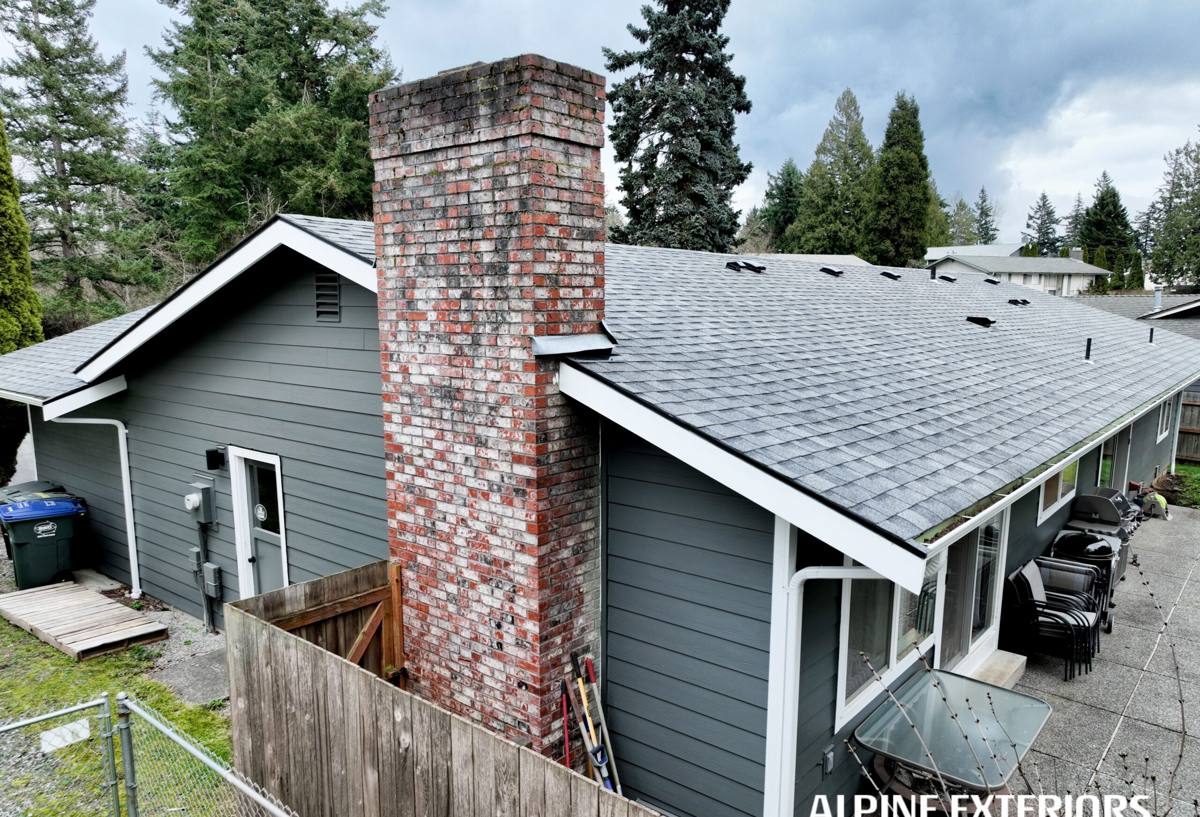
What Vinyl Gets Right
Credit where it's due. Vinyl siding:
- Costs less upfront than fiber cement, wood, or most other claddings
- Installs quickly, which keeps labor costs down
- Never needs painting, since the color runs through the material
- Handles ordinary rain fine when it's installed correctly on a well-detailed wall
- Is lightweight and easy for crews to work with
If you're building in a mild, low-wind, low-salt inland climate and budget is the deciding factor, vinyl is a defensible choice. Orcas Island isn't that climate.
What Orcas Island's Climate Actually Does to a Wall
San Juan County sits in a rain shadow compared to the mainland Cascades, but that doesn't mean the island goes easy on siding. What it lacks in total rainfall it makes up for in the combination that actually wears materials down: salt-laden marine air blowing off Puget Sound and the Strait of Juan de Fuca, driving wind-driven rain during winter storms, and long stretches of shade and dampness under Douglas fir and cedar canopy that keep north- and west-facing walls wet enough, long enough, to grow moss for months at a time.
Each of those does something different to a wall assembly:
- Salt air accelerates corrosion of fasteners, trim flashing, and any metal components behind or around the siding.
- Driving rain pushes water sideways into laps, seams, and butt joints rather than letting it run straight down and off.
- Moss and persistent moisture hold water against the cladding surface far longer than a drier climate would, which matters enormously for any material that isn't dimensionally stable when wet.
Any siding product can be installed on this island. The question we ask is whether the product is actually engineered to shrug off that combination for 30-plus years, or whether it just tolerates it until it doesn't.
The Physics Problem: Vinyl Moves More Than This Climate Allows For
Vinyl siding is a plastic — PVC — and like all plastics it expands and contracts with temperature far more than wood, fiber cement, or metal. Manufacturers account for this by requiring panels to be hung loosely in their nailing slots, never nailed tight, so the material can slide as it moves. That works fine in theory. In practice, it means vinyl siding is never actually locked down; it's always floating, always shifting a little in the wind, and always dependent on a perfect, consistent installation to look right over time.
On Orcas Island, that movement gets tested by two things vinyl doesn't love: wind off the water, which can rattle and stress loosely-hung panels on exposed elevations, and the freeze-thaw swings of a maritime winter, where PVC becomes noticeably more brittle in cold snaps. A panel that flexes fine in July can crack from a thrown rock, a ladder bump, or even just a hard impact in January. Once a panel cracks, there's no patching it — the whole piece gets replaced, and matching 10-year-old vinyl color to new stock is rarely exact, since vinyl fades unevenly with UV exposure over time.
What Happens Behind the Panel Matters More Than the Panel Itself
This is the part that doesn't show up in a showroom sample. Vinyl siding is not a waterproof skin — it's a rain screen with intentional gaps, designed to let some water through and rely entirely on the house wrap and flashing behind it to manage that moisture. That's a reasonable system on paper. But it means the actual waterproofing of your home depends almost entirely on details you'll never see again once the siding goes up: how the water-resistive barrier was lapped, how the window and door flashing was integrated, how the weep paths at the bottom of each wall were kept clear.
In a driving-rain, high-humidity environment like ours, any weakness in that hidden layer gets tested constantly instead of occasionally. We've opened up enough vinyl walls on this island to see the pattern: it's rarely the vinyl that fails outright, it's what happens to the sheathing and framing behind it when a flashing detail was slightly off and nobody found out for eight years. Fiber cement isn't immune to bad flashing either — no siding is — but it doesn't rely on loose-hung panels and unglued seams as its first line of defense, and it holds its shape and fastening tight enough that inspection and maintenance actually catch problems early instead of after they've spread.
Vinyl vs. Fiber Cement, Side by Side
| Factor | Vinyl Siding | James Hardie Fiber Cement |
|---|---|---|
| Combustibility | Melts and can contribute fuel in direct fire exposure | Non-combustible core material |
| Dimensional stability | Expands/contracts significantly; installed loose | Minimal movement; nailed tight and stays put |
| Cold-weather impact resistance | Becomes brittle and crack-prone in cold snaps | Holds up to impact across temperature swings |
| Color/finish | Color runs through material but fades with UV; cannot repaint reliably | Factory ColorPlus finish; can be repainted if desired |
| Moisture management | Relies entirely on house wrap/flashing behind loose panels | Rigid, tightly fastened cladding backed by proper flashing |
| Repairability | Cracked panels replaced whole; old color rarely matches | Individual boards can be replaced and finished to match |
| Typical warranty structure | Often prorated after early years | Non-prorated, transferable limited warranty on materials |
| Upfront cost | Lowest of common claddings | Mid-range, reflects material and install labor |
The Repair and Resale Reality on the Islands
San Juan County real estate carries a premium, and buyers touring homes here — whether it's a full-time residence or a vacation property — notice cladding quality up close, not just from the curb. Vinyl telegraphs its age: panels ripple slightly with heat, seams become more visible as caulking ages, and color fade is uneven depending on sun exposure per elevation. None of that is a structural failure, but it's the kind of thing that shows up in a home inspection report or a buyer's gut reaction during a walkthrough.
Fiber cement doesn't solve every resale question, but it reads as a permanent, higher-tier material rather than a budget one, and that matters more here than in a typical inland subdivision where every house on the block already has vinyl.
Why We Standardized on James Hardie Instead
We don't install LP SmartSide, Cemplank, Allura, primed spruce, cedar, or vinyl — not because those products are worthless, but because after years of island work we settled on one system we trust completely for this climate: James Hardie fiber cement. It's non-combustible, it's engineered in climate-specific HZ formulations rather than a one-size-fits-all product, it holds its ColorPlus factory finish without the fade patterns vinyl shows, and it carries a strong, transferable warranty when installed to Hardie's spec — which is the install standard we hold ourselves to on every job, every time, not just when it's convenient.
Standardizing on one product line also means our crews aren't relearning a new set of fastening patterns, clearances, and flashing details every time they move between houses. That consistency is part of what keeps a fiber cement installation performing the way it's supposed to for decades in salt air and driving rain, instead of just for the first few dry summers.
A Checklist Before You Choose Any Siding Product on Orcas Island
- Ask what the product's actual expansion/contraction rate is, and how the installer accounts for it
- Ask how the product performs in cold-weather impact tests, not just heat and UV tests
- Ask whether the warranty is prorated, and get the exact terms in writing
- Ask what's happening behind the cladding — house wrap type, flashing details, weep paths
- Ask how a damaged section gets repaired, and whether it will visibly match in five or ten years
- Ask whether the installer has experience specifically with marine, high-wind, or high-moss exposures like ours
If a contractor can't answer those questions specifically for your site — not generically, for your actual elevation exposures and wall assembly — that's worth pausing on regardless of which siding product they're proposing.
Let's Talk About Your Home Specifically
Every property on this island has its own exposure — some walls take the brunt of winter storms off the water, others sit shaded and damp under trees most of the year, and the right approach accounts for both. We're happy to walk your home, point out what we're actually seeing in terms of exposure and existing siding condition, and give you a straightforward, no-pressure estimate for a James Hardie installation built for what this climate actually does to a house. Reach out below to get started.