 Orcas Island Siding
 Doe Bay Roofs Work Harder Than Most
Homes tucked along Doe Bay's shoreline and up into the surrounding tree cover deal with a roofing environment that's tougher than it looks from the ground. Salt-laden air drifts in off the water and settles into fasteners, flashing, and shingle granules. Driving rain off Puget Sound doesn't fall straight down here — it comes sideways, which means it finds every weak seam, every lifted shingle tab, and every gap around a vent pipe that a calmer climate would never expose. Add in the deep shade from Douglas fir and madrone that much of Orcas Island is known for, and you get long stretches where roof surfaces stay damp far longer than they would in an open, sunny location.
That combination — salt exposure, wind-driven rain, and shade-fed moisture — is why roof repair on Doe Bay properties isn't quite the same job as roof repair in a dry inland town. A patch that would hold up fine elsewhere in San Juan County can fail here within a season if it doesn't account for how water actually moves across this roof in this location.
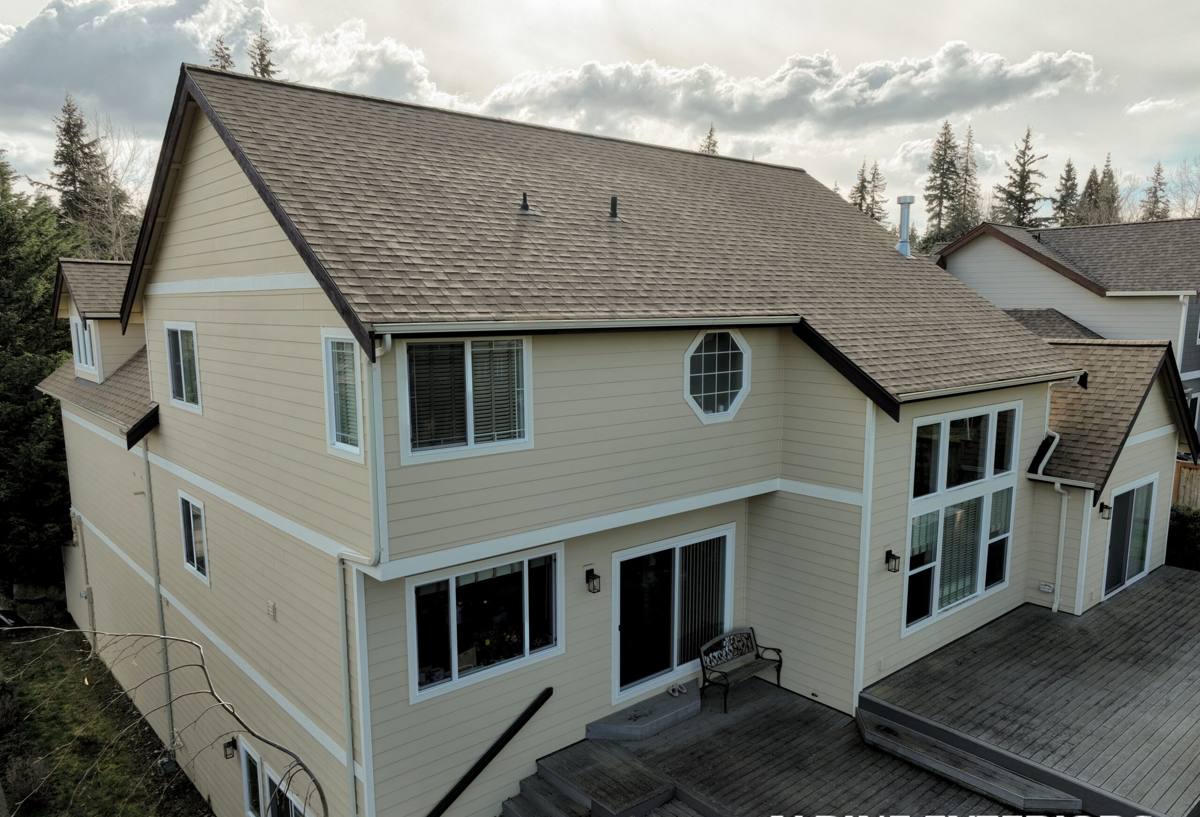
What Actually Wears Out a Doe Bay Roof
Salt Air and Metal Fatigue
Salt in the air is corrosive to exposed metal. Nail heads, flashing seams, gutter fasteners, and metal roofing panels all take slow, steady damage from marine air, especially on roof faces that catch onshore wind. Corrosion rarely shows up as a dramatic failure — it shows up as a small rust stain, a slightly loose fastener, or a flashing seam that's started to separate at the edge. Left alone, those small issues are exactly where leaks start.
Driving Rain and Wind-Driven Water
Standard roofing details are built assuming rain falls mostly straight down. On an exposed Doe Bay lot, wind-driven rain gets pushed sideways and even upward under eaves and around dormers. That means flashing, underlayment laps, and shingle overlaps all need to be installed with more margin for error than a textbook install in a sheltered spot.
Moss, Algae, and the Long Wet Season
San Juan County's mild, wet winters and shaded lots are ideal growing conditions for moss and algae. Moss doesn't just look bad — it lifts shingle edges as it grows, holds moisture against the roof deck, and works its root structures into granule layers and seams. On north-facing slopes and under tree canopy, moss can establish itself within a year or two of a roof being cleaned, which is why moss management has to be part of any real repair plan here, not an afterthought.
Signs a Doe Bay Roof Needs Repair
Most roof problems on Orcas Island don't announce themselves as a dramatic leak. They show up as small, easy-to-miss signs first:
- Granules collecting in gutters or at downspout outlets
- Shingle tabs that look curled, cupped, or lifted at the edges
- Dark streaking or green-black growth, especially on shaded or north-facing slopes
- Soft or spongy spots underfoot when walking a low-slope section
- Rust staining around flashing, vent boots, or nail heads
- Daylight visible through the roof deck from inside an attic or crawlspace
- Water stains on interior ceilings, especially after a windy rainstorm
- Gutters pulling away from the fascia or sagging under moss and debris weight
Any one of these on its own may just need monitoring. Two or three together, especially after a stretch of driving rain, usually means it's worth having someone look at the roof before the next storm.
What a Correct Repair Actually Involves
Diagnosis Before Patching
A leak's entry point and the spot where water shows up inside a home are often not the same location — water can travel along rafters or sheathing before it drips. A proper repair starts with tracing the actual path of the water, not just covering the spot where the stain appeared. That usually means checking the attic or crawlspace from the inside as well as the roof surface itself.
Matching Materials and Installation Method
Repairs need to match the existing roofing system in material, weight, and installation method — not just color. A mismatched shingle or an incompatible flashing metal can create a new weak point, sometimes through galvanic corrosion when dissimilar metals sit against each other in a damp, salt-air environment.
Flashing and Underlayment, Not Just Surface Shingles
A large share of roof leaks trace back to flashing — around chimneys, skylights, dormers, and valleys — rather than the shingle field itself. Given how much wind-driven rain this area sees, we pay particular attention to step flashing, valley metal, and underlayment laps whenever a repair opens up a section of roof, since those are the details most likely to fail under sideways rain even when the shingles above them look fine.
Ventilation Matters More Than People Expect
Poor attic ventilation traps moisture underneath the roof deck, which speeds up rot, encourages mold, and shortens the life of the roofing material from below — a problem that compounds in a naturally damp climate like this one. Part of a thorough repair is checking whether existing ventilation is doing its job, not just fixing what's visible from outside.
Roofing Materials on Orcas Island: How They Hold Up
Different roofing materials respond differently to salt air, moss, and driving rain. This is a general comparison, not a recommendation to replace a roof that's still sound — most of the time, the right move is repairing what's there.
| Material | Salt Air Behavior | Moss Resistance | Typical Repair Considerations |
|---|---|---|---|
| Asphalt composition shingle | Generally stable; metal fasteners and flashing are the vulnerable point | Low to moderate — granules give moss something to grip | Widely available materials, straightforward matching for spot repairs |
| Cedar shake/shingle | Weathers naturally but needs airflow to dry properly | Low — organic material feeds moss and algae growth | Repairs need careful weaving to keep water-shedding pattern intact |
| Standing seam metal | Coated steel or aluminum resists corrosion well when properly finished | High — moss struggles to grip a smooth metal surface | Repairs require matching panel profile and using compatible fasteners |
| Composite/synthetic shingle | Generally resistant to salt-related deterioration | Moderate — depends on surface texture | Material-specific fastening; not all products are field-repairable the same way |
None of these materials are maintenance-free in a marine, tree-shaded climate. The honest answer for most Doe Bay homes is that whatever material is already on the roof can usually be repaired correctly if the underlying structure is sound — the goal is a repair that respects how that specific material sheds water, not a generic patch.
Repair or Replace? How We Help You Decide
Not every roofing problem calls for a full replacement, and not every leak can be responsibly patched. We look at a few honest factors before recommending either direction.
| Factor | Leans Toward Repair | Leans Toward Replacement |
|---|---|---|
| Roof age relative to material lifespan | Early-to-mid life, isolated issue | Near or past expected service life |
| Extent of damage | Localized — one slope, one flashing detail, one leak point | Widespread granule loss, multiple leak areas, sagging deck |
| Decking condition underneath | Solid, dry sheathing | Soft, rotted, or delaminated sheathing |
| Moss and algae history | First occurrence or well-maintained | Repeated heavy growth despite cleaning |
| Underlying cause | Fixable detail (flashing, fastener, single shingle run) | Systemic issue (failed underlayment, wrong material for exposure) |
We'll walk you through which column your roof falls into and why, in plain terms, before any work starts.
Our Repair Process
- On-site inspection. We walk the roof and check the attic or crawlspace where accessible, looking for the actual water path, not just the visible symptom.
- Honest assessment. We explain what we found, what's causing it, and whether repair or replacement makes sense — including what happens if nothing is done.
- Written estimate. A clear scope of work and price range before anything is touched, no surprise add-ons mid-job.
- Repair work. Matching materials, correct flashing and underlayment detailing, and attention to the specific slope and exposure involved.
- Cleanup and walkthrough. We clear debris and go over the completed work with you before we consider the job done.
Why a Crew That Already Works Doe Bay Matters
Roofing in a place like Doe Bay isn't quite the same trade as roofing in a mainland subdivision. Access can mean navigating narrow, wooded driveways or getting equipment and materials onto Orcas Island in the first place, which takes planning that a contractor unfamiliar with the island simply won't have accounted for. A crew that already works this part of San Juan County knows which roof details tend to fail first in this exposure, how local moss and tree cover behave season to season, and how to schedule around weather windows that can shift quickly on the water.
That local familiarity isn't a marketing point — it's the difference between a repair that's built for the actual conditions here and one that's built for a climate this roof doesn't experience.
A Simple Roof-Check for Doe Bay Homeowners
Between professional inspections, a homeowner can catch a lot just by looking. From the ground, or safely from a ladder if you're comfortable with it, check for:
- Moss buildup, especially on shaded or north-facing roof slopes
- Granules piling up in gutters or at the base of downspouts
- Gutters and downspouts flowing freely, not backed up with debris
- Flashing around chimneys, skylights, and vent pipes sitting flat and tight
- Ceiling stains or musty smells appearing after a windy rainstorm
- Overhanging branches that keep sections of roof shaded and slow to dry
Catching these early is almost always cheaper than waiting for a leak to show up inside the house.
Let's Take a Look
If you're noticing moss, granule loss, a stubborn leak, or just want a second opinion on a Doe Bay roof before the next storm season, we're happy to come take a look. Estimates are free, there's no pressure, and you'll get a straight answer about what your roof actually needs — use the form below to get started.