 Orcas Island Siding
 Serving Lopez Village and the Surrounding San Juan Islands
Lopez Village sits in a part of San Juan County that looks calm on a sunny afternoon and turns testing fast once the marine weather rolls in. Homes here deal with a combination that few inland Washington towns ever see at the same intensity: salt-laden air off the water, wind-driven rain that hits siding sideways instead of straight down, and a mossy, damp season that can stretch for months at a time. We serve Lopez Village as part of our regular San Juan County service area, and we've built our approach around what actually happens to exterior materials out here over years, not just what looks good on installation day.
Being an island community changes how exterior work gets done, too. Materials, crews, and equipment all have to move on a schedule that respects the ferry system, and that means a contractor who plans ahead and doesn't treat island jobs as an afterthought squeezed between mainland projects. We build our scheduling and material staging around that reality rather than fighting it.
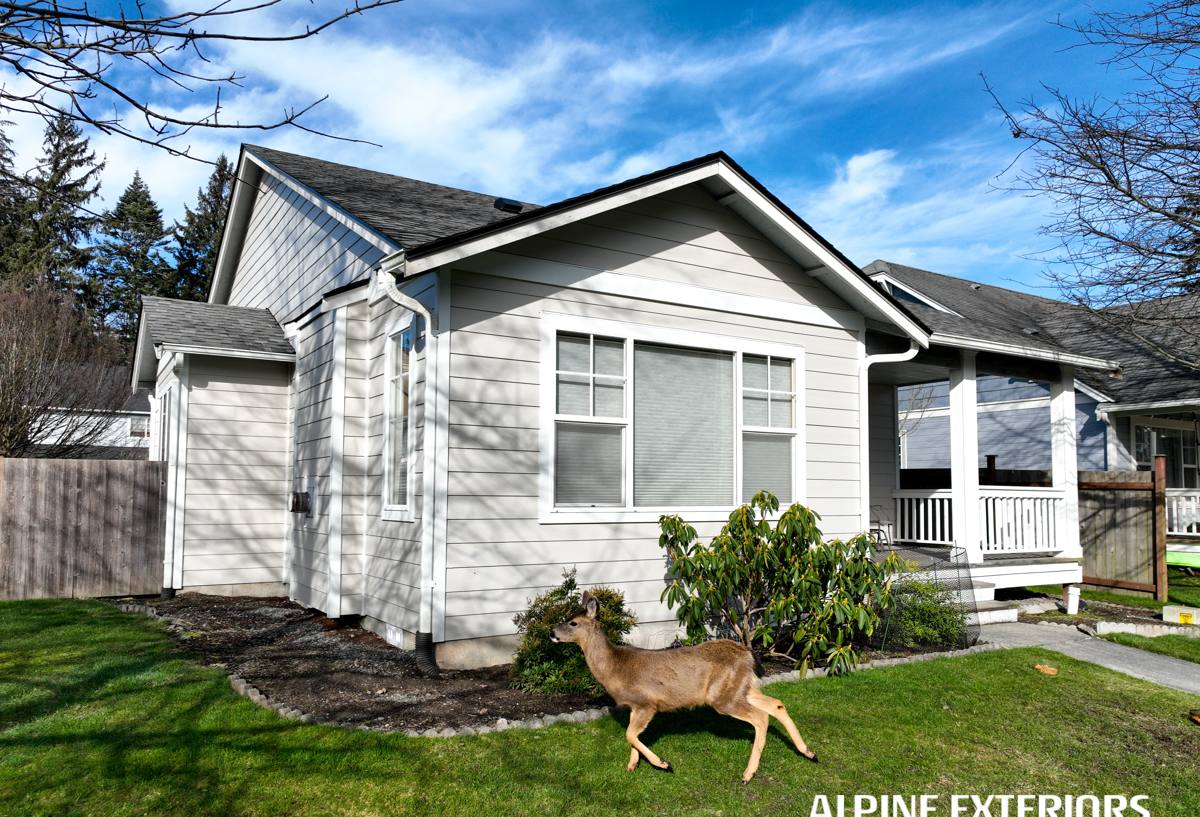
What Salt Air Does to a House Over Time
Coastal and near-coastal homes in San Juan County are exposed to airborne salt that settles on every exterior surface, not just the parts facing the water. Over years, that salt exposure accelerates corrosion on fasteners, flashing, and any metal trim that isn't rated for a marine environment. It also degrades paint films faster than the same product would wear in a drier, inland climate, and it can be tough on materials that rely on a surface coating alone to keep moisture out.
This is one of the reasons material choice matters more here than in a lot of the state. A siding product that holds up fine forty miles inland can perform very differently a short walk from saltwater, especially at butt joints, corners, and anywhere water can sit against a cut edge.
Fasteners and Flashing Matter As Much As the Siding
We spec corrosion-resistant fasteners and flashing details for every San Juan County project, not just the ones directly on the waterfront. Salt drift travels further than most homeowners expect, and a house a half-mile from the shoreline still sees meaningfully more exposure than the same house would inland. Cutting corners on hardware to save a small amount on a project is one of the most common ways an otherwise good siding job fails early.
Driving Rain and Wind-Driven Moisture
San Juan County storms don't always come straight down. Wind off the water regularly drives rain sideways into wall assemblies, which puts real pressure on lap joints, window and door trim, and any seam in the siding system. A siding job that isn't detailed correctly at those transition points can let moisture behind the cladding, where it does damage you won't see until it's already serious — soft sheathing, stained interior walls, or trim that's rotted from the inside out.
This is why we treat water-resistive barriers, flashing tape, and proper lap sequencing as non-negotiable parts of every installation, not upsells. The siding itself is the visible layer; the drainage plane behind it is what actually keeps a Lopez Village home dry through a real Pacific Northwest winter.
The Long Moss Season
San Juan County's combination of moisture, shade from mature trees, and moderate temperatures creates ideal conditions for moss and algae growth on exterior surfaces for a large part of the year. Roofs are the most visible casualty, but siding, especially on north-facing walls and anywhere shaded by trees or a neighboring structure, is affected too. Moss and algae hold moisture against a surface long after a rain has passed, which is exactly the kind of sustained dampness that shortens the life of moisture-sensitive materials.
Factory-applied, baked-on finishes resist this kind of biological growth far better than field-applied paint, and that difference becomes obvious after a few moss seasons. It's a big part of why we standardized on a factory-finished fiber cement system rather than a product that depends on paint applied on site.
Why We Only Install James Hardie Fiber Cement Siding
We get asked fairly often why we don't offer vinyl, LP SmartSide, or other fiber cement brands alongside Hardie. The honest answer is that we looked at how each of those products actually performs over a decade or two in a marine, high-moisture climate like San Juan County, and we standardized on the one system we're confident holds up without surprises.
- Vinyl siding can perform reasonably well in mild climates, but it's a thin material that expands and contracts with temperature swings, can distort or crack in a strong wind event, and its seams and J-channels are more vulnerable to wind-driven rain intrusion than a properly lapped fiber cement system.
- LP SmartSide is engineered wood — it performs well when it stays dry, but engineered wood products are inherently more sensitive to sustained moisture exposure than fiber cement, which matters a great deal in a place with a long wet, mossy season.
- Other fiber cement brands use a similar base material to Hardie but don't all offer the same climate-specific engineering, factory finish warranty, or track record we've come to trust for this region.
James Hardie fiber cement is non-combustible, doesn't swell or rot the way wood-based products can, and comes with a factory-applied ColorPlus finish that's engineered to resist fading and hold up against exactly the kind of moss, algae, and moisture cycling San Juan County throws at it. Hardie's HZ product lines are climate-engineered for different exposure zones, and the HZ5 designation used in the Pacific Northwest reflects the wetter, harsher conditions we actually build in. It's backed by a strong transferable warranty, which matters a lot on a coastal property where every material is working harder than it would elsewhere.
What Correct Installation Actually Involves
Fiber cement only performs as well as its installation. That means correct fastener spacing and type, proper gapping at butt joints, factory-primed cut edges caulked or sealed per manufacturer spec, and flashing integrated correctly with windows, doors, and any roof-to-wall transitions. We follow Hardie's installation instructions closely rather than treating them as optional guidance, because in a climate this demanding, the difference between "close enough" and "to spec" shows up within a few years.
Our Process for Lopez Village and San Juan County Projects
Working on the islands means planning material deliveries and crew scheduling around the ferry system rather than assuming next-day availability the way a mainland job might. We order and stage materials in advance, confirm ferry logistics before committing to a start date, and build a realistic timeline into every estimate so there are no surprises once work begins. A crew that's used to island scheduling moves more efficiently than one working it out for the first time, and that translates into fewer delays for the homeowner.
We also pay attention to site-specific exposure. A Lopez Village home tucked into trees with heavy shade faces a different moss and moisture profile than one with open water exposure and more direct wind. We walk each property and adjust detailing — flashing, ventilation, trim choices — to the specific conditions of that site rather than applying one generic approach to every job.
Beyond Siding: Roofing, Windows, and Decks
Siding rarely fails in isolation. A roof that's shedding water poorly, windows with failed flashing, or a deck ledger that's trapping moisture against the house can all undermine even a well-installed siding job. We handle roofing, window, and deck work alongside siding so these systems get evaluated and addressed together, rather than treating the exterior envelope as a set of disconnected trades.
How These Systems Interact
Roof overhangs affect how much wall area gets direct rain exposure. Window flashing details need to tie into the siding's water-resistive barrier correctly, not just butt up against it. Deck attachment points are a common source of hidden water intrusion if not flashed properly. Looking at the whole envelope on a Lopez Village property lets us catch these interactions before they become expensive problems.
Cost Factors for San Juan County Siding Projects
Every project is different, but a few factors consistently drive cost on island jobs more than they would on a comparable mainland project.
| Factor | Why It Matters Here |
|---|---|
| Ferry logistics and scheduling | Material delivery and crew transport need to be planned around ferry sailings, which affects timeline more than cost in most cases |
| Existing siding removal and condition | Older homes with wood or vinyl siding often reveal moisture damage underneath that needs repair before new siding goes on |
| Trim and flashing detail complexity | Homes with more windows, dormers, or roof-to-wall transitions require more flashing work, which affects labor time |
| Site exposure | Waterfront or high-wind-exposure sites may call for additional fastening or flashing detail beyond baseline spec |
| Siding profile and color selection | Different Hardie profiles and ColorPlus finishes carry different material costs |
What to Look for When Hiring an Island Exterior Contractor
Not every contractor is set up to do island work well, and it's worth checking a few things before committing to a project in Lopez Village or elsewhere in San Juan County.
- Ask whether the contractor regularly works in the San Juan Islands or if it's occasional — regular island work means smoother logistics and fewer surprise delays.
- Confirm they carry proper Washington contractor licensing and insurance, and ask to see it.
- Ask specifically how they detail flashing at windows, doors, and roof-to-wall transitions — a vague answer is a red flag in a wind-driven-rain climate.
- Get the manufacturer and specific product line in writing, not just "fiber cement" or "Hardie-style."
- Ask how they plan material delivery and crew scheduling around ferry logistics.
- Check whether the warranty is manufacturer-backed and transferable, which matters if you sell the home.
Let's Talk About Your Lopez Village Home
Every property in San Juan County has its own exposure to salt air, wind-driven rain, and moss, and the right approach depends on the specifics of your home and site. If you're weighing a siding replacement, or want a second opinion on how your roof, windows, or deck are holding up against the marine climate, we're happy to take a look and walk you through what we see. Reach out for a free, no-pressure estimate — there's no obligation, just an honest assessment from a crew that works this climate regularly.