 Orcas Island Siding
 West Beach sits on the exposed western edge of Orcas Island, facing open water with little to break the wind coming off the strait. That's part of why people build there — the view is worth it — but it also means the windows on a West Beach home work harder than windows almost anywhere else on the island. They take direct salt spray, they take driving rain head-on instead of at an angle, and they sit through a moss and mildew season that runs most of the wet months. When those windows are also old, drafty, or poorly sealed, the house pays for it twice: once in a heating bill that keeps climbing, and again in moisture damage working its way into the wall behind the frame. This page is about what it actually takes to get that right.
Why West Beach's Exposure Puts Extra Demands on Windows
Most of Orcas Island gets some protection from surrounding hills, channels, or tree cover, depending on where a house sits. West-facing waterfront property doesn't get that benefit. Wind and weather moving across the water arrive with nothing to slow them down first, which means window assemblies on these homes see more sustained wind load, more direct wind-driven rain, and more salt-laden air than a comparable house tucked into a sheltered cove or set back in the trees. None of that is a reason to avoid building there — it's simply the baseline a window has to be chosen and installed against if it's going to perform for the next twenty years instead of five.
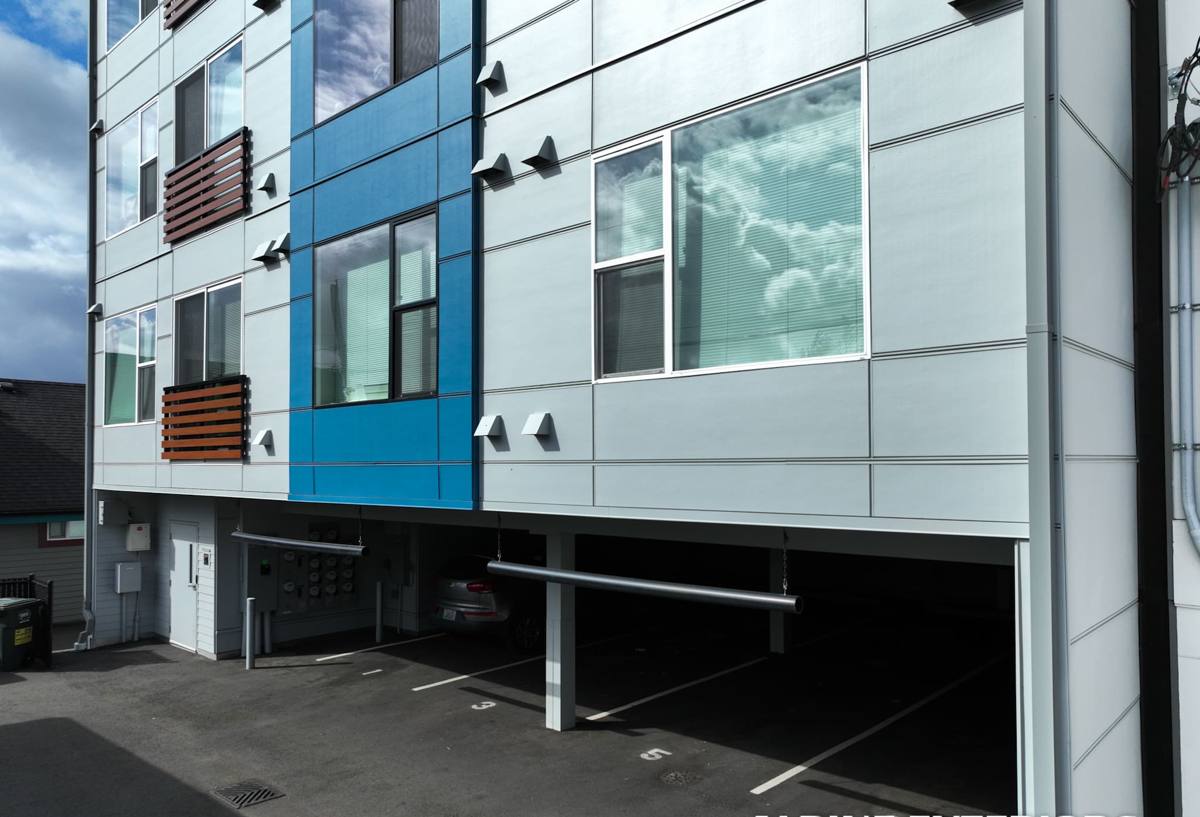
What Salt Air, Driving Rain, and Moss Season Actually Do
Salt air corrodes metal components faster than it corrodes almost anything else on a house — window hardware, weep hole screens, and fasteners are all vulnerable if they aren't rated for coastal exposure. Driving rain hitting a window straight-on, rather than falling mostly vertical, finds any weak point in the flashing or sealant around the frame and pushes water into it rather than letting it run off. And a long moss and mildew season keeps sills and lower sashes damp for extended stretches, especially on windows that don't get much direct sun to dry them out between storms. Put those three together on an exposed West Beach elevation and you get conditions that will find a poorly sealed window within a season or two, not a decade.
Where Window Failure Actually Starts
It's rarely the glass itself that fails first. It's almost always the perimeter — a bead of caulk that's cracked and let water behind the trim, a sill that stays wet long enough for the wood underneath to start softening, or weatherstripping that's compressed and no longer sealing the sash tight against the frame. Once water gets past that perimeter seal, it doesn't just show up as a drafty window. It shows up as soft trim, stained drywall, or insulation that's lost its R-value because it's been damp for months without anyone realizing it.
Why Energy Efficiency Is Its Own Problem Here, Not Just a Comfort Issue
On an exposed site like West Beach, a drafty or poorly sealed window isn't just a comfort complaint — it's a moisture entry point and a heating cost problem rolled into one. Wind-driven air finds gaps around an old sash and pushes conditioned air out and cold, damp air in, which means the furnace or heat pump runs longer to make up the difference. At the same time, that same gap is often the path water uses to get into the wall assembly during a storm. Replacing or properly sealing a window on this kind of site solves both problems at once: a tighter thermal envelope and a wall system that isn't quietly absorbing moisture behind the siding. That's a different calculation than a window upgrade on a sheltered inland lot, where the driving factor is mostly the utility bill.
What a Correct Energy-Efficient Window Installation Involves
A window is only as good as the assembly around it. Getting genuine energy performance and weather resistance out of a new window on an exposed site means getting every layer right, not just picking a well-rated unit off a spec sheet.
Frame Material Options
Frame material affects both insulating value and how the window holds up to salt air and sustained moisture. There's no single right answer for every home — it depends on the home's style, budget, and how directly exposed that particular wall is.
| Frame Material | Insulating Performance | Coastal/Salt-Air Durability | Maintenance |
|---|---|---|---|
| Vinyl | Good, multi-chambered profiles insulate well | Doesn't corrode; UV can affect color over many years | Low — no painting or refinishing needed |
| Fiberglass | Very good, low expansion/contraction keeps seals tight | Excellent — highly resistant to moisture and salt exposure | Low, holds paint well if a custom color is wanted |
| Aluminum | Weaker unless thermally broken | Prone to corrosion in salt air without coatings | Moderate — coatings need periodic inspection |
| Wood-clad | Good, but performance depends on the cladding staying intact | Vulnerable at any point the cladding is breached | Higher — exposed wood needs monitoring and upkeep |
On a site with West Beach's exposure, we lean toward fiberglass or a quality multi-chamber vinyl for most replacements, simply because they don't give salt air and driving rain a corrosion path or a bare-wood entry point to work on. Wood-clad units can still make sense on a home where the look matters and the owner is committed to keeping an eye on the cladding, but it's a decision that should be made with the maintenance trade-off spelled out up front, not discovered later.
Glazing and Ratings That Actually Matter in This Climate
Two numbers on a window's label tell you most of what you need to know: U-factor, which measures how well the window resists heat loss, and Solar Heat Gain Coefficient (SHGC), which measures how much solar heat passes through the glass. In this part of the Pacific Northwest, where winters are the bigger heating concern than summer cooling, a lower U-factor generally matters more than chasing the lowest possible SHGC. Look for double- or triple-pane units with low-e coatings and an argon- or krypton-filled gap, and ask any contractor quoting a job to show you the actual NFRC label numbers for the specific window being proposed — not just a marketing claim about "energy-efficient glass." On an exposed elevation, we also pay attention to the glazing seal quality itself, since a failed seal on this kind of site tends to show up as fogging between the panes years sooner than it would somewhere more sheltered.
Our Process for a West Beach Window Replacement
- On-site assessment of each window's exposure — which walls take direct wind and rain, and which are more sheltered by the structure itself or nearby terrain
- Inspection of the existing sill, header, and rough opening for hidden moisture damage before any new unit goes in
- Selection of frame material and glazing package matched to that wall's actual exposure, not a single spec applied to the whole house
- Removal of the old unit and repair of any compromised framing, sheathing, or sill material found underneath
- Installation with corrosion-resistant fasteners and flashing detailed to shed water outward at every layer, sequenced correctly with the house wrap or building paper
- Sealing and trim work finished to standard, with a final check of drainage paths so the window can shed incidental water even if a seal is ever tested by a storm
The steps don't change much from house to house. What changes is how much attention each one gets on a wall that's taking weather head-on versus one that's mostly sheltered — and that's a judgment call that should be made on-site, not from a price list.
What to Look for When Hiring for a Job Like This
- A contractor who inspects the existing sill and framing before quoting, rather than pricing from a photo or a phone call
- Specific answers about flashing sequencing and fastener material, not just a brand name for the window itself
- Actual NFRC-labeled U-factor and SHGC numbers for the proposed product, not a general efficiency claim
- A frame material recommendation that accounts for how exposed that particular wall actually is
- A written warranty that covers both the product and the installation labor
- A straight answer about how long special-order units take to arrive and get installed, given island shipping and scheduling realities
Is Replacement Always the Right Call, or Sometimes Just Repair?
Not every window on a West Beach home needs full replacement. A unit with intact glazing and a sound frame sometimes just needs new weatherstripping, a resealed perimeter, or hardware swapped for corrosion-resistant fixtures to perform for years longer. Where we draw the line is moisture — if the sill, jamb, or surrounding framing has already started to soften or stain, patching the surface without addressing what's happening underneath just delays a bigger repair. An honest assessment tells you which situation you're actually in before any work starts, rather than defaulting to a full replacement quote as the only option on the table.
If you're weighing window options for a home on West Beach or elsewhere on Orcas Island, we're glad to take a look, walk the exposure on each elevation with you, and give you a straight answer about what actually makes sense for your house. Reach out for a free, no-pressure estimate using the form below.