 Orcas Island Siding
 The West Sound Roofing Challenge: Salt Air, Rain, and Shade-Grown Moss
West Sound homes sit in one of the more demanding microclimates on Orcas Island. The combination of salt-laden air off the water, frequent driving rain, and heavy year-round tree cover puts real stress on a roof that a home twenty miles inland in a drier part of San Juan County simply doesn't face. Salt air accelerates corrosion on exposed metal fasteners, flashing, and vent components. Driving rain, especially during fall and winter storms, tests every seam, valley, and penetration on a roof rather than just the open field of shingles. And the tree canopy that gives many West Sound properties their privacy and character also keeps roof surfaces shaded and damp for long stretches, which is exactly what moss and algae need to take hold.
None of this means asphalt shingle roofing is a poor fit for the area. It remains one of the most practical, cost-effective roofing systems available, and it performs well here when it's specified and installed with this climate in mind. The problems we see on West Sound roofs almost never come down to "asphalt shingles don't work here." They come down to underlayment that wasn't upgraded for the moisture load, ventilation that was never balanced, or flashing details that were rushed.
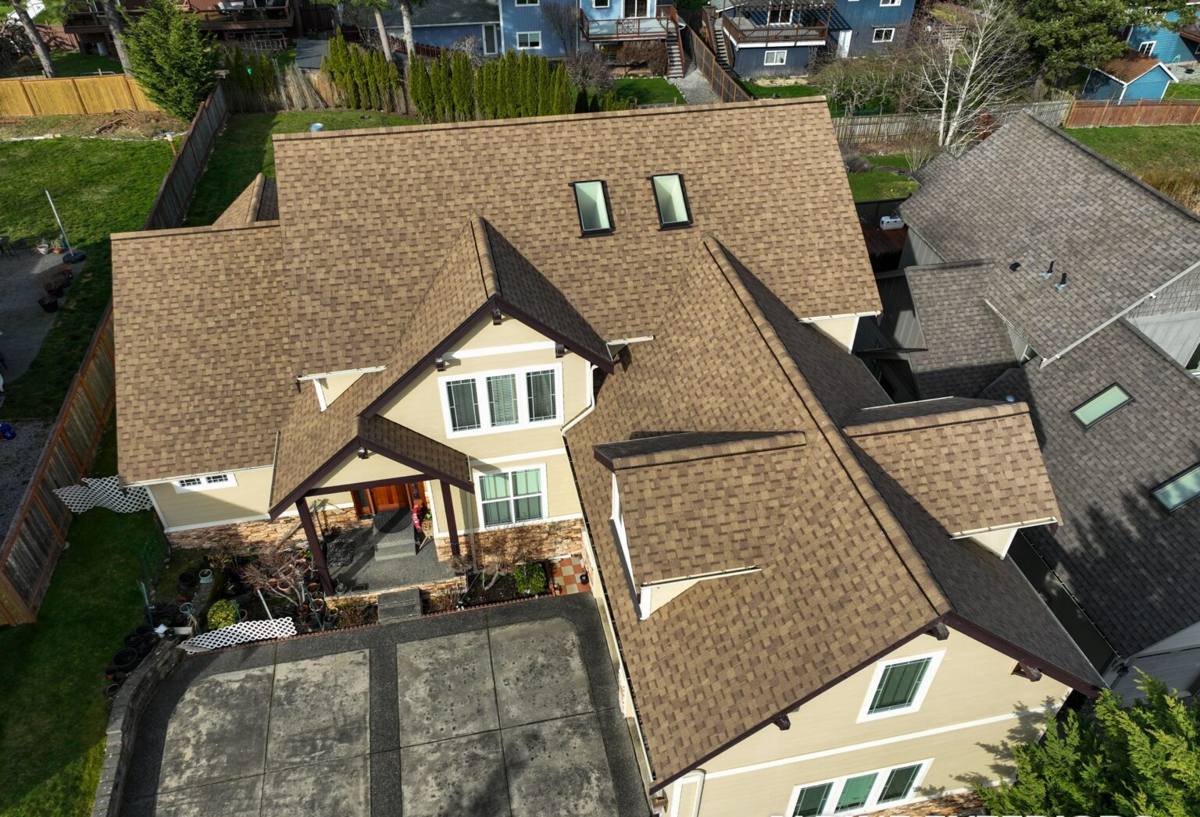
What a Roof Here Actually Needs to Hold Up
Fastening and Nailing Standards
Wind-driven rain finds every shortcut in a nailing pattern. We fasten to the shingle manufacturer's high-wind specification, not the minimum code allowance, and we check nail placement against the manufacturer's nailing line rather than eyeballing it. A shingle that's fastened too high or too low can still look fine on install day and still lift or leak within a couple of seasons.
Underlayment for a Wet Climate
On a West Sound roof we lean toward a synthetic underlayment with strong water-holdout performance, and we treat self-adhered ice-and-water barrier as standard at eaves, valleys, and around every roof penetration — not as an upgrade. In a climate where rain can sit against a roof surface for days at a time during a slow-moving system, this second layer of protection is what actually keeps water out of the deck if wind or debris ever compromises the shingle surface above it.
Ventilation That Fights Moisture From Both Directions
A roof deck takes on moisture from outside (rain, condensation, shaded damp air) and from inside (household humidity rising into the attic). Balanced intake and exhaust ventilation lets that moisture escape instead of getting trapped against the underside of the deck, where it can rot sheathing and shorten shingle life from below — a failure mode that's easy to miss because it doesn't show up as a visible leak until it's advanced.
Choosing the Right Asphalt Shingle for This Climate
Not every asphalt shingle handles a shaded, salt-air, high-moisture environment the same way. The biggest practical differences for a West Sound home come down to weight, wind rating, and algae resistance.
| Shingle Type | Typical Lifespan | Moss & Algae Resistance | Wind Rating | Best Fit |
|---|---|---|---|---|
| 3-tab (economy) | 15–20 years | Standard granules only, no built-in resistance | Lower — often 60–70 mph rated | Budget projects on well-exposed, sun-drenched roof planes |
| Architectural / laminate | 25–30+ years | Algae-resistant granule option available | Higher — commonly 110–130 mph rated | Most West Sound homes, especially shaded or tree-covered lots |
| Impact-rated / Class 4 | 30+ years | Algae-resistant granule option available | High, plus impact resistance | Exposed sites, homeowners prioritizing long-term durability over upfront cost |
For most West Sound properties, we recommend an architectural shingle with algae-resistant granules as the baseline. The heavier laminate construction handles wind gusts off the water better than a 3-tab, and the algae-resistant granules slow the dark streaking and biological growth that shaded, damp roof planes are prone to. It's not a moss-proof coating — nothing is — but it meaningfully extends the time between cleanings.
Flashing and the Details That Actually Cause Leaks
Almost every roof leak we're called out to investigate traces back to a flashing detail, not the field shingles. Valleys, chimney saddles, skylight curbs, step flashing where a roof meets a sidewall, and pipe boots are all places where water is being redirected, not just shed downhill — and redirection is where mistakes compound.
- Open or closed-cut valleys lined with ice-and-water membrane before any shingle goes down
- New step flashing and counterflashing at every wall intersection — old flashing is never reused
- Chimney flashing rebuilt with proper base and cap pieces, not just caulked over
- Pipe boots replaced with the roof, since rubber collars are usually the first component to crack
- Drip edge installed at both eaves and rakes to keep water off the fascia and out of the deck edge
These are the details that separate a roof that's dry in year twelve from one that's already showing ceiling stains by year five, and they matter more in a climate with this much sustained rainfall than they might somewhere drier.
Our Process, Start to Finish
- On-site inspection of the existing roof, attic ventilation, and any problem areas, followed by a written estimate that spells out materials and scope
- Tear-off of the old roofing and a full inspection of the deck, with any soft or damaged sheathing replaced before anything new goes down
- Installation of ice-and-water membrane at eaves, valleys, and penetrations, followed by synthetic underlayment across the full roof
- New flashing at every valley, wall, chimney, and penetration
- Shingle installation to manufacturer high-wind nailing specifications
- Ventilation check and correction so intake and exhaust are balanced for the attic space
- Full cleanup, including a magnetic sweep of the yard and driveway for stray nails
- Final walkthrough so you know exactly what was done and what to watch for going forward
Moss and Debris: Living Under the Trees
Heavy tree cover is part of what makes West Sound properties desirable, but it's also the single biggest factor in how fast a roof here needs attention. Falling needles, leaves, and cones collect in valleys and behind chimneys, holding moisture against the shingle surface long after the rest of the roof has dried. Left alone, that debris becomes a growing medium for moss, and moss doesn't just sit on top of a shingle — its rhizoids work under the edges of the granule mat, lift tabs, and hold water against the roof deck.
Zinc or copper strips near a ridge can help reduce regrowth on some roofs, but we're honest that they're not a substitute for physical removal and they work better on some roof geometries than others. Where a lot is heavily shaded, we'll talk through the trade-offs directly: which shingle option resists growth longest, how often the roof realistically needs to be checked and cleared given the specific tree cover on that lot, and whether any limited pruning near the roofline is worth discussing with an arborist to improve airflow and sun exposure.
Why Local Experience on Orcas Island Matters
Roofing logistics on an island aren't the same as on the mainland. Material deliveries have to be scheduled around the ferry, and a tear-off that gets caught mid-project by an incoming storm off the water is a real risk if the crew doesn't already understand how fast weather moves through San Juan County. A crew that works West Sound regularly knows which properties tend to run heavier moss pressure due to shade and slope, how to stage a job on narrow, tree-lined driveways without damaging landscaping, and how to time tear-offs around the wetter stretches of the year so a deck isn't left exposed longer than necessary.
That local familiarity also shows up in smaller, practical ways — knowing which West Sound neighborhoods have well or septic systems that require extra care with equipment staging, and understanding County permitting expectations for the area before a project starts rather than figuring it out mid-job.
Signs Your West Sound Roof Needs Attention Now
- Granules collecting in gutters or at the base of downspouts
- Shingle edges curling, cupping, or lifting, especially on south- or west-facing slopes
- Thick moss mats on shaded, north-facing roof planes
- Dark streaking or discoloration across large sections of the roof
- Soft or spongy spots when the roof is walked, which can indicate deck damage
- Daylight visible through the roof deck from inside the attic
- Water stains on interior ceilings or in the attic after a storm
- Missing, cracked, or lifted shingles following high wind
Any one of these is worth a look before the next storm cycle rather than after. Small issues caught early are almost always a repair; the same issue left through another wet season often turns into a full replacement.
After Installation: Keeping It Performing
A correctly installed roof still benefits from basic upkeep in this climate. We recommend clearing needles and leaf debris from valleys and gutters at least once before winter storm season, checking for early moss growth on shaded slopes annually, and avoiding pressure washing — it strips protective granules and can drive water up under shingle tabs. A soft wash or manual clearing, done carefully, protects the investment far better than high-pressure equipment.
If you're weighing a repair against a full replacement, or just want an honest look at where your roof stands, we're happy to come out and take a look. There's no pressure and no charge for the estimate — just a straightforward assessment of what your roof actually needs. Use the form below to get started.