 Orcas Island Siding
 Siding Replacement for Crow Valley Homes
Crow Valley sits inland, in the farming country that runs through the interior of Orcas Island — open pasture, wooded hillsides, and a mix of older farmhouses alongside newer homes built into the tree line. It's a different setting than the village waterfront closer to Eastsound, but it isn't sheltered from what makes exterior work on this island demanding. Salt-laden marine air still drifts across the valley off the surrounding water, storms still drive rain sideways into west- and south-facing walls, and the tree cover that makes Crow Valley a beautiful place to live also keeps walls shaded and slow to dry, which is exactly what a long moss season needs to take hold. We work in Crow Valley regularly, and everything about how we approach a siding replacement here starts from that combination of conditions.
We install James Hardie fiber cement siding exclusively — no other brand, no vinyl, no engineered wood. For a valley property dealing with this much sustained moisture and shade, it's the material we recommend without hesitation, and this page walks through why, along with what a correct siding replacement in Crow Valley actually involves.
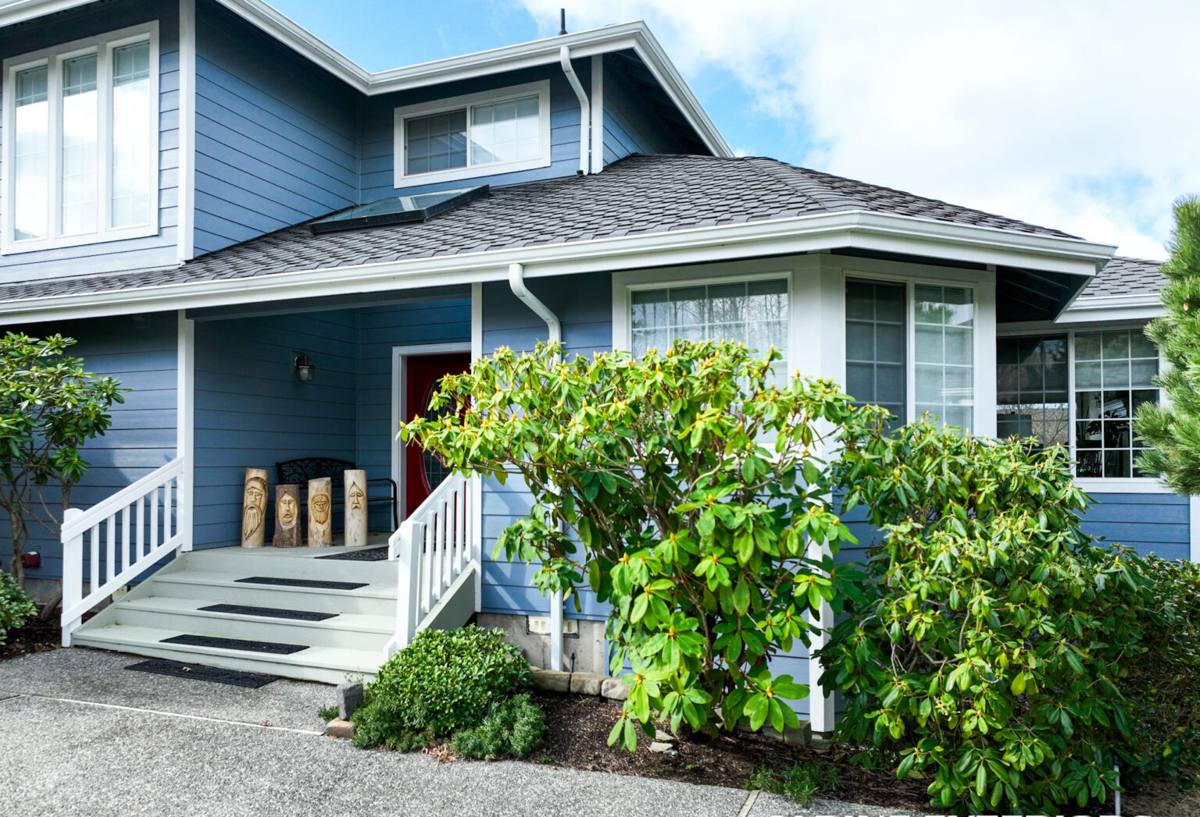
What Crow Valley's Climate Does to Siding
Salt Air That Still Reaches an Inland Valley
Orcas Island is surrounded by the Salish Sea, and that marine influence doesn't stop at the shoreline. It moves inland on prevailing wind and settles into valleys like Crow Valley as a steady, low-grade background condition — less concentrated than a home sitting right on the water, but persistent enough over years to accelerate the breakdown of a weak finish, corrode poorly chosen fasteners, and degrade caulk faster than an equivalent home would see in a drier inland climate.
Driving Rain Across Open Pasture
Crow Valley's open farmland gives wind-driven storms room to build speed before they reach a house, and rain crossing that open ground rarely falls straight down by the time it hits a wall. It gets pushed sideways into lap joints, trim seams, and any gap around a window or door that isn't flashed correctly. A siding system and installation detail built for calmer weather can still take on water here specifically because of how exposed the valley floor is to wind moving across it.
A Moss Season That Runs Long Under Tree Cover
The wooded hillsides that border much of Crow Valley keep a lot of home exteriors in partial shade for large parts of the day, and shaded walls dry out far slower after a storm than walls in open sun. Combine that with the island's mild, damp climate and you get a moss and mildew season that can run most of the year on north-facing and tree-shaded elevations — a condition that shows up first as staining and green growth, and matters because sustained organic growth holds moisture directly against whatever's underneath it.
Low Ground and Slow Drainage
Valley floors hold moisture differently than a well-drained hillside lot. Where Crow Valley homes sit on lower, flatter ground, water from a storm — or from irrigation and pasture runoff on properties still used for agriculture — can take longer to clear the area around a foundation, which puts extra importance on proper grade clearance at the base of the siding.
Signs a Crow Valley Home Needs Siding Replacement
Siding damage on a shaded, valley-floor property often shows up gradually and in specific spots rather than across the whole house at once. Before it turns into a bigger repair, watch for:
- Moss or dark staining that returns quickly after cleaning, especially on north-facing or tree-shaded walls
- Soft or spongy siding near the base of the wall or around window and door trim
- Peeling, bubbling, or chalking paint on older wood or engineered wood siding
- Cracked, warped, or missing siding sections after a windstorm
- Visible gaps at seams, corners, or trim joints where wind-driven rain can track in
- Rust staining around fasteners, a common early sign of marine air exposure this far into the island's interior
- A wall that stays visibly damp or discolored long after the rest of the house has dried out
Any one of these on its own might be minor. Several together, especially on the same wall, usually means moisture has been getting behind the siding for a while.
Why We Only Install James Hardie Fiber Cement
We don't offer a menu of siding brands and let price make the decision. We install James Hardie fiber cement, and only James Hardie, because of what we've consistently seen hold up — and what we've seen fail — on homes across Orcas Island and the rest of San Juan County.
- Non-combustible core: Fiber cement doesn't feed a fire the way wood-based siding can, which matters on a wooded island where wildfire risk is a real seasonal concern.
- Factory-applied ColorPlus finish: The color coat cures under controlled factory conditions rather than being brushed on at the job site, giving it far more resistance to fading, chalking, and moisture intrusion than field-applied paint has to offer.
- Climate-engineered HZ product lines: Hardie builds formulations specifically for regions dealing with sustained moisture exposure, a closer match for a shaded, damp valley property than a generic national spec.
- Dimensional stability: Fiber cement doesn't swell, cup, or warp the way engineered wood products can after repeated wet-season moisture cycles.
- Strong transferable warranty: Hardie backs its products with a substantial warranty structure, provided the installation follows spec — real protection, not a marketing line.
We don't install LP SmartSide, vinyl siding, Cemplank, Allura, primed spruce, or cedar. Each of those is a legitimate product, and plenty of contractors install them well. We made a professional call that standing fully behind one system we understand completely serves a Crow Valley homeowner better than offering a cheaper option whose real maintenance burden — recoating, caulk renewal, moisture sensitivity at cut edges — tends to land on the homeowner a few years after we've moved on to the next job.
What a Correct Siding Replacement Involves
The material is only half the job. A James Hardie installation that performs the way it's engineered to depends on installation details that are easy to rush and hard to spot once the wall is closed up: correct clearance between the siding and grade, proper flashing at every window, door, and roof-to-wall intersection, fasteners placed to Hardie's spacing spec and rated for this climate, and a house wrap and flashing system that functions as one integrated barrier rather than a series of separate steps. On a shaded valley wall that already dries slowly, a shortcut in any one of those details tends to show up sooner than it would on an open, sun-exposed site.
Tear-Off vs. Repair
Not every siding problem on a Crow Valley home means a full re-side. An isolated section damaged by wind, a trim piece that's worked loose, or moss staining that hasn't compromised the wall underneath can often be repaired or matched into existing Hardie siding without redoing the whole house. But if moisture has been tracking behind the wall for a while, or the home still has an older, non-Hardie product that's reached the end of its service life, a patch usually just delays a larger job while damage keeps spreading underneath. We'll walk the property and tell you honestly which situation you're actually looking at.
Choosing the Right Hardie Product for a Crow Valley Home
| Product Line | Best Use | Why It Fits Crow Valley |
|---|---|---|
| HardiePlank lap siding | Most standard farmhouse and single-family homes | Traditional lap profile sheds wind-driven rain effectively with proper overlap and flashing |
| HardiePanel vertical siding | Barns, outbuildings, gables, and modern designs | Clean vertical lines that suit the agricultural and modern-farmhouse styles common in the valley |
| HardieShingle siding | Craftsman-style homes and accent sections | Textured, shingled look without the moisture absorption and upkeep real wood shingle needs |
| HardieTrim boards | Corners, window and door casing, fascia | Factory-finished trim resists the same shaded, moisture-heavy conditions as the field siding |
Color and profile come down to the individual home, but the underlying product family and the installation approach stay consistent — we spec what actually fits a Crow Valley property's real exposure rather than defaulting to whatever's easiest to order.
Our Siding Replacement Process
- Walkthrough and assessment: We look at the whole exterior — siding, trim, flashing, grade clearance, and any shaded or moss-prone walls — before talking about product or price.
- Honest scope: We tell you plainly whether you're looking at a repair, a partial re-side, or a full tear-off, and why.
- Written estimate: A clear, itemized estimate with no pressure to sign on the spot.
- Tear-off and substrate check: Once work starts, we inspect the sheathing and framing underneath the old siding for hidden moisture damage before anything new goes up.
- Installation to spec: Correct flashing, clearance, fastening, and joint treatment, installed the way Hardie's own specifications call for, not a shortcut version of them.
- Final walkthrough: We go over the finished work with you before calling the job done.
Cost Factors for Crow Valley Siding Replacement
| Factor | What It Affects | Why It Matters Here |
|---|---|---|
| Tear-off vs. overlay | Labor scope and substrate access | Tear-off reveals hidden moisture damage that's common under older siding on shaded valley walls |
| Substrate condition | Repair costs before new siding goes on | Long-term trapped moisture behind failing siding can rot sheathing and framing before it's visible from outside |
| Tree cover and shade | Drying time and moss pressure on finished siding | Heavily shaded walls need consistent detailing to keep moss from re-establishing right after the job |
| Grade and drainage | Siding clearance and moisture management at the base of the wall | Lower, flatter valley lots hold moisture longer near grade than a well-drained hillside site |
| Site access | Labor time and equipment needs | Rural and agricultural properties can have longer driveways or wider staging needs than an in-town lot |
Real numbers depend on the specific house and its exposure, which is why we walk the property in person before quoting rather than pricing off square footage alone.
Why a Local Crew That Works Crow Valley Matters
A crew that already works this part of Orcas Island knows how salt air, driving rain, and a long moss season actually behave on real Crow Valley homes over a full year — not just how a product performs on a spec sheet. That experience shows up in practical decisions on install day: which walls stay shaded and wet longest, where extra flashing attention earns its keep, and which fastening and clearance details are worth the added time so you're not dealing with a callback after the next wet winter. Crow Valley's inland, wooded setting isn't identical to a home right on the water elsewhere on the island or in San Juan County, and a crew with real experience here treats that difference seriously instead of applying a one-size-fits-all approach.
If your Crow Valley home needs new siding, a partial repair, or just an honest look at what's happening behind an aging wall, we're glad to take a look. Reach out using the form below to schedule a free, no-pressure estimate.