 Orcas Island Siding
 Deck Replacement Built for Mountain Lake's Forest-and-Salt-Air Climate
The Mountain Lake area sits in the forested interior of Orcas Island, tucked into the shade of Moran State Park's tall timber. That setting gives homes here a different set of problems than a deck built right on the water. You get less direct salt spray than a shoreline property, but you make up for it with heavy tree cover, filtered sun, and air that stays damp long after a storm has passed. Add in the driving rain that rolls through San Juan County most of the year and the moss season that can stretch from fall into late spring, and you have conditions that are genuinely hard on exterior wood and hardware.
Salt-laden marine air still reaches inland areas of Orcas Island on windy days, so fasteners and metal connectors near Mountain Lake face some of the same corrosion risk as waterfront homes, just at a slower pace. Combine that with shade-driven moisture retention and organic debris from the surrounding forest, and a deck that would last two or three decades in a dry, open climate can start failing structurally in half that time if it wasn't built or replaced with this specific environment in mind.
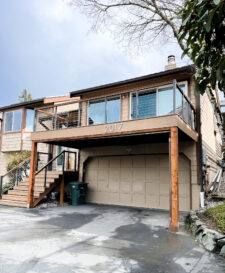
Signs Your Deck Has Reached the End of Its Life
Not every tired-looking deck needs full replacement. But there's a point where patching boards or re-staining stops being a fix and just becomes a way to delay a bigger problem. We look for a combination of the following before recommending replacement over repair:
- Soft, spongy, or spring-back decking when you walk across it, especially near the edges or in shaded corners
- Persistent moss or dark staining that returns within weeks of cleaning
- Visible rot or discoloration at the ledger board where the deck meets the house
- Rust streaking around fasteners or joist hangers, or hardware that's visibly corroded
- Railing posts that wiggle at the base, which usually points to compromised framing, not just a loose bolt
- Gaps between boards that have closed up completely, trapping moisture and debris with nowhere to drain
- A deck more than 20-25 years old that has never had its structural connections inspected or upgraded
If you're seeing two or more of these, it's worth having someone look at the framing underneath, not just the surface boards. Surface rot is often the visible symptom of a moisture problem that's already reached the structure.
What a Correct Deck Replacement Actually Involves
A deck replacement done right is a structural project, not a cosmetic swap of old boards for new ones. In a shaded, moisture-heavy setting like Mountain Lake, the parts you don't see matter more than the decking itself.
Framing and Ledger Flashing
The ledger board — where the deck attaches to the house — is the single most common failure point on older decks in wet climates. If it isn't properly flashed to shed water away from the house framing, moisture works its way behind the siding and rots both the ledger and the wall structure it's bolted to. A correct replacement means removing the old ledger, inspecting the rim joist and sheathing behind it, and installing proper flashing before anything gets reattached. Joists and beams get evaluated for rot and undersizing at the same time, since older decks were often framed to lighter standards than current code calls for.
Decking Material Choice
Material selection matters more here than in a dry, sunny climate. Wood species, board spacing, and finish all affect how well a deck sheds moisture and resists moss in shaded conditions. We'll walk through the realistic trade-offs for your specific site rather than pushing one product for every job.
Fasteners and Hardware
Given the mix of shade-driven dampness and periodic salt air, we use corrosion-resistant fasteners and structural connectors rated for coastal exposure, even on inland lots. This is one of the cheapest parts of the job to get right and one of the most expensive to fix later if it's done wrong, since replacing hardware usually means pulling up decking that's otherwise fine.
Comparing Decking Materials for a Mountain Lake Property
There's no single "best" decking material — it depends on how much maintenance you're willing to do, your budget, and how much shade and moss exposure the site gets. Here's an honest comparison based on how these materials actually perform in a shaded, damp Pacific Northwest island setting:
| Material | Moss/Moisture Resistance | Maintenance Needs | Typical Lifespan |
|---|---|---|---|
| Pressure-treated wood | Moderate — needs regular cleaning and sealing | High (annual cleaning, periodic staining) | Shorter without upkeep, longer with it |
| Cedar | Good natural resistance, but surface still needs care in deep shade | Moderate to high | Moderate |
| Capped composite | Very good — resists moisture absorption | Low (occasional washing) | Long, with manufacturer warranty backing |
| PVC decking | Excellent — doesn't absorb moisture at all | Low | Long |
Composite and PVC products cost more up front, but in a shaded, moss-prone spot like Mountain Lake, the lower maintenance burden often makes more sense than a wood deck that needs yearly attention just to stay ahead of moss and staining. That said, plenty of homeowners still prefer the look and feel of real wood and are happy to keep up with the maintenance — it's a legitimate choice as long as you go in with clear expectations.
Site Conditions That Change the Job at Mountain Lake
Every deck replacement in this area has to account for the tree canopy. Overhanging branches drop needles and leaf litter that collect between boards and hold moisture against the surface, which is exactly what moss needs to take hold. A few things we factor into the build or rebuild:
Board spacing gets set to allow adequate drainage without creating gaps that trap debris. Under-deck airflow matters more here than on an open, sunny lot, since a deck built low to the ground in a shaded yard dries out much more slowly after rain than one with clear ventilation underneath. Where the site allows it, we also talk through gutter or drip-edge details near the house connection, since runoff concentrated near the ledger is a common contributor to the rot we see on older decks in this area.
None of this is exotic work, but it's the kind of detail that gets skipped when a crew is used to building decks in drier, more open conditions and treats every site the same way.
Permits and San Juan County Considerations
Deck replacement projects on Orcas Island generally fall under San Juan County's building permit process, and requirements can vary based on the size of the deck, its height off the ground, and whether the footprint or structural attachment to the house is changing. Some smaller like-for-like replacements may have simpler requirements than a full rebuild with a larger footprint or new structural connections. We handle the permit conversation as part of the estimate rather than leaving it for homeowners to sort out on their own, since getting it wrong can mean delays or rework later.
Our Deck Replacement Process
We keep the process straightforward so there are no surprises partway through:
- On-site assessment — we inspect the existing deck, framing, ledger connection, and site conditions, including sun/shade exposure and drainage patterns specific to your lot.
- Honest scope and material conversation — we explain what's failing, what's salvageable if anything, and walk through material trade-offs based on your budget and how much upkeep you want to take on.
- Written estimate — a clear breakdown of demolition, framing, materials, and any permit work involved, with no vague allowances hiding the real cost.
- Permitting — we handle the San Juan County paperwork where applicable before work begins.
- Demolition and structural rebuild — old decking and framing come out, the ledger and framing get corrected and properly flashed, and new structural connections go in to current standards.
- Decking installation — boards, railings, and hardware are installed with spacing and fastening appropriate to a shaded, moisture-prone site.
- Final walkthrough — we go over the finished deck with you, including basic care guidance for whatever material you chose.
Why a Crew That Already Works Mountain Lake Matters
Getting materials, equipment, and crews to and from Orcas Island takes planning around ferry schedules, and it's a genuinely different logistical exercise than a mainland job. A contractor who already works this island isn't figuring that out for the first time on your project — deliveries are scheduled, timelines account for ferry availability, and there's no learning curve costing you delays. Just as important, a crew with real time on the ground here has already seen how decks fail in this specific mix of shade, moss, and marine air, rather than applying assumptions from drier or more open sites elsewhere in the county.
Local experience also means straight answers about what your particular lot needs. A deck backed up against dense forest canopy is a different project than one in a more open, sun-exposed yard, even if they're both technically in the Mountain Lake area, and that distinction should shape the material and drainage decisions from the start.
Keeping Your New Deck Looking Good
Whatever material you choose, a little seasonal upkeep goes a long way in this climate. Clearing leaf and needle debris from between boards before it packs down, keeping gutters and downspouts near the deck clear so runoff doesn't pool against it, and giving the surface an occasional wash to stay ahead of moss will meaningfully extend the life of any decking material — composite included. We'll go over the specifics for your material at the end of the job so you know exactly what upkeep, if any, to expect.
If your deck near Mountain Lake is showing soft spots, persistent moss, or rust at the hardware, it's worth a look before those problems reach the framing. We offer free, no-pressure estimates — use the form below to get one scheduled.