 Orcas Island Siding
 Why Deer Harbor Roofs Take a Different Kind of Beating
Deer Harbor sits close to the water, tucked under a heavy tree canopy on Orcas Island, and that combination is tougher on a roof than most homeowners realize until they're dealing with the results. Salt-laden air off the water accelerates corrosion on fasteners, flashing, and any exposed metal. Driving rain off Puget Sound doesn't just fall straight down — wind-driven rain gets pushed sideways into laps, valleys, and vent boots that were never designed to shed water horizontally. And the shade from the surrounding conifers keeps roof surfaces damp far longer after a storm than a roof out in the open would stay, which is exactly the condition moss needs to take hold.
None of this means a roof in Deer Harbor is doomed to fail early. It means the installation has to account for these conditions from the first layer down, not just the shingles on top. A roof built the same way you'd build one in a dry inland town will underperform here, sometimes by years, regardless of the material's rated lifespan.
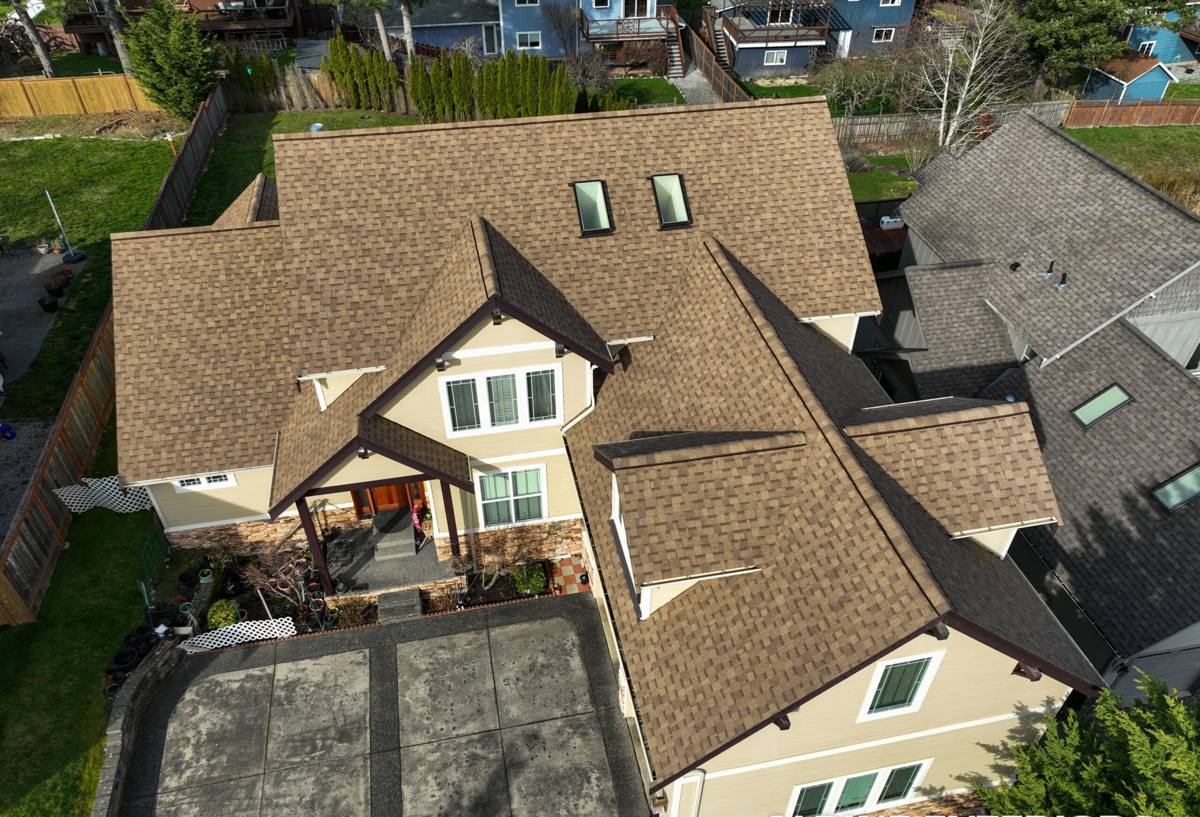
What a Correct New Roof Installation Actually Involves
Starting With the Deck, Not the Shingles
Every re-roof starts with a full tear-off and a real look at the decking underneath, not a quick glance. San Juan County's damp climate means roof decks that have been leaking slowly for years can look fine from above while the plywood or board sheathing underneath has gone soft. Any deteriorated decking gets replaced before anything else goes down. Skipping this step is the single most common shortcut in the roofing trade, and it's the one that causes soft spots, nail pop-through, and premature shingle failure later.
Underlayment and Moisture Barriers Built for Wet Winters
Over the repaired deck, we install a synthetic underlayment across the full roof, with self-adhered ice-and-water membrane at the eaves, valleys, and around every penetration — chimneys, vents, skylights. On homes in shaded, low-lying parts of Deer Harbor where roofs stay wet longer, we extend that membrane further up the roof plane than code minimums require, because the extra protection against wind-driven rain and standing moisture is cheap insurance compared to a rotted deck five years down the road.
Ventilation: The Part Homeowners Never See
A roof that can't breathe traps moisture in the attic, which shows up as mold, rot, and ice damming in cold snaps. We check and correct intake and exhaust ventilation as part of every installation — not as an upsell, but because a beautiful new roof over a poorly ventilated attic will fail from the inside before the shingles ever wear out.
Choosing a Roofing Material for Salt Air and Moss
There's no single "best" roofing material for Orcas Island — the right choice depends on your home's exposure, budget, and how much upkeep you're willing to do. Here's how the common options actually perform under salt air and heavy shade:
| Material | Salt Air Durability | Moss Resistance | Maintenance | Typical Lifespan |
|---|---|---|---|---|
| Architectural asphalt shingle | Good, with corrosion-resistant fasteners | Fair to good with algae-resistant granules | Periodic moss/debris removal | 25–30 years |
| Standing seam metal | Very good with proper coatings and fasteners | Excellent — sheds moss easily on the slope | Low | 40–50+ years |
| Cedar shake | Fair — needs regular treatment | Poor without diligent upkeep | High — regular cleaning and treatment | 20–30 years with upkeep |
We're upfront about the trade-offs. Cedar shake looks right at home on the islands, but it's the most moisture-sensitive option in a climate that stays damp for months at a time, and it demands a maintenance commitment that not every homeowner wants. Metal costs more up front but shrugs off moss and salt corrosion better than anything else on this list. Asphalt remains the most common choice because it balances upfront cost with solid performance, provided it's installed with the right underlayment and fastener hardware for a marine environment.
Building Moss Resistance Into the Install
Moss isn't just cosmetic — a heavy moss mat holds water against the shingle surface, works its way under tabs, and shortens the life of the roof underneath it. Rather than treating moss as something to fight after the fact, we build resistance into the installation itself:
- Zinc or copper strips installed near the ridge, so rainwater carries trace metal ions down the roof slope and inhibits moss and algae growth over time
- Algae-resistant shingle products where the budget and aesthetic allow, which slow the black streaking and green growth common on shaded roofs
- Correct slope transitions and valley work so water doesn't pool or slow down in low spots where moss gets a foothold
- Honest advice on canopy exposure — if overhanging limbs are keeping a section of roof shaded and wet, trimming that back does more for moss prevention than any roofing product
None of this makes a roof moss-proof. It reduces how fast moss returns and how much damage it does before you catch it, which matters more on a heavily wooded lot than it does on an open one.
Our Process for a Deer Harbor Re-Roof
A new roof project on Orcas Island runs on a similar timeline to anywhere else, with a few extra planning steps built in for island logistics:
- On-site assessment of the existing roof, decking condition, ventilation, and any problem areas specific to your home's shade and exposure
- Written estimate covering material options, tear-off scope, and any decking repair likely to be needed
- Material ordering and delivery scheduled around ferry logistics, since supplies for an island job have to be staged in advance rather than picked up same-day
- Full tear-off and disposal of the old roofing material
- Deck repair, underlayment, flashing, and ventilation work
- New roofing material installed to manufacturer specification
- Site cleanup, including a magnetic sweep for stray fasteners
- Final walkthrough so you understand what was done and what to watch for going forward
Every proper installation should include the following — it's worth asking any contractor to confirm these before work starts:
- Full tear-off to the deck, not a layover on existing shingles
- Deck inspection with repair or replacement of any soft or damaged sheathing
- Ice-and-water membrane at eaves, valleys, and all penetrations
- Corrosion-resistant fasteners and flashing suited to a marine environment
- Ventilation checked and corrected, not just assumed to be adequate
- Written warranty terms for both materials and workmanship, explained plainly
Why a Crew That Already Works Orcas Island Matters
Roofing logistics on an island aren't the same as on the mainland. Materials, dumpsters, and equipment all have to move by ferry, and a contractor who hasn't planned around that schedule can turn a three-day job into a week of waiting on deliveries. A crew that already works Deer Harbor and the rest of Orcas Island knows how to stage materials ahead of time, how to read the weather windows between Pacific storm systems, and which parts of the island tend to hold moisture longest based on tree cover and sun exposure.
That local knowledge shows up in small decisions — extending ice-and-water membrane further on a shaded north slope, choosing fastener hardware rated for the salt exposure closer to the water, or timing a tear-off so your roof deck isn't sitting open when a rain system is forecast to move through San Juan County. None of that comes from a spec sheet. It comes from having done this work on this island, repeatedly, in these conditions.
What Affects the Cost of a New Roof Here
Every roof is priced individually, but the same handful of factors drive most of the variation we see on Orcas Island jobs:
- Roof size and pitch — steeper roofs take longer to work safely and use more material per square foot of coverage
- Number of existing layers — tearing off two layers of old shingles costs more in labor and disposal than one
- Decking condition — hidden rot found during tear-off adds material and labor that couldn't be quoted sight unseen
- Material choice — asphalt, metal, and cedar shake sit at very different price points, as reflected in the comparison above
- Roof complexity — valleys, dormers, skylights, and multiple chimneys all add flashing work and time
- Access and staging — driveway access, tree clearance for equipment, and ferry-dependent delivery timing all factor into scheduling and cost
We walk through each of these during the on-site estimate so you know what's driving the number, rather than handing you a flat quote with no explanation behind it.
Caring for a New Roof Through Deer Harbor's Wet Season
A correctly installed roof still needs some seasonal attention in this climate. Gutters under conifer canopy fill with needles and debris faster than in open areas, and clogged gutters push water back under the roof edge instead of away from the house. We recommend clearing gutters at least twice a year, more often on heavily treed lots, and doing a visual check for moss buildup or displaced shingles after any major windstorm. Catching a lifted shingle or a moss patch early is a five-minute fix; ignoring it through a wet winter can turn into a deck repair the following year.
If you're planning a new roof for a home in Deer Harbor or elsewhere on Orcas Island, we're happy to walk the roof with you and give you a straight, no-pressure estimate — use the form below to get started.