 Orcas Island Siding
 Why Doe Bay Windows Wear Out Differently Than Windows Inland
Doe Bay sits on the exposed eastern side of Orcas Island, facing open water and weather that comes straight off the Salish Sea. That's a different set of conditions than a window twenty minutes inland in San Juan County ever has to deal with. Salt-laden air corrodes hardware and finishes faster. Wind-driven rain gets pushed sideways into gaps that would stay dry in a calmer spot. And the long, damp shoulder seasons here mean wood trim and sills stay wet longer than they do almost anywhere else in Washington. None of that is a reason to avoid window work in Doe Bay — it's just the reason a generic, big-box installation approach tends to fail early here while a properly detailed one doesn't.
When we talk about "energy-efficient windows" for this specific area, we're not just talking about a U-factor sticker. We're talking about a window and an installation method that can shed driving rain, resist salt corrosion on hardware and cladding, and keep performing after five or ten wet seasons instead of just on install day.
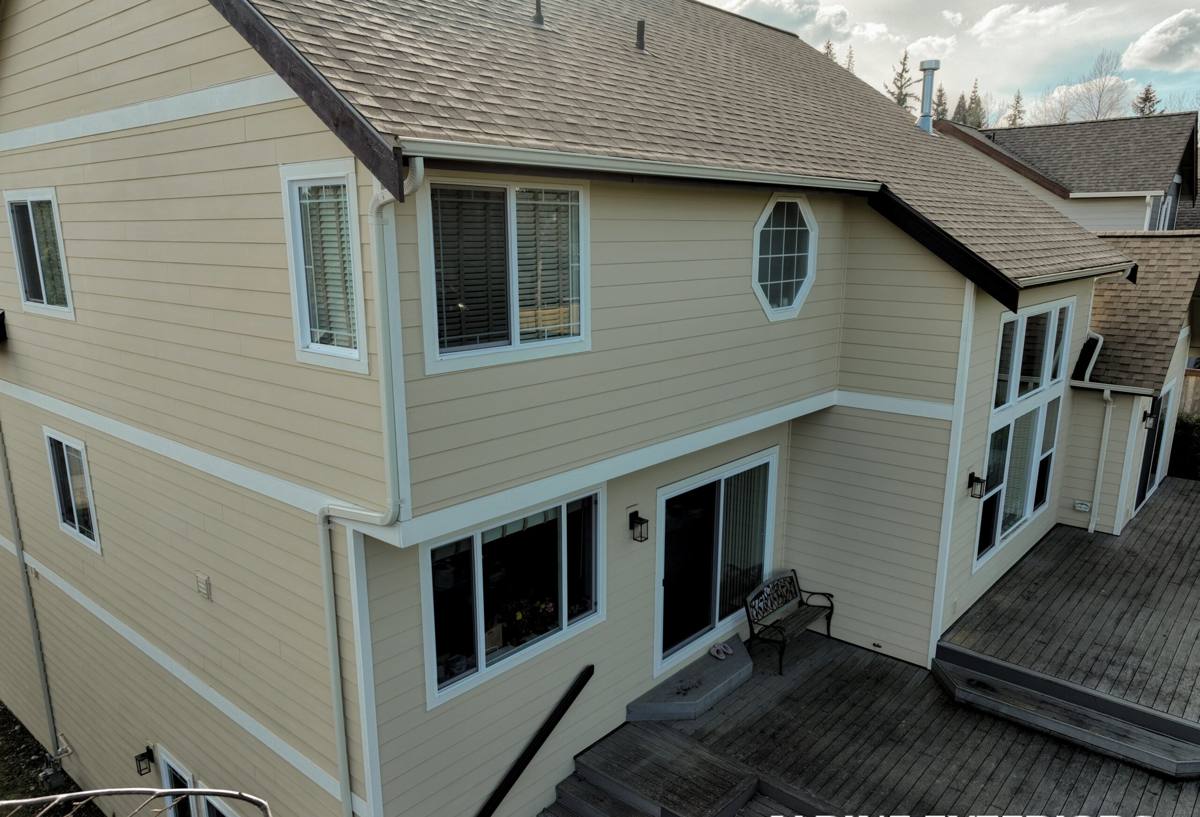
What "Energy-Efficient" Actually Means in Practice
Every new window sold today carries an NFRC energy label, but the numbers that matter for a Doe Bay home aren't all the same as the ones that matter for a house in eastern Washington. Here's the short version of what to actually look at:
| Rating | What It Tells You | Why It Matters Here |
|---|---|---|
| U-Factor | How well the window resists heat loss (lower is better) | Keeps heating costs down through our long, mild-but-persistent wet winters |
| Air Leakage (AL) | How much air passes through the frame/sash under pressure | Directly tied to wind-driven rain resistance — a leaky frame lets in water, not just draft |
| Condensation Resistance | How well the window resists interior condensation | High humidity + temperature swings near the water make this a real issue for island homes |
| Solar Heat Gain Coefficient | How much solar heat passes through the glass | Less critical here than in sunnier climates, but still worth balancing on south/west exposures |
For most Doe Bay homes, we weight air leakage and condensation resistance more heavily than a spec sheet from a mainland supplier might suggest. A window that's excellent on paper for heat loss but marginal on air infiltration will let salt-laden, wind-driven rain work its way into the wall assembly over a few seasons — and by the time that shows up as a stain on the interior sill, there's often already damage behind it.
Frame Material Trade-Offs for a Marine Environment
| Frame Type | Salt Air Performance | Maintenance | Honest Trade-Off |
|---|---|---|---|
| Vinyl | Good — won't corrode or rot | Low | Can look and feel less premium; quality varies a lot between manufacturers |
| Fiberglass | Very good — dimensionally stable, resists salt and moisture | Low | Higher upfront cost than vinyl |
| Aluminum-clad wood | Fair to good depending on cladding and hardware | Moderate — interior wood still needs occasional attention | Beautiful interior finish, but cladding seams and fasteners near salt air need good detailing |
| Bare wood | Poor without diligent upkeep | High | We're honest with clients that unclad wood on an exposed, waterside Doe Bay lot is a high-maintenance choice — not that the product itself is bad, just that it demands a maintenance schedule many owners of a part-time island home can't keep up with |
The Three Things This Climate Actually Does to a Window
Salt Air
Salt in the air settles on hardware, screws, and cladding fasteners and accelerates corrosion, especially on anything within a few hundred yards of the water. Cheap or mismatched hardware is usually the first thing to fail — a stuck lock or a corroded hinge pin long before the glass unit itself has any problem.
Driving Rain
Wind off the water doesn't just fall on a window, it pushes into it. Flashing details, sill pans, and sealant joints have to be built to handle rain moving sideways and upward under wind pressure, not just rain falling straight down. This is the single biggest difference between an installation that lasts and one that leaks within a few years.
Moss and Prolonged Dampness
San Juan County's long wet season keeps north-facing walls, sills, and anything shaded by trees damp for extended stretches. Moss and algae take hold on any surface that stays wet, and around windows that means trim, sills, and even weep holes can get clogged or hidden under growth if they aren't checked periodically. A clogged weep hole is a small thing that turns into trapped water and a much bigger repair.
What a Correct Installation Involves
Swapping a window is easy. Installing one correctly for a site like Doe Bay is a different job entirely. Here's what we consider non-negotiable:
- Full removal of the old unit and inspection of the rough opening for hidden rot before anything new goes in
- A sloped sill pan flashing that directs any water that does get past the window back outside, not into the wall
- Proper integration of flashing with the existing weather-resistive barrier — shingled correctly so water always sheds downward and outward
- Corrosion-resistant fasteners and hardware rated for coastal/marine exposure, not standard interior-grade hardware
- Low-expansion, exterior-grade sealant at all joints, with backer rod where gaps call for it
- Insulation of the gap between the window frame and rough opening — not stuffed, not skipped
- Interior and exterior trim reinstalled or replaced with attention to keeping end grain sealed
- A final water test on exposed elevations before we call the job done
Skipping any one of these doesn't usually show up on install day. It shows up two or three wet seasons later, which is exactly why so many callbacks we see on Orcas Island are for windows that were installed within the last five to eight years, not the original 1970s or '80s units.
Our Process
- On-site assessment. We look at exposure (how much direct wind and rain the opening actually gets), the condition of the existing framing, and how the home is used — full-time residence versus part-time or seasonal.
- Product recommendation. We walk through frame material, glazing package, and hardware options against your exposure and budget, and explain the trade-offs honestly rather than steering toward whatever has the best margin.
- Written scope and timeline. Because most materials come over on the ferry, we build lead time into the schedule up front instead of surprising you with it midway through the job.
- Installation. Old units out, opening inspected and repaired as needed, new units set with proper flashing and sealing, trim finished.
- Water test and walkthrough. We test exposed windows under a hose before we consider the job complete, and walk the homeowner through operation and any care items.
Cost Factors to Expect
| Factor | Why It Moves the Price |
|---|---|
| Frame material | Vinyl is typically the most affordable; fiberglass and clad-wood cost more up front but often less over the life of the window in a marine setting |
| Number and size of openings | More straightforward — larger and more numerous openings mean more labor and material |
| Condition of the rough opening | Hidden rot or old flashing failures found during removal add time and material that can't always be quoted before the old window is out |
| Access and ferry logistics | Doe Bay's location on Orcas Island means material lead times and site access can add scheduling cost that a mainland job wouldn't have |
| Trim and interior finish work | Matching existing interior trim, especially in older homes, adds finish carpentry time |
We give ranges, not fixed numbers, until we've actually seen the opening — a straightforward vinyl swap-out and a full opening rebuild with rot repair are not the same job even if the window itself costs the same.
Repair, Restore, or Replace?
Not every window on a Doe Bay property needs full replacement. Fogged glass between the panes almost always means a failed seal — sometimes the sash or glass unit alone can be replaced rather than the whole window. Sticking sashes and hard-to-turn locks are often a hardware or corrosion issue that can be serviced. Where we usually recommend full replacement is when the frame itself has taken on water damage, when air leakage around the frame is contributing to visible moisture or mold on interior trim, or when the existing units are old enough that efficient replacements will pay for themselves in comfort and heating costs over time. We'll tell you honestly which category a given window falls into rather than defaulting to "replace everything."
Why a Crew That Already Works Doe Bay Matters
A lot of window problems we get called out to fix on Orcas Island didn't come from bad products — they came from installation methods that would have been fine on a sheltered inland lot but weren't built for direct wind and salt exposure. A crew that regularly works this specific stretch of San Juan County already knows which elevations on a Doe Bay lot take the worst of the weather, how to detail flashing for wind-driven rain rather than just vertical rain, and which hardware actually holds up near salt water instead of just being marketed as "coastal-rated." That local pattern recognition is hard to get from a crew that mostly works elsewhere and treats a job on Orcas Island as a one-off.
There's also the practical side: island jobs need realistic material lead times, ferry-aware scheduling, and a crew that isn't guessing at how long a job will actually take once travel is factored in. A contractor unfamiliar with island logistics tends to either underbid the schedule or pad it heavily out of uncertainty — neither serves the homeowner well.
Protecting the Investment After Installation
Even a correctly installed window benefits from periodic attention in this climate. A simple seasonal checklist goes a long way:
- Rinse salt residue off frames and hardware near the water a couple of times a year
- Check and clear weep holes so moss and debris don't block drainage paths
- Look at exterior caulking annually for cracking or separation, especially after a hard winter
- Operate locks and hardware periodically so corrosion doesn't set in unnoticed on rarely used windows
- Keep an eye on interior sills after heavy wind-driven storms for any sign of moisture intrusion
None of this is difficult, but it's easy to skip on a part-time or seasonal home, and it's the kind of small maintenance that prevents a much larger repair down the line.
If you're weighing whether your windows need repair, restoration, or full replacement, we're happy to take a look and give you a straightforward assessment — no pressure, no obligation. Use the form below to request a free estimate for your Doe Bay property.