 Orcas Island Siding
 Lopez Island's Climate Is Hard on Roofs — Here's Why
Lopez Island sits out in San Juan County the way most of the archipelago does: surrounded by salt water, exposed to weather systems that come off the Strait, and shaded in plenty of spots by fir and cedar canopy. That combination is tougher on a roof than most homeowners realize. Salt-laden air corrodes exposed metal faster than it would inland — nails, flashing, vent stacks, and fastener heads all take the hit over time. Driving rain, especially when it comes in sideways during a fall or winter blow, finds every weak seam, every lifted shingle tab, and every under-flashed penetration. And a long, damp moss season means organic growth gets a head start on roofs that don't drain and dry out quickly.
None of this means Lopez Island roofs fail faster than roofs anywhere else in Western Washington. It means the details of the installation — the underlayment, the flashing, the fastener choice, the ventilation — matter more here than they would in a drier, less exposed part of the state. A roof that's installed to a generic standard will often show its age early on an island. A roof installed with San Juan County's actual conditions in mind holds up the way it's supposed to.
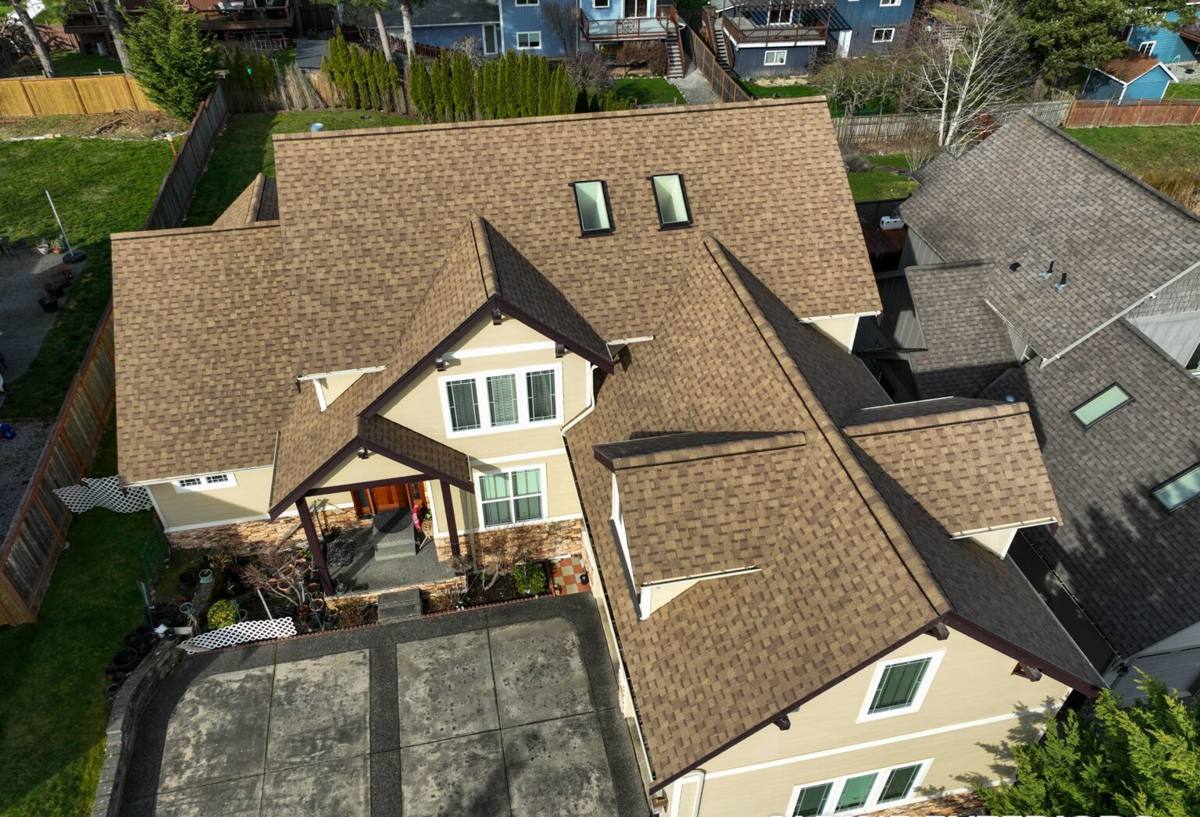
Signs Your Roof Needs Full Replacement, Not Another Repair
Not every roof problem calls for a full tear-off. Sometimes a flashing repair or a section of missing shingles is genuinely all that's needed, and we'll tell you that if it's true. But there's a point where patching stops being cost-effective and starts being a way to spend money without solving the underlying problem. These are the signs we look for when we're deciding whether to recommend repair or replacement:
- Granule loss heavy enough that you can see bare, shiny patches on asphalt shingles, or granules collecting in gutters
- Shingles that are curling, cupping, or cracking across multiple slopes rather than one isolated area
- Moss forming continuous mats rather than a few scattered patches — mats hold moisture against the roof surface around the clock
- Leaks showing up in more than one location, or a leak that reappears after a repair
- Soft or spongy decking felt underfoot, which usually means water has already gotten past the roofing material
- A roof at or past the manufacturer's expected service life for its material and exposure
- Daylight visible through the roof deck from inside an attic or crawlspace
If you're seeing two or more of these, it's worth having someone look at the whole roof rather than chasing one leak at a time.
What a Correct New Roof Installation Actually Involves
Tear-Off and Deck Inspection
A proper replacement starts with removing the old roofing down to the deck, not layering over it. That's the only way to actually see what's underneath — soft spots, rot around old penetrations, or damage from a leak that's been quietly running for years. Any damaged decking gets replaced before anything new goes down. Skipping this step is the single most common shortcut that leads to problems a few years later, and it's not visible once the new roof is on, which is exactly why it matters who's doing the work.
Moisture Barrier and Underlayment Choices for a Wet Climate
Underlayment is the backup layer that protects your home if wind-driven rain ever gets past the surface roofing material — and on an island exposed to the Strait, it will be tested at some point. We use synthetic or self-adhering underlayment in the areas most likely to see wind-driven moisture, particularly at eaves, valleys, and low-slope sections, rather than relying on older felt products alone. This is a place where spending a bit more up front avoids a much more expensive fix later.
Flashing Details That Actually Matter Near Salt Water
Flashing is where roofs actually fail — around chimneys, skylights, vent stacks, and wall intersections. In a salt-air environment, we pay close attention to the metal itself and how it's fastened, since standard fasteners and lower-grade flashing metal corrode faster this close to the water. Properly formed step flashing, counter-flashing, and sealed penetrations are what keep a roof watertight for its full lifespan instead of developing slow leaks at year eight or ten.
Ventilation That Fights Moss Instead of Feeding It
A roof that can't breathe traps moisture in the attic space, which condensates, drips back down onto the underside of the deck, and creates exactly the damp conditions moss and algae thrive on from both directions. Balanced intake and exhaust ventilation — enough soffit intake to match the ridge or roof vent exhaust — keeps the deck drier and the shingles cooler, which slows both moss growth and premature aging of the roofing material.
Choosing a Roofing Material Built for Lopez Island Conditions
There's no single "best" roofing material for every home — it depends on your roof's pitch, how much shade and moss exposure you get, your budget, and how long you want to go before the next replacement. Here's how the common options actually perform in this climate:
| Material | Salt Air & Moisture Behavior | Moss Resistance | Typical Lifespan | Maintenance |
|---|---|---|---|---|
| Architectural asphalt shingle | Good when properly flashed; algae-resistant granule options help | Moderate — benefits from algae-resistant (AR) shingle lines | 25–30 years | Periodic moss/debris removal |
| Standing seam metal | Excellent once properly coated and fastened with compatible hardware | High — sheds moisture fast, little surface for moss to grip | 40–50+ years | Low; occasional fastener/seam check |
| Cedar shake / shingle | Traditional look but absorbs moisture; needs careful detailing near salt air | Lower without regular upkeep — organic material is moss-friendly | 20–30 years with upkeep | Higher; treatment and cleaning needed |
| Synthetic/composite shingle | Good; engineered to resist moisture absorption | Moderate to high depending on product | 30–50 years | Low to moderate |
We'll walk through these trade-offs with you based on your specific roof — a heavily shaded north slope calls for different thinking than a wide-open south-facing roof getting full sun and wind.
Our New Roof Installation Process
We keep the process straightforward because a roof replacement is stressful enough without surprises:
- On-site inspection and measurement. We look at the whole roof, not just the area you called about, and check attic ventilation and any existing damage.
- Material and scope walkthrough. We go over material options, what your roof actually needs versus what's optional, and give you a clear, honest estimate.
- Scheduling around weather and logistics. Roofing on an island means planning material delivery and crew scheduling around ferry availability and weather windows, which we build into the timeline up front rather than discovering mid-project.
- Tear-off and deck repair. Old roofing comes off, the deck gets inspected, and any damaged sections are replaced before we move forward.
- Underlayment, flashing, and material installation. Each layer goes down in the sequence that actually sheds water — underlayment, flashing, then the roofing material itself.
- Ventilation check. We confirm intake and exhaust ventilation are balanced for the finished roof.
- Cleanup and magnetic sweep. Job site debris and stray fasteners are cleared from the yard and driveway before we consider the job done.
- Final walkthrough. We go over the finished roof with you, answer questions, and cover warranty paperwork.
What Affects the Cost of a New Roof on Lopez Island
Every roof is priced based on its own specifics, but the same handful of factors drive most of the variation we see:
- Roof size and pitch — more square footage and steeper slopes both add labor time and material
- Number of tear-off layers — removing two layers of old roofing costs more than removing one
- Deck condition — hidden rot or soft decking found during tear-off means replacement lumber, which is priced as it's discovered
- Material choice — asphalt, metal, cedar, and synthetic products span a wide price range, as shown above
- Roof complexity — valleys, dormers, skylights, and chimneys all add flashing work
- Accessibility — steep sites, water-access-only properties, or long driveways can affect staging and delivery logistics
- Permit and disposal fees — these vary by jurisdiction and by how much old material comes off the roof
We'd rather walk your specific roof and give you real numbers than throw out a broad range that doesn't mean much until we've actually seen the project.
Moss, Algae, and Keeping a New Roof Performing Long-Term
A well-installed roof still benefits from basic upkeep, especially through a long moss season. A little routine attention goes a long way toward getting the full lifespan out of the materials you paid for:
- Keep gutters clear so water actually drains instead of backing up under the roof edge
- Trim back overhanging branches to cut down on shade, debris, and the moisture moss needs to establish
- Avoid pressure washing shingle or shake roofs — it can strip granules and force water under the surface; gentler moss removal methods protect the roofing material
- Consider zinc or copper strips near the ridge on moss-prone roofs, which release trace metals that discourage regrowth as rain washes over them
- Have the roof looked at every couple of years, particularly after a rough winter, so small issues get caught before they become leaks
Why a Crew That Already Works on Lopez Island Makes a Difference
Island work isn't the same as mainland work, and it shows up in ways homeowners don't always think about until a project is underway. Material deliveries have to be coordinated around ferry schedules. Crews need to plan their day around sailing times rather than just driving over whenever it's convenient. Weather windows for tear-off matter more when getting a crew back out isn't a quick same-day fix. A contractor who's done this work on Lopez Island before has already solved these logistics — they know how to stage materials, how much buffer to build into a schedule, and what actually goes wrong on an exposed roof out here versus what's just theoretical. That experience shows up in fewer delays, fewer surprises, and a roof that's built for the conditions it will actually face.
Permits, Warranties, and Insurance Considerations in San Juan County
Roof replacements in San Juan County may require a permit depending on the scope of work and your specific property — we handle that process as part of the job rather than leaving it for you to sort out. Manufacturer warranties on shingles and other roofing materials are also conditional on correct installation; if flashing, underlayment, or ventilation isn't done to spec, a warranty claim can be denied even though the material itself was never at fault. And for homes with direct shoreline exposure, it's worth talking to your insurance carrier about wind and impact ratings for the material you choose, since coverage terms can vary by product and installation method.
If your roof is showing its age, or you just want an honest opinion on whether repair or replacement makes sense, we're happy to come take a look. There's no pressure and no obligation — just a straightforward assessment of what your roof actually needs. Use the form below to request a free estimate.