 Orcas Island Siding
 Board & Batten Siding Around Mountain Lake
Mountain Lake sits up in the wooded, higher-elevation part of Orcas Island, tucked among fir and madrone rather than sitting right on the water. That setting is exactly why board and batten shows up so often as the siding style of choice out here — the vertical lines and rustic proportions read as "cabin in the woods" instead of "subdivision house," and they fit the terrain honestly instead of fighting it. It's a good look for this part of the island. It's also a siding profile that punishes a sloppy install harder than most, because every batten is a seam, and every seam is a place water can find its way in if the work underneath isn't right.
We install board and batten on homes around Mountain Lake regularly, and this page covers what actually matters for that job in that setting: what the local conditions do to siding over time, what a correct board and batten system looks like underneath the boards, and why we only build it out of James Hardie fiber cement rather than the wood or vinyl alternatives.
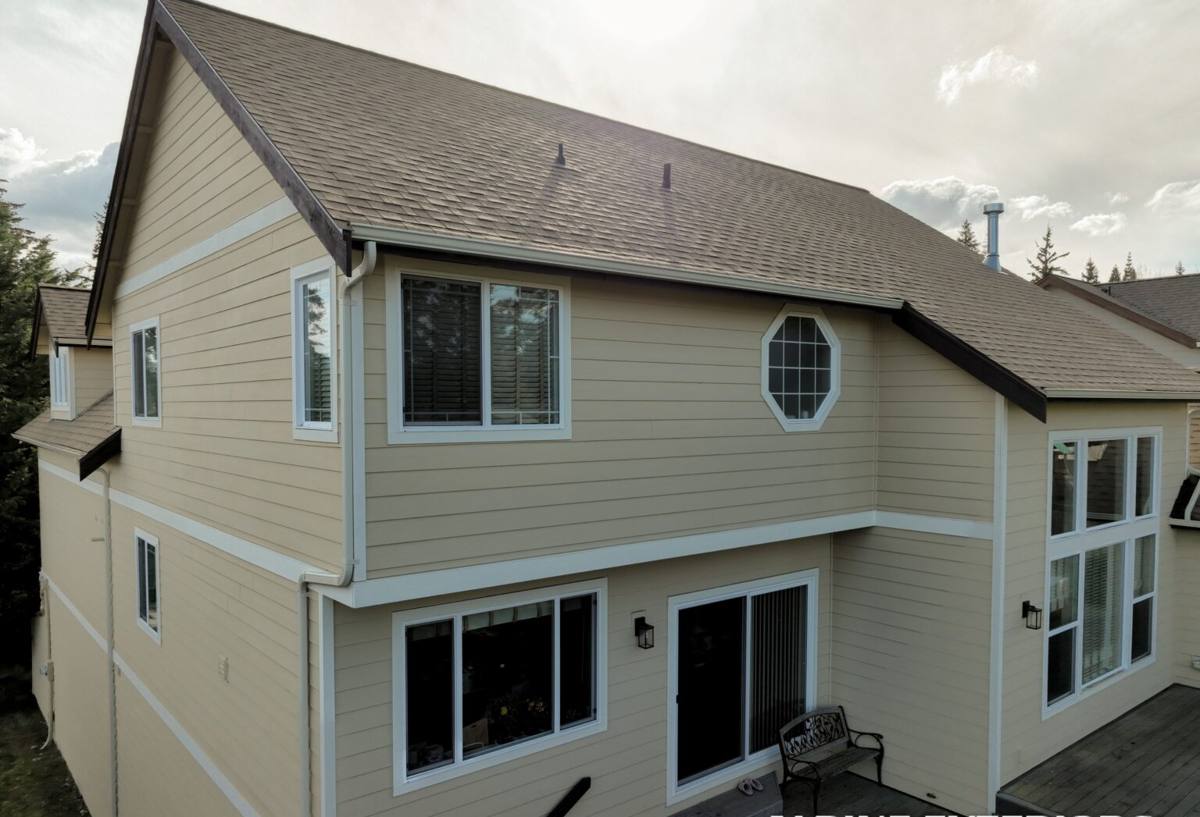
What This Microclimate Does to Siding
San Juan County has a reputation for being drier than the mainland Puget Sound, and on the water that reputation mostly holds. Up around Mountain Lake, the picture changes a little. The tree canopy that makes the area beautiful also keeps siding shaded for much of the day, which means less direct sun to dry things out after a storm. Add in wind that still carries salt air across the island even away from the immediate shoreline, plus the driving, wind-pushed rain that comes through the San Juans in the wetter months, and you get a combination that's tough on any siding material: slow-drying surfaces, near-constant low-level moisture, and a long moss and algae season that can run most of the year in the shadiest spots.
None of that is a reason to avoid board and batten — it's a reason to build it correctly. The vertical board orientation actually sheds bulk rainwater well when it's detailed right. The problems show up when the assembly behind the boards can't manage the moisture that does get past the surface, or when the material itself can't take repeated wet-dry cycling and shaded, mossy exposure without breaking down.
Why Shade and Moisture Matter More Than Rain Totals
A lot of homeowners think about siding durability in terms of how much rain falls. What actually drives deterioration is how long a wall assembly stays wet after it rains. A sun-exposed wall on the water side of the island can shed a storm and be dry by afternoon. A shaded wall tucked into the trees near Mountain Lake might stay damp for days, especially through fall and winter. That extended dry-out time is what feeds moss growth, softens vulnerable materials, and stresses paint and caulk joints — and it's the single biggest reason siding choice and installation detail matter more here than the raw climate numbers suggest.
What a Correct Board and Batten Installation Involves
Board and batten is a system, not just a look. Getting it right means paying attention to layers most people never see:
- A drainage plane behind the siding. A weather-resistive barrier, properly lapped and taped, so any moisture that gets past the boards has somewhere to go besides your wall sheathing.
- A rainscreen gap. A small air space between the back of the siding and the wall lets water drain and lets the assembly dry from both sides — critical in a shaded, slow-drying spot like Mountain Lake.
- Correct fastening. Battens and boards fastened per the manufacturer's spec, not just "close enough," so the panels aren't stressed or prone to working loose over time.
- Flashing at every horizontal transition. Window heads, trim boards, roof-to-wall intersections, and the base of the wall all need metal or engineered flashing, not just caulk.
- Factory-finished material. A finish applied and cured under controlled conditions holds up to shade and moisture far better than a field-applied coat, especially somewhere the wall may not fully dry out for days at a stretch.
Skip any one of those steps and the siding might still look fine for a couple of years. In an area like Mountain Lake, where the wall doesn't get much help drying itself out, shortcuts tend to show up as trapped moisture, soft spots, or persistent moss and staining well before the material should be showing its age.
Why We Build It in James Hardie, Not Wood or Vinyl
We get asked fairly often why we don't offer board and batten in cedar, primed wood, or vinyl, since all three are common ways to get the look. Here's the honest answer.
Cedar and primed wood look great fresh out of the gate, and in a dry, sunny climate they can be a reasonable choice with diligent upkeep. In a shaded, moisture-holding spot like Mountain Lake, wood board and batten needs real, ongoing maintenance — recoating, caulk inspection, and watching for the soft spots that come from repeated wet-dry cycling — to avoid rot at the battens and board edges, which are exactly the seams this style depends on. That's a maintenance schedule most homeowners underestimate when they're buying the material, not a defect in wood itself.
Vinyl board and batten is low-maintenance and inexpensive, but it's a thin, flexible material that relies almost entirely on trim pieces and J-channels to look intentional, and it doesn't hold up structurally or visually to the same standard over decades. In a wooded setting where the material is going to sit in shade and damp conditions for long stretches, vinyl's long-term track record just isn't where we want to put a homeowner's money.
James Hardie fiber cement is what we install instead. It's non-combustible, engineered specifically for wet Pacific Northwest exposure (Hardie's HZ10 product line is built for climates like ours), and it comes with a factory-applied ColorPlus finish that resists the fading, staining, and moss adhesion that plague field-painted materials in shaded spots. It's also dimensionally stable, so the batten reveals stay straight and tight instead of gapping or cupping the way wood can after a few wet seasons. We install it as a full system — HardiePanel or HardiePlank configured as board and batten, with HardieTrim battens and trim — built on the drainage and flashing details described above, backed by a strong transferable warranty when installed to spec.
Our Process for a Mountain Lake Board and Batten Project
- On-site assessment. We look at existing siding condition, wall assembly, shade exposure, and any moss or moisture staining that points to a drainage problem worth solving while the wall is open.
- Plan the drainage and flashing details for your specific exposure — a wall that stays shaded most of the day gets treated differently than one that sees afternoon sun.
- Remove and inspect. Old siding comes off, sheathing gets checked for hidden rot or moisture damage before anything new goes up.
- Install the weather-resistive barrier and rainscreen gap per manufacturer spec.
- Install James Hardie boards and battens with correct fastening, spacing, and flashing at every transition.
- Final walkthrough covering care basics and what to watch for given your specific site conditions.
What Drives the Cost of a Board and Batten Project
Every home is different, but these are the factors that most often move the price on a board and batten job in this area:
| Factor | Why It Matters |
|---|---|
| Board width and reveal | Wider boards and battens mean fewer seams but more material per square foot; narrower reveals mean more trim and labor |
| Wall condition underneath | Rot or moisture damage found during tear-off adds sheathing repair before new siding can go on |
| Number of window and roof transitions | Each one needs its own flashing detail — more transitions means more labor |
| Site access and material staging | Wooded, sloped, or lake-adjacent lots can take longer to stage and protect than a flat, open lot |
| Color and finish selection | Factory ColorPlus finishes vary slightly in cost by color line, but all outperform field-applied paint here |
We walk through all of this on site and give you a straightforward, itemized estimate — no vague allowances, no pressure to decide on the spot.
Maintenance: What Board and Batten Actually Needs Here
One of the real advantages of a correctly installed Hardie board and batten system in a shaded spot like Mountain Lake is how little it asks of you. Still, a little attention goes a long way:
- Rinse siding gently once or twice a year, more often on the shadiest walls, to keep moss and algae from taking hold
- Keep gutters clear so roof runoff isn't dumping extra water onto the siding below
- Trim back branches and vegetation that keep a wall in constant shade or hold moisture against it
- Check caulking at trim and window edges every couple of years and re-caulk as needed
- Watch for any dark staining or soft spots near the base of the wall or at batten seams, and have them looked at early rather than waiting
Why It Matters That We Already Work Around Mountain Lake
Getting materials, crews, and equipment to a job on Orcas Island takes real planning — ferry schedules, staging, and lead time all factor into how a project gets sequenced, and a crew that's done it before doesn't lose a week figuring that out on your job. Just as important, a contractor who's already worked in the shaded, wooded conditions around Mountain Lake knows what that specific microclimate does to a wall over time, and details the drainage and flashing accordingly instead of building to a generic spec that assumes more sun and less standing moisture than the site actually gets. That local knowledge is the difference between board and batten siding that looks right for five years and board and batten siding that's still doing its job in twenty.
If you're weighing board and batten for a home near Mountain Lake, we're happy to come take a look, walk the site with you, and put together a straightforward, no-pressure estimate — just fill out the form below.