 Orcas Island Siding
 Decking Built for the Obstruction Pass Environment
Obstruction Pass sits close to the water on the east side of Orcas Island, and homes out there deal with a version of San Juan County weather that's a little more aggressive than what you'll find further inland. Salt-laden air moves through constantly, driving rain comes in sideways off the water during winter storms, and the tree cover that gives so many of these properties their privacy also means shade, damp air, and a long moss season that can run from October well into spring. A deck out here isn't just outdoor furniture space — it's a structure that has to shed water, resist corrosion, and stand up to organic growth year after year without turning into a slip hazard or a rot problem.
Composite decking, done right, handles this environment better than most alternatives. But "composite decking" covers a wide range of products and installation approaches, and the difference between a deck that looks good for two years and one that performs for two decades comes down to material choice, substructure work, and details most homeowners never think to ask about.
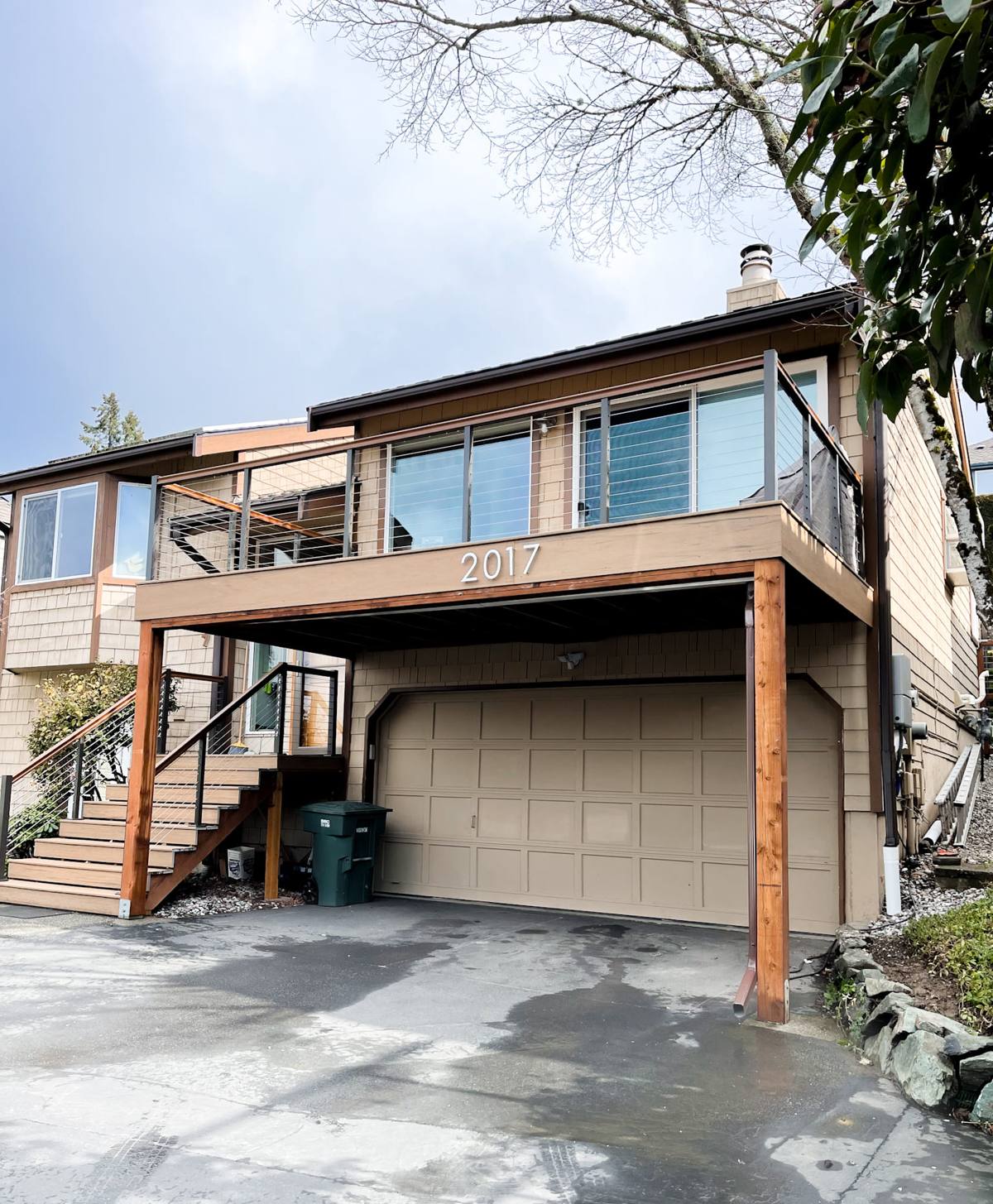
What Salt Air, Rain, and Moss Actually Do to a Deck
Salt Air and Metal Fatigue
Proximity to Rosario Strait and the surrounding waterways means airborne salt settles on every exterior surface, including fasteners, joist hangers, and railing hardware. Standard galvanized steel corrodes faster in this environment than it would inland. Once fasteners start rusting, they can streak the decking surface, weaken connections, and eventually fail well before the boards themselves wear out.
Driving Rain and Trapped Moisture
Winter storms on Orcas Island don't just drop water — they push it. Rain driven at an angle gets up under railings, into board gaps, and against ledger connections where the deck meets the house. If flashing and drainage aren't handled correctly at that ledger, water works its way into the band joist and framing, which is one of the most common sources of hidden rot on older decks in this area.
Moss, Algae, and Shade
Tree canopy is part of what makes Obstruction Pass appealing, but it also keeps deck surfaces damp longer after rain and blocks the sun exposure that would otherwise help boards dry out. That combination is exactly what moss and algae need to take hold, especially on the north-facing or heavily shaded sections of a deck. Left unaddressed, surface growth doesn't just look bad — it holds moisture against the board and creates a genuinely slick, unsafe walking surface.
Why Composite Makes Sense Out Here
Traditional wood decking can be built to last in this climate, but it demands a maintenance schedule most homeowners don't keep up with — annual cleaning, periodic sealing, and close attention to end grain and fastener holes. Modern capped composite decking gives you a manufactured wood-fiber core wrapped in a polymer shell, which means the surface doesn't absorb water the way real wood does, doesn't require staining or sealing, and resists the moss and algae staining that's so persistent in shaded, damp settings like this one.
That said, composite isn't a "set it and forget it" material, and it isn't immune to Orcas Island conditions. Cheaper, non-capped composite boards can still absorb moisture at the core if the cap is compromised, and any composite board installed with poor drainage or airflow underneath will trap moisture regardless of what the surface is made of. The material only performs as well as the installation underneath it.
Composite vs. Alternatives: How They Hold Up Locally
| Material | Moisture Resistance | Moss/Algae Resistance | Maintenance | Typical Lifespan |
|---|---|---|---|---|
| Pressure-treated wood | Moderate — absorbs water, needs sealing | Low — porous surface holds growth | Annual cleaning/sealing | 10–15 years |
| Cedar | Good if maintained, poor if neglected | Low to moderate | Regular oiling/sealing | 15–20 years with upkeep |
| Non-capped composite | Moderate — core can absorb moisture at cut ends | Moderate | Periodic washing | 15–20 years |
| Capped composite (our standard) | High — polymer shell sheds water | High — resists staining and growth | Occasional rinse/wash | 25–30+ years |
What a Correct Installation Involves
Most deck problems we get called out to fix on Orcas Island don't start with the decking material — they start underneath it. A composite deck that's going to hold up near the water needs:
- Proper ledger flashing where the deck attaches to the house, so water is directed away from the band joist instead of into it
- Stainless steel or coated corrosion-resistant fasteners and hardware throughout, not just at the visible surface
- Adequate substructure ventilation so air can move under the deck and boards can dry out between rain events
- Correct board spacing for composite's expansion and contraction, which differs from wood
- Joist tape or a moisture barrier on top of framing members to protect the wood substructure from prolonged dampness
- Grading and drainage at ground level so water doesn't pool under low decks, which is a common issue on sites with limited slope
Skipping any of these to save time or cost shows up later as squeaking, soft framing, staining, or hardware failure — usually right when the deck is otherwise still looking new on the surface.
Our Process for an Obstruction Pass Composite Deck
1. Site and Structure Assessment
We start by looking at sun exposure, tree cover, drainage patterns, and — for a rebuild — the condition of the existing substructure. Shaded, low-airflow sections get flagged early since they'll need extra attention to ventilation and board selection.
2. Material Selection
We walk through board profile, color, and railing options with an eye toward how each will actually perform in a shaded, damp, salt-air setting rather than just how it looks in a showroom sample.
3. Framing and Waterproofing
This is where the long-term performance of the deck gets decided — ledger flashing, joist protection, hardware grade, and structural spacing are all addressed before a single composite board goes down.
4. Installation
Boards are laid with manufacturer-specified gapping and fastening, accounting for temperature and moisture conditions at time of install so the finished deck stays tight and consistent through seasonal changes.
5. Final Walkthrough
We go over care basics — how often to rinse the surface, what to watch for in shaded corners, and how to keep drainage paths clear — so the deck starts its life set up to resist the moss and algae buildup that's so common in this area.
What Drives the Cost of a Composite Deck Project
| Factor | Why It Matters |
|---|---|
| Deck size and shape | More square footage and complex angles increase material and labor |
| Substructure condition | Rebuilding rotted or undersized framing adds cost but is not optional if found |
| Board tier and color | Composite lines vary in cap technology, warranty length, and price |
| Railing system | Cable, glass, and metal rail systems cost more than standard composite railing |
| Site access | Waterside and sloped lots common around Obstruction Pass can add staging and access time |
| Height and permitting | Elevated decks may require engineering and San Juan County permitting |
As a general range, straightforward composite deck replacements often land in the low-to-mid five figures, with larger, elevated, or structurally complex projects running higher. We won't give a real number until we've seen the site — anything else is a guess.
Why a Local Crew Matters for This Job
Obstruction Pass isn't a large or heavily trafficked part of Orcas Island, and that's part of what makes it a distinct install environment — tree cover, exposure, and access vary noticeably from one property to the next even within a small area. A crew that already works this part of San Juan County knows which sections of a lot tend to hold moisture, how shade patterns shift through the seasons, and what hardware grade actually holds up against the salt air coming off the water. That local knowledge shows up in fewer callbacks and a deck that's built for the site it's actually on, not a generic spec sheet.
It also matters for practical reasons — material delivery, permitting familiarity with San Juan County requirements, and being able to respond quickly if something needs a follow-up visit. Island logistics aren't the same as mainland logistics, and a contractor who's already set up to work here avoids a lot of the delays that come with bringing in an outside crew for a one-off job.
Maintenance Checklist for Composite Decks Near the Water
- Rinse the deck surface a few times a year, more often in shaded sections prone to moss
- Keep gutters and downspouts clear so runoff isn't dumping extra water onto or under the deck
- Trim back overhanging branches where practical to improve sun exposure and airflow
- Check railing posts and fastener points annually for any early signs of corrosion staining
- Clear leaves and debris from board gaps before they trap moisture through fall and winter
- Confirm under-deck ventilation isn't blocked by stored items or overgrown landscaping
Get a Straight Answer on Your Deck
If you're planning a new composite deck or replacing one that's showing its age near Obstruction Pass, we're happy to take a look and give you an honest assessment of what your site needs — no pressure, no inflated scope. Use the form below to request a free estimate.