 Orcas Island Siding
 Why Siding Takes a Beating on Orcas Island
Homes on Orcas Island sit in one of the more demanding exterior environments in Washington. You've got salt-laden air coming off the water, long stretches of driving rain pushed in by winter storms, and a shoulder season where moss and algae get a foothold on anything that stays damp for more than a day or two. Add in the number of homes tucked under fir and cedar canopy — common throughout San Juan County — and you get siding that rarely gets a full afternoon of direct sun to dry out between rain events. That combination is exactly what separates siding that looks good for five years from siding that holds up for twenty-five.
Salt air is corrosive to exposed fasteners and trim metal, and it accelerates the breakdown of coatings that aren't formulated to resist it. Driving rain — rain pushed sideways by wind rather than falling straight down — finds every gap in flashing, every under-caulked seam, and every panel that wasn't held off the wall assembly correctly. And moss doesn't just sit on the surface; given enough time and moisture, it holds water against the siding face and telegraphs into seams and fastener holes. None of this is unique to any one property on the island — it's the baseline condition anyone building or re-siding here has to design around.
Why We Install James Hardie and Only James Hardie
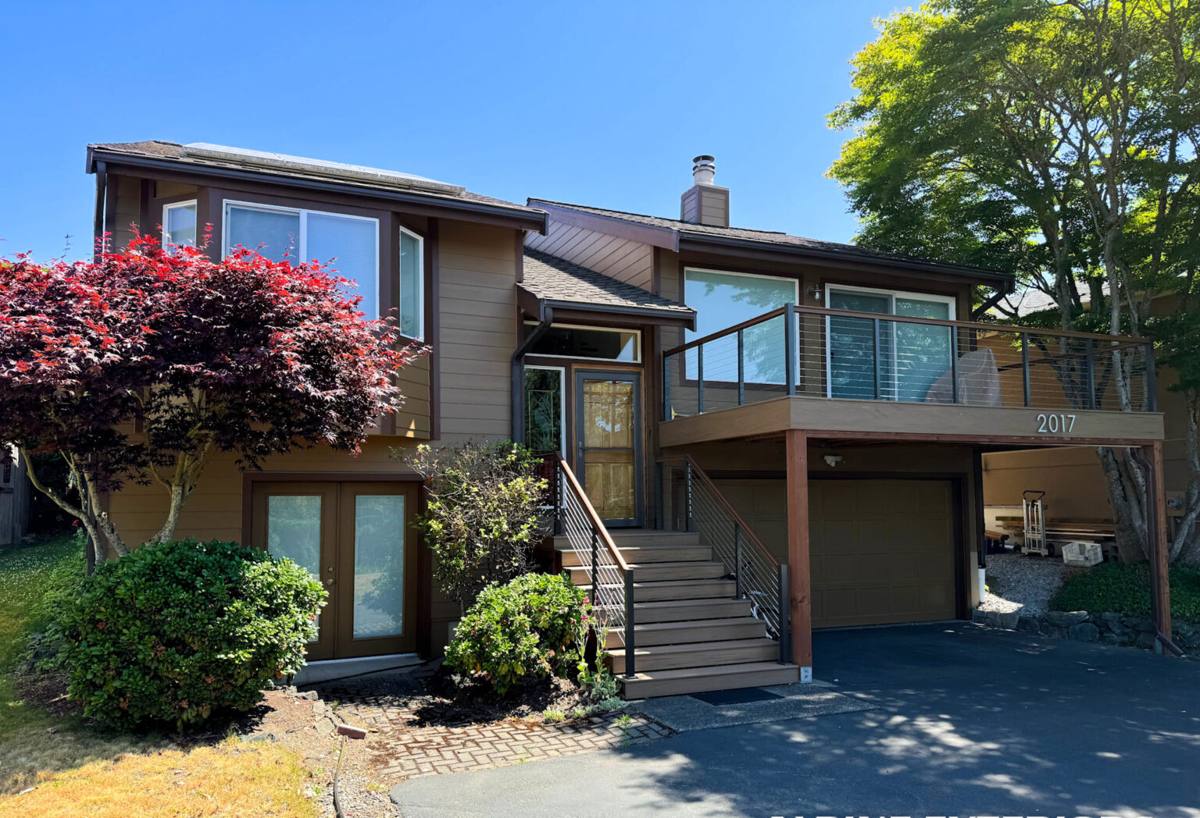
We standardized on James Hardie fiber cement siding for every job we take on, and we don't install vinyl, LP SmartSide, primed spruce, cedar, or other fiber cement brands. That's not a marketing position — it's a decision based on what actually survives a marine climate long-term. Fiber cement is dimensionally stable, meaning it doesn't expand and contract with moisture swings the way wood-based products do, and it's non-combustible, which matters given how much of the island is surrounded by forest and dependent on volunteer fire response. James Hardie's ColorPlus factory-applied finish is baked on under controlled conditions rather than field-painted, which gives it more consistent adhesion and UV resistance than a coating applied on-site in variable weather — a real advantage when your paint crew's schedule is at the mercy of Pacific Northwest weather windows.
We're not going to tell you every other product is worthless — vinyl is cheap and easy to install, cedar has real aesthetic appeal, and LP SmartSide has improved over the years. But each of those comes with a maintenance burden or a moisture vulnerability that we think is a bad trade for a home exposed to salt air and sustained rain. Vinyl can warp and fade, and its seams rely on lap joints that aren't sealed, which lets wind-driven rain work its way behind the panels over time. Wood-based products need ongoing paint or stain maintenance, and once a coating fails, moisture gets into the substrate fast. We'd rather put one product on every home, know it cold, and stand behind it, than juggle five product lines and their five different failure modes.
What Correct Installation Actually Involves
James Hardie siding is only as good as the installation behind it. The product itself is engineered to perform, but a huge share of the siding failures we get called out to inspect on Orcas Island trace back to installation shortcuts, not the material. A correct install includes:
- A drainage plane (weather-resistive barrier) installed continuously behind the siding, lapped correctly top over bottom, with no gaps at penetrations
- Rainscreen furring or a similar gap strategy that lets water that does get behind the panel drain and the wall assembly dry out — important given how often walls here stay damp
- Flashing at every window, door, and roof-to-wall intersection, installed so water sheds outward and down, never trapped behind trim
- Panels fastened at the manufacturer's specified spacing and depth — overdriven or underdriven nails are one of the most common causes of early failure
- Correct clearance at grade, decks, and roof lines so siding never sits in standing water or constant splash-back
- Factory-cut and factory-primed edges used wherever possible, with any field cuts sealed per Hardie's published details
Every one of those details matters more here than in a dry inland climate, because the margin for error shrinks when a wall assembly is dealing with rain nearly year-round. A gap in flashing that might never cause a problem in a low-rainfall region can lead to rot and mold behind the wall within a couple of wet seasons on Orcas.
The HZ5 Zone and Why It's Relevant Here
James Hardie engineers its siding by climate zone, and most of Washington — including San Juan County — falls into the HZ5 zone, which accounts for the freeze-thaw cycles and sustained moisture exposure typical of the Pacific Northwest. HZ5 products are formulated and tested for that combination of cold, wet conditions, which is different from what's specified for hot, dry, or hurricane-prone regions. Using the correct climate zone product isn't optional — it's part of why the manufacturer's warranty holds up, and it's one of the first things we confirm before ordering material for any job.
How Our Process Works
Assessment and Prep
We start with a walk-around of the home to look at existing siding condition, trim and flashing details, roofline intersections, and any areas showing moss growth, staining, or soft spots that indicate moisture is already getting in. On older homes we'll often find that the existing weather barrier or flashing needs to be redone even if the siding itself looks salvageable from the road — that's usually where the real problem is hiding.
Material Staging
Getting materials to an island job site takes more lead time than a mainland project. We plan deliveries around ferry schedules and confirm quantities carefully before ordering, because a missing bundle of trim or a short pallet of panels isn't a same-day fix out here — it can mean a multi-day gap in the schedule waiting on the next available ferry slot. We build that into the project timeline upfront so it doesn't turn into a surprise mid-job.
Installation and Weather Sequencing
We sequence the tear-off and dry-in work around weather windows so a wall isn't left exposed to driving rain overnight. On a Pacific Northwest project, that means watching the forecast closely and sometimes shifting the order of work — starting on a more sheltered elevation first, for example — rather than working strictly left to right around the house.
Final Inspection
Before we consider a job finished, we walk every elevation checking fastener lines, caulk joints, flashing laps, and clearances at grade and roof intersections. We'd rather catch a missed detail ourselves than have it show up as a callback two winters from now.
Comparing Siding Options for an Orcas Island Home
Homeowners weighing siding materials for a marine, high-rainfall property should look past sticker price to what each product actually costs to own over time. Here's how the common options stack up against the conditions Orcas Island homes deal with:
| Material | Behavior in Salt Air & Driving Rain | Ongoing Maintenance | Typical Lifespan |
|---|---|---|---|
| James Hardie fiber cement | Dimensionally stable, non-combustible, factory finish resists salt and UV exposure | Periodic wash-down; ColorPlus finish holds color without repainting | Decades when installed to spec |
| Vinyl | Unsealed lap joints allow wind-driven rain intrusion; can warp in temperature swings | Low, but no repair option once cracked or faded | Variable; shorter in harsh coastal exposure |
| Cedar | Attractive but absorbs moisture; prone to moss and rot without diligent upkeep | Regular staining/sealing required, especially in shaded, damp locations | Shorter without consistent maintenance |
| LP SmartSide | Engineered wood strand product; more moisture-sensitive at cut edges and seams than fiber cement | Edge sealing and coating upkeep needed to prevent swelling | Depends heavily on installation quality and maintenance |
This isn't a knock on any homeowner who's chosen a different product — it's simply the reasoning behind why we only install one of them. In a climate this consistently wet, the products that rely on a perfect, permanent seal or an ongoing paint schedule carry more long-term risk than we're willing to put our name behind.
Living With Moss and Salt: Maintenance That Actually Matters
Even the right siding, installed correctly, benefits from a little seasonal attention on Orcas Island. Salt air leaves a fine film on exterior surfaces that's worth rinsing off a couple of times a year, particularly on elevations facing open water. Shaded, tree-covered sides of a house — very common here — are where moss and algae take hold first, so those are the areas worth checking each fall before the wet season sets in. A soft wash with a garden hose and a mild cleaner is usually enough; pressure washing at close range can damage the ColorPlus finish or force water behind panels, so it's worth avoiding high-pressure equipment directly on the siding face.
Gutters and downspouts deserve equal attention. A clogged gutter during a heavy driving-rain event will overflow directly onto the siding below it, concentrating water exactly where you don't want it. Keeping gutters clear going into fall and winter does more to protect siding longevity here than almost any other single maintenance task.
Signs Your Current Siding Needs Attention
Because problems often start behind the siding before they're visible on the surface, it's worth knowing what to look for:
- Persistent moss or dark staining that returns quickly after cleaning
- Soft or spongy spots when you press on siding, especially near the bottom courses or under windows
- Visible gaps or separation at trim, corners, or window flashing
- Paint or finish that's peeling, chalking, or has lost its color unevenly
- A musty smell or visible mold on interior walls that back up to exterior siding
- Warping, bowing, or panels that no longer sit flat against the wall
Any one of these is worth a professional look before it turns into a larger repair. Moisture problems in a climate like this don't stay small for long.
Why It Matters to Hire a Crew That Already Works This Island
Siding work on Orcas Island isn't the same job as siding work on the mainland, even a few miles away. Material logistics run on ferry schedules, not same-day delivery trucks. San Juan County permitting and building department requirements have their own local nuances. And the climate exposure — salt air layered on top of Pacific Northwest rainfall — calls for installation details that a crew unfamiliar with island conditions may not think to prioritize. A contractor who regularly works Orcas Island homes has already worked out the scheduling, staging, and weather-sequencing decisions that make the difference between a smooth project and a delayed, exposed one.
We also think there's real value in being straightforward about scope before work starts: what the existing wall assembly looks like once old siding comes off, what flashing or sheathing repairs are actually needed versus optional, and what the realistic timeline looks like once ferry logistics are factored in. Surprises during a siding project are almost always avoidable with a thorough upfront assessment.
Get a Straightforward Estimate
If your home's siding is showing its age, or you're planning ahead for a project this year, we're happy to walk the property with you and give you an honest read on what's going on and what it would take to do right. There's no pressure and no obligation — just a clear look at your options using the form below.