 Orcas Island Siding
 Why Siding Repair Looks Different in North Beach
North Beach sits right on the water on Orcas Island's north shore, in San Juan County, and that location changes what a repair crew actually finds when a call comes in. A cracked board or a soft spot near a window doesn't happen the same way here as it does on a home a few miles inland. Marine air moves across these lots more or less constantly, storms coming off open water drive rain sideways into walls instead of just falling on a roof, and a lot of North Beach homes sit under fir and cedar canopy that keeps north- and shore-facing walls damp long after a storm has cleared. That combination of salt, wind-driven rain, and a moss season that can run most of the year is what actually drives the repair calls we get out here, and it's a different problem than a repair scoped for a typical inland Orcas Island home.
This page is about siding repair specifically for homes in North Beach — not full replacement, not a different service. What tends to go wrong, how to tell a cosmetic problem from one that needs attention now, what a correct repair actually involves, and why it matters that the crew doing the work already knows this stretch of shoreline.
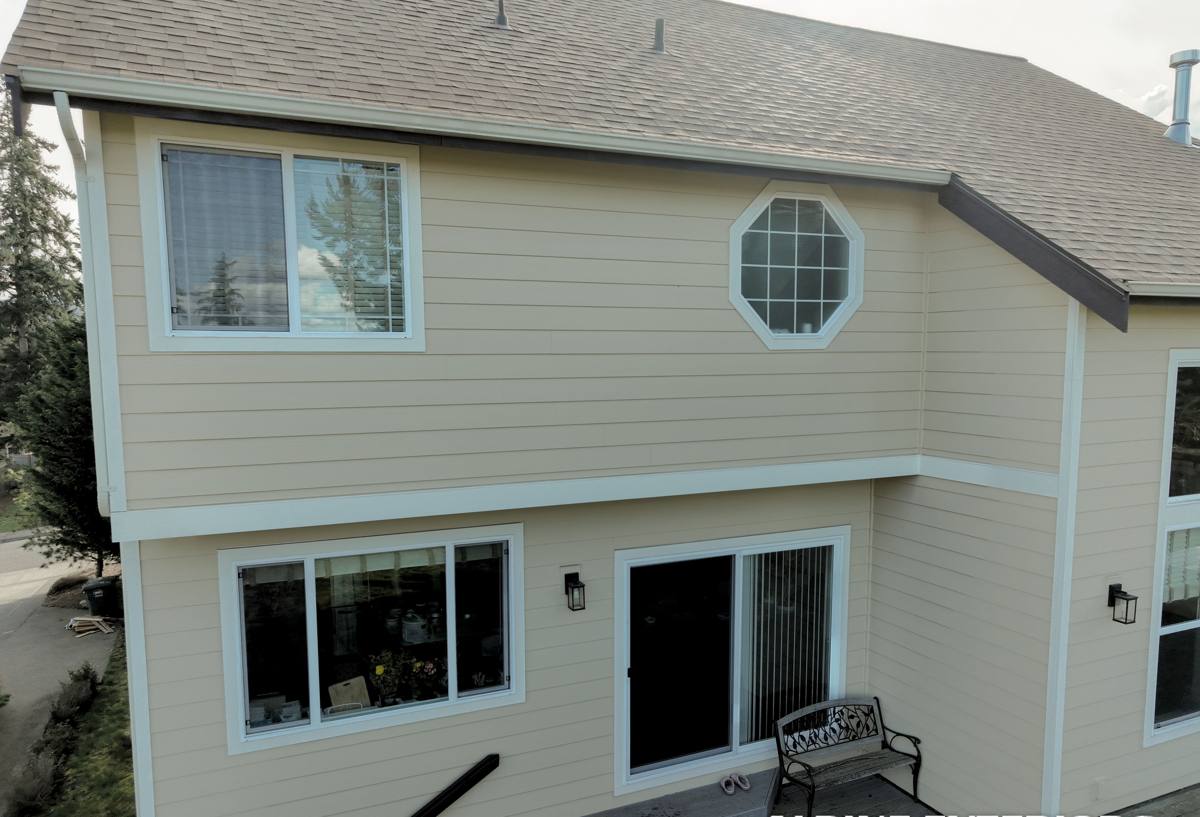
What Actually Damages Siding in North Beach
Salt Air and Fastener Corrosion
Salt-laden air off the water settles on siding, trim, and fasteners continuously, not only during storms, and it works on metal well before any damage is visible from the ground. A fastener that's lost holding strength doesn't announce itself — it shows up later as a board that's started to bow slightly, a corner trim piece pulling loose, or streaking around a fastener head where corrosion has begun bleeding through the finish. On a shoreline lot, this is one of the most common reasons a section of siding needs attention well before the material itself is actually failing.
Wind-Driven Rain at Joints and Penetrations
Storms coming off the water don't fall straight down. They push rain sideways into whatever wall is facing the weather, and that wind-driven rain finds its way into butt joints, corner boards, and anywhere siding meets a window, door, or roofline. A cracked caulk joint or a flashing detail that was never quite right lets water get behind the siding instead of running past it, and that's usually where we find damage that actually needs repair — not on the broad face of a wall, but concentrated at the seams and penetrations.
Moss and Sustained Shade Moisture
A lot of North Beach properties sit under tree cover on their inland side while facing open water on the other, which means one side of the house dries out in the wind while the other stays shaded and damp for days after a storm passes. That shaded, north-facing exposure is exactly what moss needs to take hold, and once it does, it holds moisture directly against the siding surface and its fasteners far longer than an exposed wall would ever stay wet on its own. Moss isn't just cosmetic — sustained dampness underneath it is what actually drives decay and corrosion in the wall behind it.
Cosmetic Wear vs. Repair-Worthy Damage
Not every mark on a wall needs the same response, and telling the difference correctly is the first real job of an honest repair estimate.
| Symptom | Usually Cosmetic | Often Repair-Worthy |
|---|---|---|
| Light surface staining or graying | Yes — weathering | Only if paired with soft spots |
| Moss on a shaded wall | Cosmetic at first | Yes if left untreated — traps moisture long-term |
| Hairline cracking in caulk joints | No | Yes — opens a path for wind-driven rain |
| Small chip or ding in a board | Usually | Only if it's exposed the substrate to moisture |
| Soft or spongy spot in a board | No | Yes — moisture has already reached the material |
| Streaking or rust at fastener heads | Cosmetic if isolated | Can indicate corrosion progressing underneath |
Cosmetic issues affect how a wall looks and can usually wait for routine maintenance. Repair-worthy issues affect what's happening behind the siding, and letting those sit is what turns a small, inexpensive repair into a larger one.
How We Diagnose Before Recommending Repair
A repair estimate that's actually useful starts with a real look at the wall, not a guess from the driveway. That typically includes:
- Checking butt joints, corner boards, and trim for cracked or missing caulk, especially on walls facing open water
- Probing any suspect board for soft spots that indicate moisture has already reached the material, not just a visual check
- Looking at fasteners and flashing for early corrosion, particularly around windows, doors, and roof-to-wall intersections
- Checking shaded and north-facing walls for moss coverage and how long those areas actually stay wet after rain
- Assessing whether damage is isolated to a section or has spread to adjacent boards and fasteners
- Confirming what's actually behind the visible siding, since sheathing and framing condition matter more than the surface symptom
We walk through what we find honestly, including what can simply be monitored and what's purely cosmetic, before recommending any scope of work.
Repair vs. Replace: How That Decision Gets Made
Homeowners often assume any siding problem means the whole wall has to come off, or the opposite — that a patch repair will always be the cheaper, equally good option. Neither assumption holds up consistently. What actually drives this decision:
- How far the damage has spread. A cracked joint or a single damaged board is usually a straightforward repair. Moisture that's reached the sheathing across multiple boards is a different, larger scope.
- What's behind the siding. Sound framing and sheathing under a damaged section is a strong repair candidate. Compromised sheathing usually means opening up more of the wall than the visible damage suggests.
- Age and material of the existing siding. Repairing an aging wood or engineered-wood product that's near the end of its practical life often means doing the same repair again in a few years, on this coastline in particular.
- Whether a color or profile match is realistic. A close match keeps a repair from standing out; when one isn't available, that's worth an honest conversation before starting.
| Cost Factor | Why It Matters in North Beach |
|---|---|
| Extent of hidden moisture damage | Sheathing or framing damage adds scope an estimate can't confirm until the wall is opened up |
| Fastener and flashing grade | Coastal-grade hardware costs more upfront but doesn't corrode again on the same timeline |
| Match availability | Older or discontinued siding profiles can be harder to match than current product lines |
| Wall accessibility | Shoreline lots with limited access or steep grade can affect setup and staging |
| Isolated vs. spreading damage | A single board is a different job than damage that's already reached several adjacent boards |
The honest answer on cost depends on what an inspection actually finds once the affected section is opened up, which is why we scope repairs after a real look at the wall rather than a flat estimate from a description over the phone. We'll give you a straight answer on which category your siding falls into, including when a full section genuinely makes more sense than patching around a recurring problem.
What a Correct Siding Repair Involves
Fixing the Cause, Not Just the Symptom
A soft board or a stained corner is a symptom. Cracked caulk, a missing flashing detail, or a section that never dried out properly is usually the cause. A repair that replaces the visible damage without correcting what let moisture in behind it tends to fail again in the same spot, often faster the second time.
Matching Material and Finish
Where the existing siding is sound and the damage is isolated, a repair means matching board profile and finish as closely as the existing product allows. On older wood or engineered-wood siding, an exact match isn't always available, and we'll say so upfront rather than after the work is done. Where a section is too far gone to patch credibly, we'll walk through replacing that section with James Hardie fiber cement — the same non-combustible, factory-finished product we install on new work — rather than matching a failing material board for board.
Fasteners and Flashing Brought Up to Spec
Any fastener or flashing we replace goes in at a grade suited to salt-air exposure, not a like-for-like swap with whatever corroded the first time. This is one of the places a repair either holds for years or needs redoing on a similar timeline, and it isn't a place to cut a corner just because it's a repair rather than a new installation.
Maintenance That Extends a Repair's Lifespan
- Rinse salt residue off siding periodically, especially on walls facing open water directly
- Keep gutters and downspouts clear so runoff isn't landing against a wall or pooling at the foundation line
- Treat moss on shaded, north-facing walls before it spreads rather than after it's established
- Check caulk at joints and trim once or twice a year, and recaulk before a joint cracks open fully
- Trim back branches and vegetation that keep a wall shaded and damp longer than it needs to be
- Address soft spots or active leaks right away — these are moisture signs, not cosmetic ones, and they don't improve with time
Why It Matters That We Already Work North Beach
A crew that mostly repairs siding a few miles inland can still do competent work on a shoreline property, but North Beach has patterns that come up here more than almost anywhere else on Orcas Island — corrosion concentrated on the water-facing walls, moss that establishes on the shaded side of the same house within the same season, and repair access that has to account for shoreline setbacks and, on some lots, getting materials over on a schedule that isn't a same-day errand. Working this stretch of the island regularly means we're not guessing at any of that. We know what fastener grade actually holds up facing open water here, where moss tends to take hold first on a North Beach lot, and how to scope a repair so it addresses what's actually happening behind the wall, not just what's visible from the yard.
That familiarity also means a more accurate estimate the first time — less back-and-forth once work starts, because the inspection already accounted for how this specific shoreline behaves instead of applying a generic checklist built for an inland home.
Get an Honest Look at Your Siding
Whether you're dealing with one damaged section, ongoing moss on a shaded wall, or just want a straight read on where your siding actually stands, we're glad to walk the property and tell you plainly what we find — including if the honest answer is that it doesn't need much yet. Reach out below for a free, no-pressure estimate.