 Orcas Island Siding
 Homes around Mountain Lake sit in one of the more heavily wooded, sheltered corners of Orcas Island — set back under fir, cedar, and madrona canopy near Moran State Park rather than lined up along open shoreline. That setting changes what siding actually has to survive here. Walls get less direct sun to dry out after a storm, more shade-driven moss pressure, and still catch a milder version of the same salt-tinged marine air and driving rain that move across the rest of San Juan County. Siding replacement at Mountain Lake isn't just swapping old boards for new ones — it's matching the material and the installation details to a specific microclimate that punishes shortcuts more than a sunnier, more open lot elsewhere on the island would. This page covers what that means for a Mountain Lake home, what correct siding replacement involves, and how our process works from first look to final walk-through.
What Mountain Lake's Setting Does to Siding
Three conditions drive most of the siding problems we see around Mountain Lake, and they layer on top of each other rather than acting alone.
Heavy Forest Canopy and a Long Moss Season
The fir, cedar, and madrona cover around Mountain Lake keeps a lot of walls in partial shade for much of the day, which means siding here dries out slower after rain than it would on an open, sun-exposed lot closer to the water. That extended damp window is exactly what moss and mildew need to establish themselves, and north- and east-facing walls under heavy canopy can carry visible growth for most of the year rather than just the wettest months. Siding that holds moisture at the surface instead of shedding it spends more time in that moss-friendly window before the next real dry stretch arrives, and once moss gets a foothold on a wall, it holds even more water against the surface than the shade alone would.
Salt-Tinged Marine Air, Even Set Back From the Shoreline
Mountain Lake sits back from Orcas Island's saltwater shoreline, but the island is small enough that marine air off the Salish Sea moves across it regardless of elevation or tree cover. That air carries a mild salt content that accelerates corrosion in exposed fasteners and hardware and works against field-applied finishes over time, even on a wooded, lake-and-forest property that feels far removed from open water. It's easy to assume a setting like this is sheltered from what a waterfront home deals with. In practice, it gets a milder version of the same exposure, plus its own shade-driven moisture problems layered on top.
Driving Rain and Elevation
Storms moving through San Juan County don't always drop straight down, and wind can drive rain sideways into whichever wall happens to be exposed at the time, even on a property tucked into the trees. Mountain Lake's higher elevation compared to the island's waterfront neighborhoods also tends to run cooler and wetter for longer stretches during the fall and winter, which slows drying further and extends how long joints, laps, and cut ends stay saturated after a storm passes through.
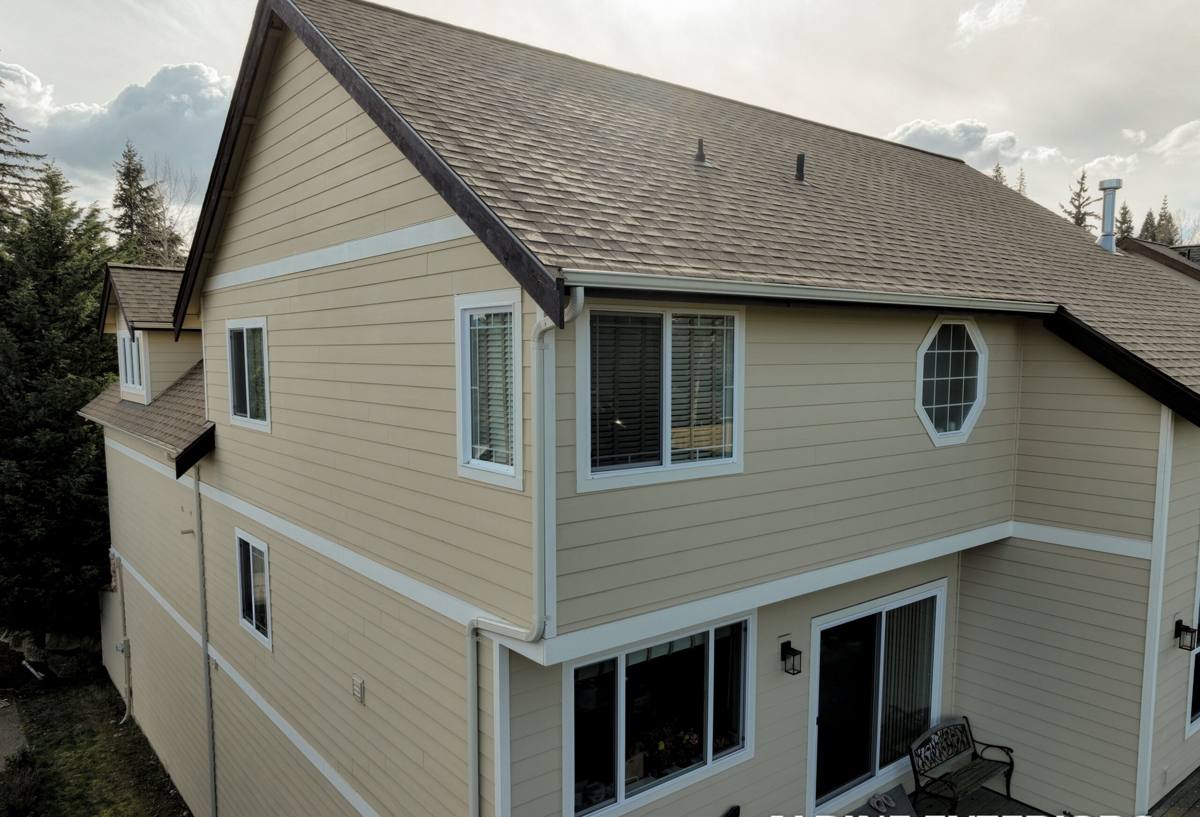
Signs a Mountain Lake Home Needs Siding Replacement
Not every siding problem calls for full replacement, but these are the signals that usually point toward it rather than a repair or a repaint:
- Moss or mildew that returns within weeks of cleaning, especially on shaded north- or east-facing walls
- Soft or spongy spots when you press on the siding, particularly near grade, deck ledgers, or window sills
- Paint or finish that's chalking, peeling, or failing faster than a normal repaint cycle would explain
- Visible cupping, warping, or delamination in wood-based or engineered wood siding
- Rust staining running down from fasteners or trim
- Gaps opening at butt joints, corners, or trim that weren't there a few years ago
- Noticeably drafty rooms or rising heating bills that point to a failing weather barrier behind the siding
- Siding at or beyond the expected service life for the material it's built from
Choosing Siding That Actually Holds Up at Mountain Lake
Material choice matters more in a shaded, damp setting like this than it does on an open, sun-exposed lot. The table below is a general comparison of how common siding materials behave under sustained shade and moisture — actual performance still depends heavily on installation quality.
| Material | Behavior Under Shade & Moisture | Maintenance at Mountain Lake | Typical Longevity Here |
|---|---|---|---|
| James Hardie fiber cement | Dimensionally stable; doesn't swell, cup, or feed moss growth | Low; factory ColorPlus finish resists fading and moisture intrusion | 30+ years with correct installation |
| Vinyl siding | Can trap moisture behind panels in shaded, poorly ventilated walls | Low upfront cost, but seams stay damp longer under tree cover | Variable; shorter on heavily shaded elevations |
| LP SmartSide / engineered wood | Wood-based core is moisture-sensitive at cut edges and joints | Moderate to high; edge sealing is critical in sustained shade and dampness | Depends heavily on installation quality and upkeep |
| Cedar / primed wood | Absorbs and releases moisture readily; feeds moss growth directly | High; needs regular refinishing and moss treatment on shaded walls | Shorter without consistent, disciplined maintenance |
This company installs James Hardie fiber cement exclusively. We don't install vinyl, LP SmartSide, Cemplank, Allura, primed spruce, or cedar. Each of those has a place in the broader siding market, and homeowners elsewhere are happy with them, but in a shaded, moss-prone setting like Mountain Lake, we've made a professional call to install one non-combustible, dimensionally stable product engineered for this kind of moisture exposure rather than offer a lower-cost option that shifts long-term maintenance risk back onto the homeowner. Hardie's ColorPlus factory finish and HZ5 climate-engineered formulation are built for regions dealing with sustained moisture, which is a close match for what a canopy-shaded, lake-adjacent property like this deals with year-round.
What Correct Siding Replacement Installation Involves
The siding product itself is only part of what determines whether a wall stays dry here. Most premature failures we see trace back to what's underneath or around it.
Tear-Off and Sheathing Inspection
Removing the old siding lets us see the actual condition of the wall sheathing underneath — soft spots, rot, or prior water damage that new siding installed over the top would simply hide. Any damaged sheathing gets replaced before anything new goes up, since installing new siding over a compromised wall just guarantees the same problems resurface sooner.
Moisture Barrier and Drainage
Given how long walls here can stay damp under tree cover, we don't treat the weather-resistive barrier as an afterthought. A properly lapped moisture barrier, with drainage detailing where the wall assembly calls for it, gives the wall a way to shed any water that gets past the siding surface instead of trapping it against the sheathing.
Flashing
Flashing at windows, doors, and any roof-to-wall transitions is where most siding-related leaks actually start on an older home. We use corrosion-resistant flashing suited to marine-air exposure and integrate it properly with the moisture barrier rather than relying on caulk alone to keep water out.
Fasteners and Clearance
Standard fasteners corrode faster in this air than most homeowners expect, so we spec corrosion-resistant fasteners placed to Hardie's published spacing requirements. We also maintain proper clearance between the siding and grade, decks, and roof lines — clearance that's easy to shortcut and one of the first places moisture and moss establish themselves at the base of a wall.
Our Siding Replacement Process
- On-site assessment. We walk the exterior, note which walls carry the most shade and moisture exposure, and take measurements for an accurate estimate.
- Material and color selection. We go over Hardie's product lines and ColorPlus color options that suit the home and its setting, with honest answers about what each involves.
- Scheduling around island logistics. Material orders and crew scheduling account for ferry timing so the job isn't held up mid-way by a missed sailing.
- Removal and sheathing inspection. Old siding comes off, the sheathing is inspected, and any damaged material is repaired or replaced before continuing.
- Moisture barrier and flashing installation. The weather-resistive barrier and flashing go in first, since this layer determines whether the wall actually stays dry.
- Siding installation. Hardie siding is installed to manufacturer specification, with attention to fastening pattern, clearance, and joint treatment.
- Trim, caulking, and final details. Trim and joints are finished to shed water correctly, not just to look complete.
- Final walk-through. We review the completed work with the homeowner and go over warranty and care details.
Cost Factors for Siding Replacement at Mountain Lake
Every home prices out differently, but these are the main variables that move a siding replacement bid up or down. We don't quote figures without seeing the property, since access and existing wall condition alone can shift a number significantly.
| Factor | Why It Matters Here |
|---|---|
| Home size and wall complexity | More corners, trim, and window openings mean more flashing detail and labor |
| Existing sheathing condition | Rot or soft sheathing found during tear-off adds repair cost not visible before removal |
| Access and site conditions | Wooded, sloped lots around the lake can add setup and staging time |
| Siding profile and finish | Panel size, texture, and ColorPlus color selection affect material cost |
| Trim and detail work | Homes with more architectural trim require more precise, labor-intensive finishing |
| Delivery and logistics | Ferry-dependent material delivery is a real scheduling factor, though usually not a major cost driver when planned ahead |
Why Hire a Crew That Already Works Mountain Lake and Orcas Island
A siding contractor who mostly works inland jobs isn't wrong about siding in general — they're just working from a different set of defaults. Fastener specs, drainage detailing, and moisture-barrier coverage that are perfectly adequate on a typical mainland home are often undersized for what a shaded, moisture-heavy setting like Mountain Lake deals with year-round. A crew that's already worked around Mountain Lake and elsewhere on Orcas Island has seen which details actually fail out here, not just which ones fail in a textbook.
There's also the practical side: island jobs need material orders and crew scheduling planned around ferry access, not squeezed in as an afterthought. A contractor unfamiliar with that logistics reality can end up with a job stretched out over unplanned delays. Local experience means the schedule accounts for that from the start, and it means knowing, wall by wall, which sides of a Mountain Lake home need the most attention before the crew ever shows up.
Maintaining New Siding in This Climate
Correctly installed Hardie siding needs far less upkeep than wood-based products, but a few habits keep it performing the way it's built to in a shaded, damp setting like this:
- Keep tree limbs and brush trimmed back from walls so siding gets what sun exposure the lot allows
- Rinse off moss or mildew buildup on shaded walls before it spreads across a full run of siding
- Check caulking at trim and joints periodically, since it's the one field-applied component that ages faster than the siding itself
- Keep gutters and downspouts clear so water isn't discharging against the base of a wall
- Address any small gaps, cracks, or soft spots promptly rather than waiting for the next dry season
If your siding is showing its age or you're planning ahead for a replacement, we're glad to walk the exterior with you and give an honest read on what a Mountain Lake home actually needs. Reach out for a free, no-pressure estimate using the form below.