 Orcas Island Siding
 Siding Replacement for West Beach Homes
West Beach sits on the exposed west side of Orcas Island, facing open water toward Waldron Island and the Strait — the same orientation that gives the area its long sunset views also puts homes there directly in the path of whatever weather is moving through. Siding on a west-facing shoreline lot works harder than siding on a sheltered, tree-protected part of the island, and it shows: faster finish wear, more moisture pressure at joints and trim, and a moss season that rarely lets up on shaded north walls even when the water-facing side stays relatively dry. A siding replacement here isn't just a cosmetic upgrade. Done right, it's the single biggest thing that determines whether the next 20-30 years are quiet or full of repeat repairs.
We install James Hardie fiber cement siding exclusively — not as one option among several, but as the professional standard we've settled on after years of exterior work in San Juan County. This page walks through what West Beach's climate actually does to siding, what a correct replacement involves, and how our process runs on a property in this part of the island.
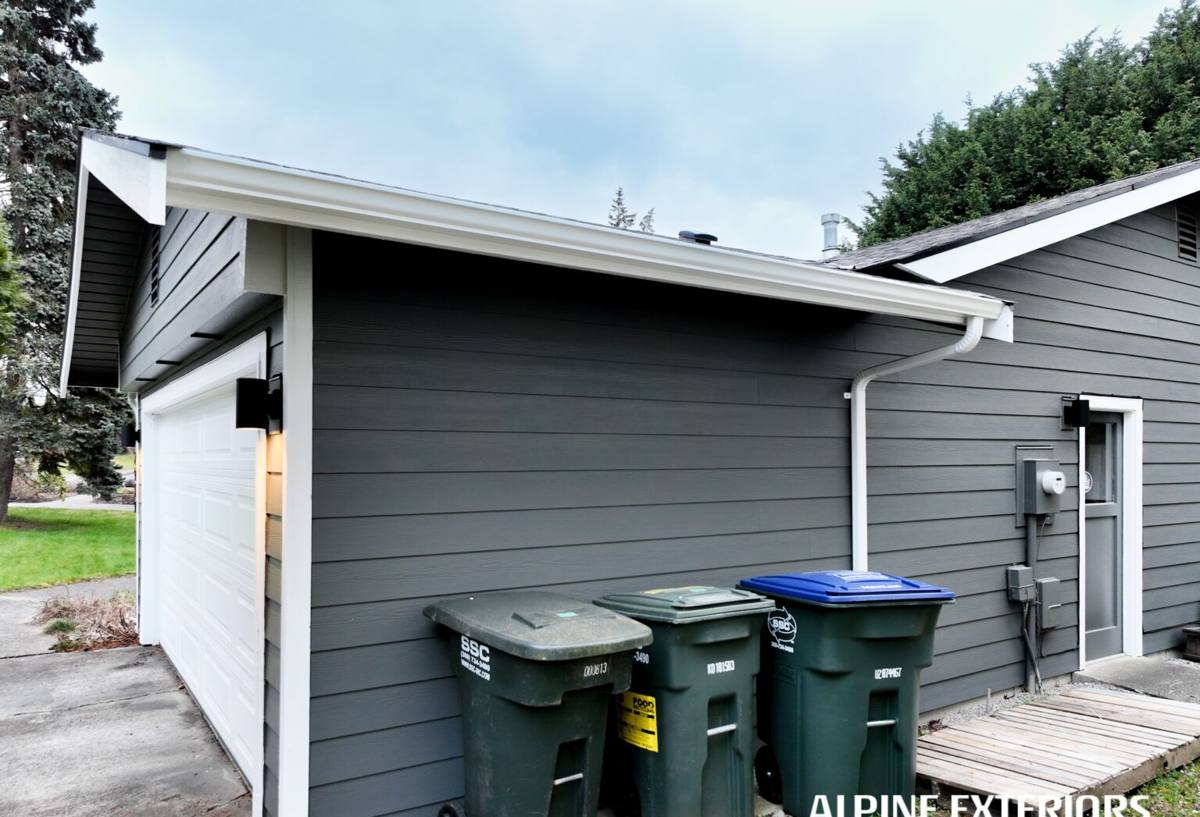
What West Beach's Exposure Does to Siding
Salt Air, Constantly
Homes with an open water view on West Beach sit closer to salt-laden marine air than almost anywhere else on Orcas Island. That air doesn't just affect the waterfront row — it carries inland across the whole area. Over time it accelerates corrosion on fasteners, flashing, and any lower-grade trim hardware, and it works against field-applied paint and stain finishes faster than most homeowners expect going in.
Driving Rain Off the Water
Storms moving in off the water hit West Beach's west-facing homes with rain that's driven sideways, not falling straight down. That wind-driven rain gets pushed into butt joints, around window and door trim, and into any seam where the siding system isn't detailed correctly. It's the reason siding that's rated fine on a spec sheet can still fail early here — the material itself often isn't the problem, the installation detail around it is.
A Moss Season That Runs Most of the Year
Not every wall on a West Beach property faces the water. Plenty of homes here sit on wooded lots or have north- and east-facing walls shaded by fir and madrona, and those elevations stay damp long after a storm passes. Mild temperatures and near-constant moisture add up to a moss and mildew season that can run close to year-round on shaded siding, and any material that's even slightly porous becomes a surface moss can take hold on and spread across.
Temperature Swings and Freeze-Thaw
Winters here aren't extreme, but they're not mild enough to ignore either. Siding that absorbs moisture and then goes through repeated freeze-thaw cycling is under real stress — it's a slower failure mode than storm damage, but it's just as capable of shortening a siding system's working life if the product isn't built for it.
Signs a West Beach Home Needs Siding Replacement
Some siding problems are obvious. Others build slowly enough that a homeowner doesn't clock them as a pattern until they add up. Worth a professional look if you're seeing:
- Moss or dark staining that comes back quickly after cleaning, especially on shaded or north-facing walls
- Soft or spongy siding, particularly near the bottom of walls or around window and door trim
- Visible warping, cupping, or peeling paint on wood-based or engineered wood siding
- Cracked, buckled, or missing panels after a windstorm off the water
- Rust streaking running down from fasteners or trim hardware
- Musty smells or staining on interior walls that back up to exterior siding
- Siding older than 20-25 years with no documented replacement or major repair
None of these automatically mean the whole house needs new siding. But on a west-facing property, small problems compound faster than they would somewhere more sheltered, so it's worth catching them before another wet season adds to the damage.
What a Correct Siding Replacement Actually Involves
A siding replacement is not just stripping old panels off and nailing new ones on. Done correctly, it addresses everything behind the visible surface, because on an exposed property like this, that's usually where the real problems start.
Tear-Off and Sheathing Inspection
Once the old siding comes off, we check the sheathing underneath for rot, soft spots, or water staining before anything new goes up. Covering damaged sheathing with fresh siding just hides a problem that keeps getting worse behind the wall — far cheaper to find and fix it now than to reopen the wall in a few years.
Weather Barrier and Flashing Work
Most siding failures on West Beach properties trace back to water getting behind the cladding, not through it. That means the house wrap, window flashing, and every wall penetration get real attention at this stage — it's the step that's easiest to rush and hardest to inspect once new siding is up, so we don't treat it as optional.
Installation to Manufacturer Spec
James Hardie's warranty is contingent on installation following their published specifications: correct fastener spacing and type, proper clearance above grade and rooflines, and correct field-cutting and sealing at every joint. We install to that spec as the standard, not as an add-on.
Final Walkthrough
We walk the finished project with the homeowner, cover what maintenance — if any — is actually needed going forward, and confirm the work matches what was estimated before calling it done.
Why James Hardie Fiber Cement, and Nothing Else
We install James Hardie fiber cement siding exclusively. We do not install LP SmartSide, vinyl siding, Cemplank, Allura, primed spruce, or cedar. Each of those has a place in the broader market and plenty of satisfied owners in other climates — our decision is a professional standard specific to what a west-facing Orcas Island property deals with, not a judgment on anyone who's chosen differently.
- Non-combustible core: fiber cement doesn't feed a fire the way wood-based siding can, which matters for both homeowner safety and insurance underwriting.
- Factory-applied ColorPlus finish: the color coat is baked on under controlled conditions rather than brushed on in the field, and it holds adhesion and color far longer under sustained UV and salt exposure than a field-applied finish.
- Climate-engineered HZ product line: Hardie's HZ5 formulation is built for regions with significant moisture exposure and freeze-thaw cycling — a close match for what this part of the island sees every winter.
- Dimensional stability: fiber cement doesn't swell, cup, or warp the way engineered wood can after repeated wetting cycles through a wet season.
- A strong, transferable warranty: backed by Hardie, provided the installation follows their published specifications — which is exactly why correct installation matters as much as the product choice itself.
Where Other Siding Products Fall Short on an Exposed Property Like This
| Product | Trade-off on a West Beach property |
|---|---|
| Vinyl siding | Can warp or crack under sustained UV and temperature swings; panel seams give wind-driven rain a path behind the cladding |
| LP SmartSide / engineered wood | Wood-strand core is more moisture-sensitive at cut edges and fastener points, a real liability with this level of sustained humidity and salt exposure |
| Primed spruce or cedar | Requires ongoing paint or stain maintenance to avoid rot; a heavier long-term cost than the upfront price suggests, and harder to schedule repeat visits for on an island where crews and materials move around ferry timing |
| Other fiber cement brands | May lack a climate-specific HZ-style line or the same factory-finish warranty depth as James Hardie |
What Drives Siding Replacement Cost in West Beach
Every estimate is specific to the house, but a handful of factors consistently move the number. We walk through each of these directly with the homeowner during the estimate rather than handing over a total with no explanation behind it.
| Factor | Why it matters |
|---|---|
| Square footage and number of stories | More surface area and higher wall sections both add material and labor time |
| Trim and detail complexity | Homes with extensive window trim, corner boards, or architectural detail take longer to fit and flash correctly |
| Sheathing condition once old siding is off | Rot or water damage found underneath needs to be repaired before new siding goes on, which isn't always visible at the estimate stage |
| James Hardie product line and color | Lap siding, shingle-style panels, and board-and-batten each price differently, and ColorPlus colors vary by line |
| Site access and logistics | Shoreline lots and wooded, hard-to-reach sites can add setup time; material and crew scheduling on Orcas Island runs around ferry availability, which we build into the timeline upfront |
Why a Crew That Already Works West Beach Matters
Working San Juan County job sites through every season shapes decisions that don't show up on a spec sheet — which wall orientations on a West Beach property stay wet longest, where extra flashing attention actually pays off, and which install-day shortcuts turn into a callback two winters later. It also means that when a warranty or maintenance question comes up years down the line, it's a call to a crew still working in the same area, not a company that quoted the job once and never came back. On an island where getting a contractor over isn't a same-day errand, that continuity is worth something real.
Before Hiring a Contractor for Siding Replacement Here
- Ask what siding product they install and why, not just the price per square foot
- Confirm they check sheathing condition before closing the wall back up
- Ask how they handle weather barrier and flashing detail at windows and trim
- Confirm proper Washington licensing and insurance
- Ask how ferry logistics factor into their project timeline
- Get a clear, itemized explanation of the estimate, not just a lump-sum number
If your West Beach home needs new siding, or you'd like an honest assessment of what's actually going on behind the current siding, we're glad to come take a look. Reach out using the form below for a free, no-pressure estimate.