 Orcas Island Siding
 West Sound sits on the sheltered western shore of Orcas Island, and "sheltered" is a relative term out here — homes along this stretch still take a steady beating from salt-laden marine air, wind-driven rain off the water, and a moss season that can run most of the year on shaded, north-facing walls. When siding starts to fail on a West Sound home, it's rarely one dramatic event. It's years of that exposure working into joints, corners, and finish coats until a homeowner notices soft spots, streaking, or paint that won't hold anymore. This page is about what a correct siding replacement looks like for a home in this specific part of Orcas Island, not a generic overview of siding in general.
Why West Sound's Climate Is Hard on Siding
West Sound faces open water, and that matters more for siding than most homeowners realize until they're the ones dealing with it. Salt air corrodes exposed fasteners and trim and breaks down paint and factory finishes faster than an inland site ever would. Storms rolling in off the water don't fall straight down — they drive rain sideways into west- and south-facing walls, forcing moisture into butt joints, corner boards, and any gap in the caulking that a finish is supposed to be sealing. And because a lot of West Sound properties sit under fir canopy or in shaded coves, walls stay damp long after a storm clears, which is exactly the condition moss needs to take hold and spread across a wall.
None of that means siding is doomed here. It means the material, the finish, and the installation details all have to be matched to what this specific shoreline actually does to a house, year after year, rather than to a generic Pacific Northwest average.
How the Damage Actually Shows Up
Siding failure on a West Sound home is usually gradual and localized before it's obvious. Watch for these signs that replacement, not another round of patching, is the right call:
- Soft or spongy spots when you press on a wall, especially near grade, decks, or roof lines
- Paint that's peeling, bubbling, or won't hold a fresh coat for more than a season or two
- Persistent moss or dark streaking on shaded or north-facing walls that keeps coming back after cleaning
- Visible cupping, warping, or cracked boards, particularly on the sides that take the most wind-driven rain
- Gaps opening at butt joints, corners, or trim where caulk has cracked and pulled away
- Rust streaks below fastener heads, a sign the fasteners themselves are corroding in the salt air
- Rising energy bills or noticeably drafty rooms, which can point to a failing weather barrier behind the siding
What a Correct Siding Replacement Involves
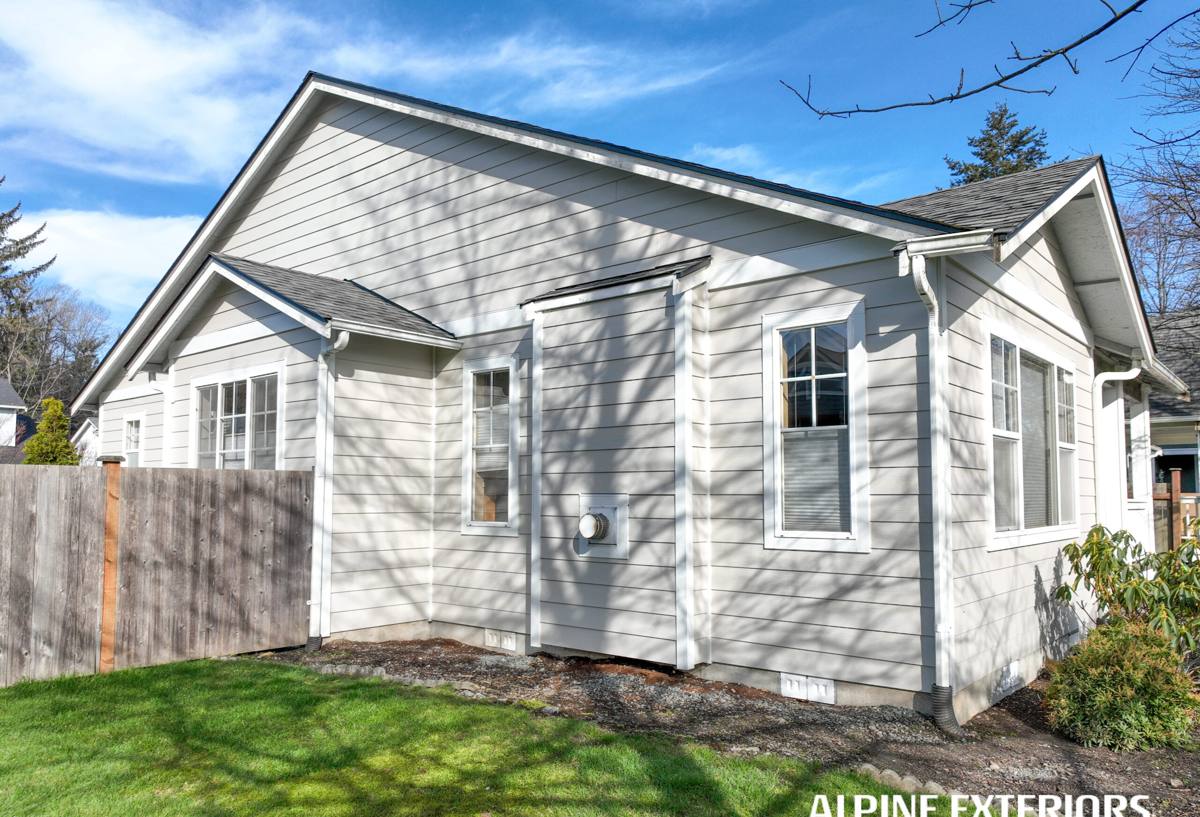
Pulling old siding off and nailing up new boards isn't a replacement — it's a reskin, and it carries the same problems forward if the wall behind the siding was never addressed. A proper siding replacement on a West Sound home means treating the whole wall assembly as the job, not just the visible surface.
Tear-Off and Inspection
Once the old siding comes off, the sheathing and framing underneath get inspected for rot, soft spots, and hidden moisture damage — which, given how long driving rain and shaded dampness can work on a wall before it shows on the surface, is common to find in spots a homeowner never suspected. Any compromised sheathing or framing gets repaired or replaced before anything new goes back up. Skipping this step is the single most common reason a siding job looks fine for a year or two and then fails from the inside out.
Weather-Resistive Barrier and Flashing
A correctly installed weather-resistive barrier goes over the sheathing, lapped and taped to shed water down and out rather than trapping it against the wall. Flashing gets installed at every window, door, and roof-to-wall intersection — these transitions are where wind-driven rain finds its way in on an exposed shoreline like West Sound, and they're the details that separate a wall that stays dry for decades from one that starts rotting behind the siding within a few years.
Fastening and Clearance
Fasteners rated for salt-air, marine exposure go in at the manufacturer's specified spacing — the wrong fastener corrodes and streaks the siding, and loose or overdriven fasteners create gaps that let moisture behind the board. Proper clearance gets maintained between the bottom of the siding and grade, decks, and roof lines, since splash-back and reduced clearance are among the first places moisture damage shows up on any coastal home.
Finish and Final Details
Caulking, trim, and touch-up finishing get completed to the manufacturer's spec, and any factory-finished product gets handled and cut in a way that preserves that finish rather than exposing raw edges to the weather. This is also where a crew's attention to detail either shows or doesn't — a rushed finish stage is where small gaps and thin caulk lines turn into the maintenance headaches homeowners deal with a few years down the road.
The Material We Install, and Why
This company installs James Hardie fiber cement siding exclusively. We don't install vinyl, LP SmartSide, primed wood, or cedar, and on a shoreline like West Sound that's exposed to salt air, driving rain, and a long moss season, that's not a brand preference — it's a decision built around what actually holds up here without asking a homeowner to carry a heavy maintenance schedule.
Fiber cement has no organic core for salt air or moisture to work into over time, which matters directly on a site that stays damp longer than most inland locations. Hardie's ColorPlus factory finish is baked on under controlled conditions and carries its own warranty against fading and cracking, which holds up far better against sustained salt exposure than a field-applied paint job does. Hardie also builds HZ product lines engineered specifically for regions dealing with moisture and coastal exposure, rather than one generic formulation sold everywhere in the country. It's non-combustible too, which is worth factoring in on a wooded island where wildfire risk is a real seasonal concern alongside the marine exposure.
Material Comparison for a West Sound Home
| Factor | Vinyl Siding | Wood / Cedar | James Hardie Fiber Cement |
|---|---|---|---|
| Core material | PVC plastic | Solid or engineered wood — organic | Cement, sand, and cellulose fiber — non-organic |
| Combustibility | Combustible, can warp near heat | Combustible | Non-combustible |
| Moisture behavior in salt air | Doesn't absorb water but seams and fasteners are vulnerable points | Vulnerable at cuts, joints, and grade without diligent upkeep | Does not swell, rot, or delaminate from moisture exposure |
| Finish durability | Color molded in but can fade and become brittle over time | Field-applied stain or paint, requires recoating on a set schedule | Factory-baked ColorPlus finish, far less field maintenance |
| Moss and organic growth | Non-organic surface but seams trap debris and moisture | Organic substrate readily supports growth if maintenance lapses | Inorganic substrate doesn't feed moss the way wood does |
| Warranty structure | Varies widely by manufacturer and grade | Typically limited or tied to finish maintenance compliance | Strong transferable warranty backed by HZ engineering for the region |
Cost comparisons that stop at the initial installation price miss the point for a West Sound home. What matters over a 15- to 20-year window is how much recoating, caulk renewal, and board or panel repair a product needs to keep performing in this exposure, and how much of that maintenance ends up deferred simply because getting a crew back out to an island property takes more planning than a mainland job would.
Our Process for a West Sound Siding Replacement
- On-site assessment — we walk the home, check sun and wind exposure on each elevation, and look for the early signs of moisture damage described above.
- Scope and estimate — you get a clear, written scope covering tear-off, any sheathing repair we anticipate, the Hardie product line and color, and a realistic timeline.
- Material staging — because getting materials to Orcas Island means planning around ferry schedules, we order and stage everything ahead of the start date so the job isn't held up mid-project waiting on a delivery.
- Tear-off and wall inspection — old siding comes off, and we inspect and address whatever the wall behind it actually needs before anything new goes up.
- Weather barrier, flashing, and installation — barrier, flashing, fastening, and clearance are all installed to spec, not shortcuts taken to save a day of labor.
- Final walkthrough — we walk the finished job with you, point out anything worth knowing about upkeep, and make sure you're satisfied before we consider the job done.
Why Local Experience on Orcas Island Matters
A siding replacement on West Sound isn't logistically the same job as the same replacement on the mainland, and a crew that hasn't worked San Juan County regularly tends to find that out the hard way, mid-project. Materials, dumpsters, and equipment all have to move by ferry, which means a schedule has to build in real transit time rather than assuming next-day delivery. Weather windows for tear-off and dry-in are tighter here than people expect, since West Sound's exposure to wind and rain off the water can close a work window faster than a sheltered inland site would. And when a callback is needed after the job, a crew that already works this island can get back out without the same lead time a one-off mainland contractor would need. Hiring a crew that already knows West Sound's specific conditions isn't a convenience — it's what keeps a project on schedule and keeps the finished siding performing the way it's supposed to.
Maintenance After Installation
A correctly installed Hardie exterior asks very little of a homeowner compared to wood or a poorly detailed vinyl job, but "very little" isn't "nothing." A periodic rinse to clear salt residue and organic debris off the surface, an annual look at caulk lines and trim, and prompt attention if a section ever takes physical damage will keep the siding performing for decades. Compared to the recoating schedule a wood exterior demands in this same climate, it's a fraction of the ongoing effort — which matters even more on an island where scheduling any maintenance visit takes more than a phone call.
Cost Factors for a West Sound Project
| Factor | Why it affects your project |
|---|---|
| Home size and wall complexity | More elevations, corners, and cutouts mean more material and labor time |
| Condition of the existing wall | Sheathing or framing repair needed behind old siding adds scope beyond the visible surface |
| Hardie product line and profile | HZ5 vs. HZ10 engineering and lap, shingle, or panel profiles carry different material costs |
| Access and site conditions | Driveway access, slope, and staging space affect labor time and equipment needs |
| Ferry and delivery logistics | Material staging and crew transit are built into an honest island timeline and quote |
| Trim and detail work | Corner boards, window and door trim, and factory-finish color all factor into the final number |
If your West Sound home is showing any of the signs above, or you're simply planning ahead before a small problem becomes a bigger one, we're glad to take a look. Reach out for a free, no-pressure estimate — we'll walk the property, give you a straight assessment of what your siding actually needs, and explain exactly what a correct replacement would involve for your home.