 Orcas Island Siding
 Why Eastsound Decks Wear Differently Than Decks Inland
A deck in Eastsound doesn't fail the same way a deck fails in a dry inland climate. Homes here sit close enough to the water that salt air is a constant, low-grade stress on every exposed fastener and finish. Add San Juan County's long stretch of driving rain each fall and winter, plus a moss season that can run from October well into spring, and you get a specific pattern of wear: rot that starts from the top down instead of the bottom up, fastener corrosion that shows up years before the wood itself is compromised, and slick, moss-covered boards that are as much a safety issue as a cosmetic one.
We work on decks across Orcas Island regularly, and Eastsound decks show a fairly consistent set of problems. Understanding why helps you make better decisions about repair versus replacement, and it's the first thing we walk through with homeowners before we ever pick up a tool.
Salt Air's Slow Damage
Salt-laden air accelerates corrosion in any exposed metal — nails, screws, joist hangers, structural brackets. On a lot of older decks, the fasteners were never rated for coastal exposure to begin with. You'll see rust streaking down the face of boards, or a screw head that snaps off the moment you try to back it out because it's corroded from the inside. That corrosion doesn't stay contained to the metal — it weakens the wood fibers immediately around the fastener, which is often where rot gets its first foothold.
Driving Rain and Moisture Cycling
It's not just total rainfall that matters, it's the pattern. Wind-driven rain gets pushed sideways into ledger boards, stair stringers, and the underside of rail posts — areas that a lot of deck designs don't shed water from well. Then the wood dries out between storms, swells again with the next one, and that repeated wet-dry cycling is what splits boards, loosens joints, and pulls fasteners.
Moss Season
Moss needs shade, moisture, and time — Orcas Island decks, especially ones under tree cover or on the north side of a house, offer all three for most of the year. Moss holds moisture against the deck surface long after the rain has stopped, which speeds up decay in the boards underneath it. It also makes stairs and walking surfaces genuinely slippery, which is a liability issue as much as a maintenance one.
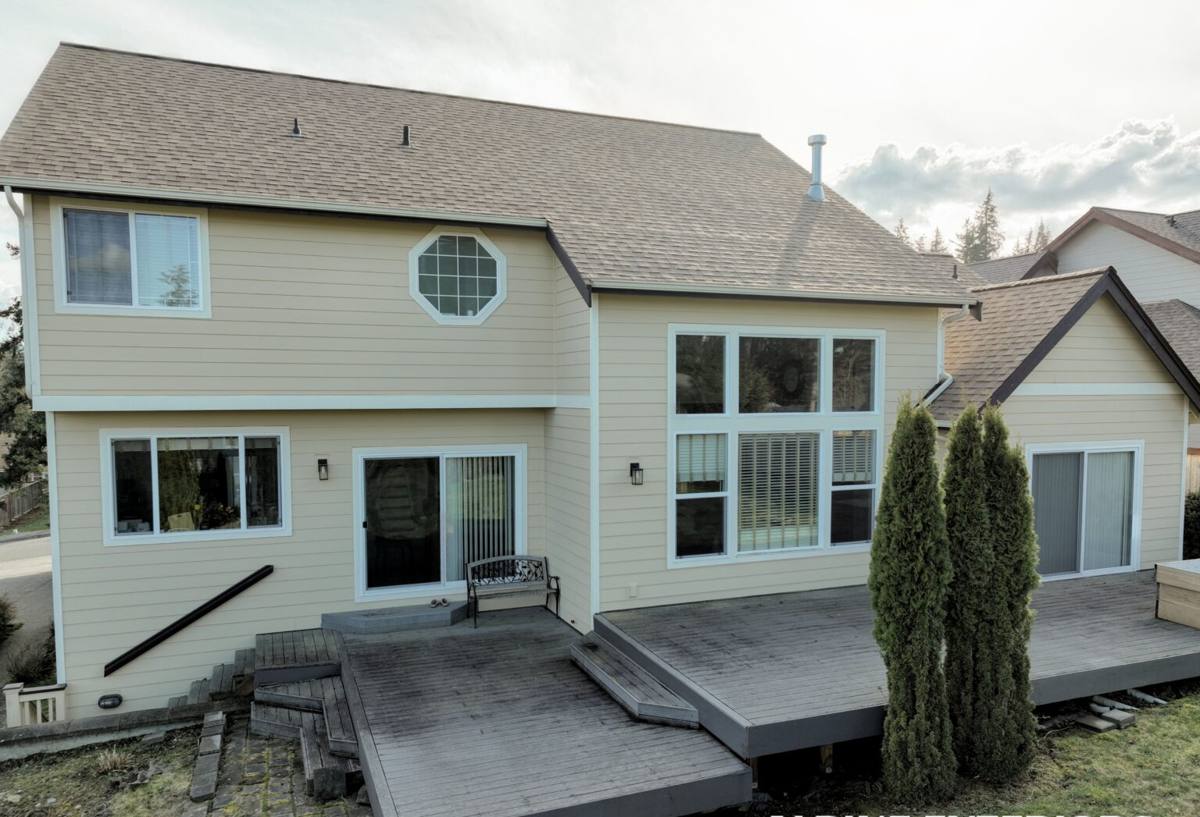
Signs Your Deck Needs Repair — and Signs It Needs More
Not every deck problem calls for a full rebuild, but not every problem is fixable with a few new boards either. Here's how we sort it out on a typical visit.
- Soft or spongy decking boards, especially near the house or along the perimeter
- Rust streaking below screws or nail heads
- A ledger board that's pulling away from the house, even slightly
- Wobbly or loose railings — this is a safety issue, not a cosmetic one
- Stairs that flex or feel unstable underfoot
- Persistent moss or algae that regrows within weeks of cleaning
- Gaps opening up between boards, or boards cupping/warping
- Visible daylight or gaps where joists meet beams or posts meet footings
Surface-level issues — a handful of rotted boards, surface rust on hardware, moss buildup — are almost always repairable. The deciding factor for whether we recommend repair versus rebuild is what's happening in the framing: the ledger connection, the joists, the posts and footings. If those are sound, repairing the visible layer is usually the right call and the more cost-effective one.
What a Correct Deck Repair Actually Involves
A repair that only replaces what's visible and ignores the cause tends to fail again within a couple of seasons. A repair done right addresses both.
Structural Assessment First
Before any board comes off, we check the ledger attachment (this is the single most common source of catastrophic deck failure nationwide, not just here), the condition of joists and beams, post-to-footing connections, and whether the original construction meets current structural expectations. Decks built years ago, especially owner-built or older contractor-built decks, sometimes have undersized framing or missing hardware that wasn't required — or wasn't caught — at the time.
Fastener and Hardware Replacement
Given the corrosion issues coastal air causes, we don't just patch around failing hardware — we replace it with fasteners and structural connectors rated for coastal, high-moisture exposure. This is one of the most overlooked parts of deck repair. Reusing standard hardware in a repair on a deck like this just resets the clock on the same corrosion problem.
Proper Water Management
A lot of deck rot traces back to water that had nowhere to go. Correct repair work includes flashing at the ledger, appropriate gapping between boards for drainage, and grading or drainage details at the base of posts so water isn't sitting against the wood. Skipping this step is why some decks need the same repair again in three or four years.
Matching or Upgrading the Decking Surface
Depending on what you're starting with, we'll either replace damaged boards to match the existing material or talk through an upgrade if the existing product isn't holding up well in this climate. We'll walk through the honest trade-offs of each option below.
Decking Material Comparison for This Climate
| Material | How It Holds Up Here | Repair Considerations |
|---|---|---|
| Pressure-treated lumber | Good rot resistance if properly sealed and maintained; needs regular re-staining/sealing to handle driving rain | Individual boards are easy and affordable to replace; requires ongoing maintenance to keep performing |
| Cedar | Naturally rot- and insect-resistant, ages well visually, but softer and more prone to surface wear from moss and moisture cycling | Easy to spot-repair and blend new boards with old; needs periodic sealing near the coast |
| Composite decking | Very good moisture resistance and low maintenance; performance varies by brand and product line | Repairs must match the exact product — mismatched composite boards are visually obvious and some older product lines are no longer manufactured |
| Older/unrated hardware & fasteners | Poor — corrodes faster in salt air regardless of the decking material | We treat hardware upgrades as part of nearly every repair scope, not an optional add-on |
Our standard is to use fasteners and structural hardware rated for coastal exposure on every repair, regardless of what decking material is on top. We've found that skipping this step — even to save a little on a repair — usually means redoing the same work sooner than it should be needed.
Our Deck Repair Process
- On-site assessment. We inspect the decking, framing, ledger connection, posts, footings, and railings, and identify moisture sources — including moss coverage and drainage patterns specific to your lot.
- Honest scope and estimate. We tell you plainly what's cosmetic, what's structural, and what your real options are — repair, partial rebuild, or full replacement — with no upselling into work the deck doesn't need.
- Repair or replacement of damaged framing and decking. Rotted joists, compromised ledger connections, and failing boards get addressed at the structural level, not just patched over.
- Hardware and fastener upgrade. Coastal-rated connectors and fasteners go in on the repaired sections.
- Water management corrections. Flashing, board spacing, and drainage details are corrected as part of the repair, not treated as extra.
- Final walkthrough. We go over what was done, what to expect going forward, and simple maintenance steps that matter most for your deck's exposure and location.
Repair vs. Full Replacement: What Actually Drives the Decision
| Factor | Favors Repair | Favors Replacement |
|---|---|---|
| Framing condition | Joists, beams, and ledger are structurally sound | Widespread rot in framing members or a failing ledger connection |
| Extent of damage | Isolated boards, localized rot, or hardware corrosion | Damage spread across most of the deck surface or structure |
| Age of the deck | Newer deck with a clear, isolated cause of damage | Older deck already near the end of its expected service life |
| Material availability | Matching decking material is still available | Discontinued composite product with no visual match possible |
| Code and safety | Existing structure meets current safety expectations | Original construction has undersized or missing structural elements |
We'd rather tell you honestly that a repair is the right call and save you money than push a bigger project you don't need — and just as important, we'll tell you plainly if a repair is going to be a short-term fix on a deck that's structurally past its useful life.
Keeping a Repaired Deck in Good Shape Year-Round
Once repairs are done, a little seasonal attention goes a long way in this climate, particularly with moss season and salt air working against you year-round.
- Sweep debris and standing moisture off the deck surface regularly, especially under tree cover
- Clean moss and algae before it establishes — the earlier, the easier
- Check railings and stair connections for looseness once or twice a year
- Re-seal or re-stain wood decking on the manufacturer's recommended schedule, not just when it looks faded
- Keep gutters and downspouts clear so runoff isn't draining directly onto the deck or ledger area
- Rinse salt residue off hardware and railings periodically if your deck faces open water or exposed wind
- Watch for early rust bleed on fasteners — it's cheaper to address than the rot that follows
Why It Matters That We Already Work in Eastsound
Deck repair isn't a one-size-fits-all trade, and Orcas Island isn't a one-size-fits-all climate. A crew that mostly works in drier, inland conditions may not default to coastal-rated hardware, may not think about moss-driven moisture retention, and may not recognize the early signs of salt-air corrosion until it's already done structural damage. We're on Eastsound decks regularly enough to know what actually fails here, not just what fails in a general how-to guide.
There's also the practical side: working locally means we're not adding a long ferry or drive commute into every estimate and repair visit, and we're available to check on how a repair is holding up after a wet winter if you want a second look.
Get an Honest Look at Your Deck
If your Eastsound deck has soft boards, rusting hardware, persistent moss, or just doesn't feel as solid as it used to, it's worth having someone look at it before another wet season adds to the damage. Fill out the form below for a free, no-pressure estimate — we'll give you a straight answer on what your deck actually needs.