 Orcas Island Siding
 Lopez Village sits close enough to the water that every window on a house is doing double duty: keeping heat in during the wet months and standing up to salt-laden air the rest of the year. On Orcas Island and across San Juan County, window failures rarely show up as a single dramatic problem. They show up as a slow creep of fogged glass, soft trim, and utility bills that don't match how well-built the house otherwise is. If you're weighing a window upgrade in Lopez Village, it helps to understand what's actually happening to windows out here and what a correct installation looks like before you start comparing bids.
Why Lopez Village Windows Wear Differently
Windows in Lopez Village face a combination of conditions that inland Washington homes simply don't deal with. Salt air carries fine mineral particulate that settles on metal hardware, aluminum cladding, and exposed fasteners, slowly working into pits and seams. Driving rain off the water pushes water sideways into wall assemblies rather than letting it run straight down, which means flashing details and sill pitch matter more here than in a sheltered inland lot. And the long moss season — realistically running from fall through late spring in this part of San Juan County — keeps humidity elevated around window openings for months at a time, which is exactly the environment that lets wood rot and seal failure take hold.
None of this means windows on Orcas Island are doomed to fail early. It means the installation details that get glossed over in milder climates — flashing sequencing, sill pan drainage, sealant selection — are the details that determine whether a window lasts 10 years or 30 in a place like Lopez Village.
What We See Most Often on Service Calls
- Fogged or hazy double-pane glass, meaning the seal has failed and the argon or air gap has been compromised
- Soft or spongy wood at the sill and lower corners, often hidden until trim is removed
- Hardware that's stiff, corroded, or won't latch tight anymore due to salt exposure
- Visible moss or algae staining on sills and lower sashes from prolonged damp exposure
- Drafts that weren't there a few years ago, usually from compressed or UV-degraded weatherstripping
- Condensation on the interior glass in winter, a sign the window's thermal performance no longer matches the home's heating load
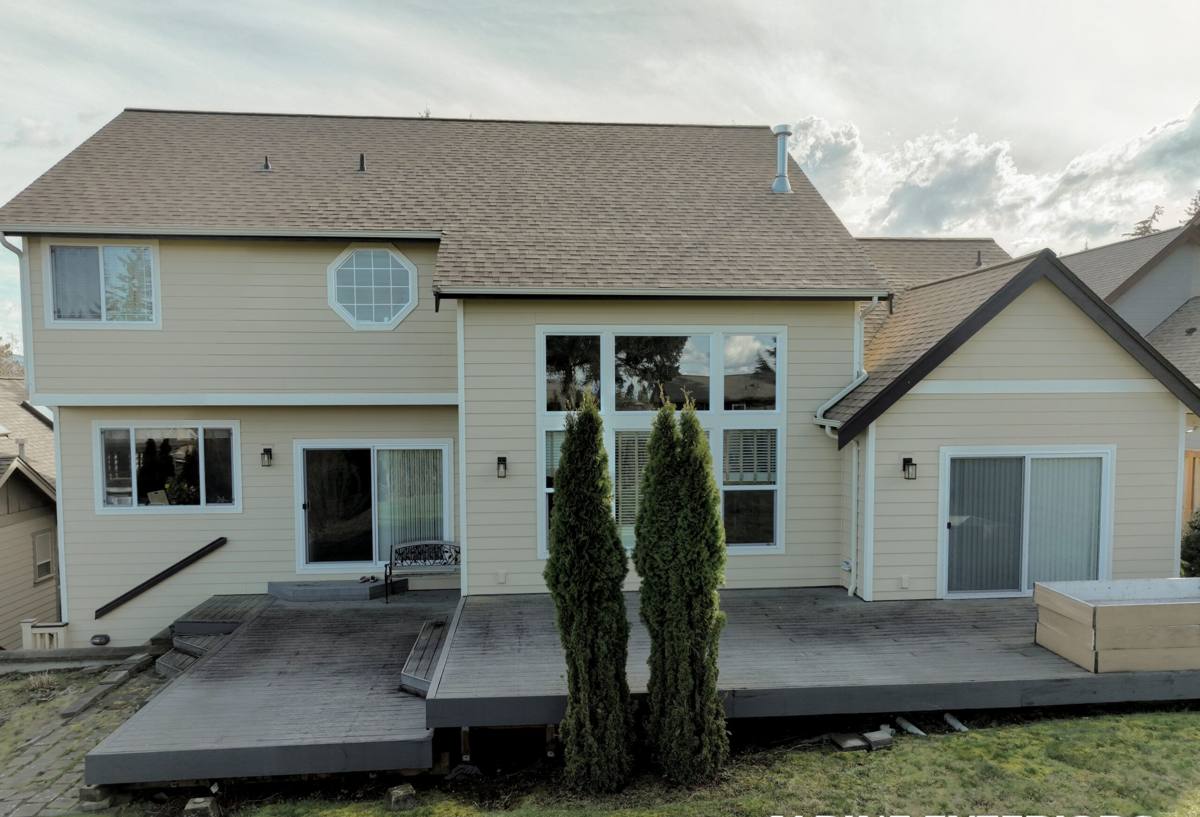
What "Energy-Efficient" Actually Means for This Climate
Energy-efficient windows are marketed with a lot of numbers — U-factor, SHGC, VT — and most of that marketing is written for a national audience, not for a marine climate like the San Juan Islands. For Lopez Village homes, the two numbers that matter most are U-factor (how well the window resists heat loss) and air infiltration rating (how well it resists wind-driven drafts). Solar heat gain coefficient matters less here than it would in a hot, sunny climate, since Orcas Island doesn't have the cooling-load problem that SHGC is mainly designed to solve.
A genuinely efficient window for this area combines a low U-factor with a frame and seal system that's been tested for air infiltration under wind pressure, not just static lab conditions. That's a different spec sheet than what gets pushed in big-box retail windows, which are usually optimized for cost and general-climate performance rather than coastal wind and rain exposure.
Frame Material Trade-Offs for Coastal Homes
| Frame Material | Salt Air Behavior | Maintenance | Our Take |
|---|---|---|---|
| Vinyl | Doesn't corrode; UV can chalk lower-grade vinyl over time | Low — occasional cleaning | Good value, verify UV-stabilized formulation for coastal use |
| Fiberglass | Excellent — dimensionally stable, resists salt pitting | Low | Strong choice for exposed Lopez Village sites, higher upfront cost |
| Aluminum-clad wood | Cladding protects wood but hardware and seams need inspection | Moderate | Works well if flashing and cladding seams are detailed correctly |
| Bare wood | Handsome but most vulnerable to moss-season moisture | High — regular refinishing | We'll install it if a homeowner wants the look, but we're upfront about the upkeep |
Sill Pans and Flashing: The Part That Actually Prevents Rot
Most window failures we open up in this area aren't glass failures — they're water management failures. Wind-driven rain finds its way behind the trim and sits at the sill unless there's a proper sloped sill pan and integrated flashing directing it back out. This is the single most important — and most commonly skipped — part of a correct window installation on Orcas Island.
A correct install sequences flashing so that each layer sheds water onto the layer below it, the way shingles do, with the sill pan sloped outward and the window's nailing flange properly lapped with the house wrap or weather-resistive barrier. Skip this sequencing, and even a premium window will eventually let water into the wall cavity — you just won't see it until the trim or sheathing starts to soften.
Our Installation Process in Lopez Village
- On-site assessment: We inspect existing windows, sills, and surrounding wall condition, and check for hidden moisture or rot before quoting anything.
- Product selection: We walk through frame material and glass package options based on the home's exposure — a water-facing wall gets a different recommendation than a sheltered interior courtyard window.
- Removal and inspection: Once the old window is out, we inspect the rough opening for rot or soft framing before anything new goes in — this is often where problems get found and fixed for good.
- Sill pan and flashing installation: We install a sloped, drained sill pan and properly sequenced flashing tied into the existing weather barrier.
- Window set and shimming: The window is leveled, plumbed, and shimmed so it operates smoothly and seals evenly — a racked frame is one of the fastest ways to get premature seal failure.
- Insulation and air sealing: Gaps are filled with appropriate low-expansion foam or backer rod and sealant, not just packed with fiberglass that does nothing for air infiltration.
- Exterior and interior trim: Trim is reinstalled or replaced with attention to caulking joints that will actually be exposed to driving rain.
- Final check: We test operation, latching, and look for daylight or draft gaps before calling the job done.
Why Local Experience in Lopez Village Matters
A crew that installs windows all over the mainland, then does the occasional ferry job on Orcas Island, is working outside their normal rhythm — logistics, material lead times, and weather windows all behave differently out here. A crew that regularly works Lopez Village and the surrounding parts of San Juan County already knows how to plan around ferry schedules, how long materials realistically take to arrive, and which parts of the island catch the worst of the wind-driven rain versus which are more sheltered.
That local knowledge shows up in small but real ways: knowing to build in extra buffer for weather delays, knowing which flashing details hold up on a water-facing lot versus a tree-sheltered one, and not treating every Lopez Village home like a generic mainland installation.
Signs It's Time to Replace Rather Than Repair
- Fogging between panes on more than one or two windows — this means seal failure is systemic, not isolated
- Soft or spongy wood at the sill or jamb that gives when pressed
- Windows that won't stay latched or have visibly warped out of square
- Noticeable drafts even after weatherstripping has been replaced
- Interior condensation or mold growth around the frame every winter
- Single-pane or early-generation double-pane units original to an older Lopez Village home
If only one or two windows show problems and the surrounding wall is dry and solid, a targeted repair or reseal may be all that's needed. We'll always tell you honestly when repair is the smarter call rather than pushing a full replacement.
Planning Around Ferry Logistics and Lead Times
Because Orcas Island depends on ferry service, window orders need more lead time than a mainland job would, and installation scheduling has to account for ferry availability for both crew and materials. We build that reality into our project timelines from the start rather than surprising homeowners with delays partway through. If you're planning a window project around a specific season — getting sealed up before the wet months set in, for example — it's worth starting the conversation early so material lead times don't push the work past the window you were hoping for.
Get a Straight Answer for Your Lopez Village Home
Every home in Lopez Village faces the weather a little differently depending on how exposed it is to wind and water. We'd rather walk your windows in person and give you an honest read on what needs replacing, what can be repaired, and what it'll cost, than guess from a distance. Fill out the form below for a free, no-pressure estimate — no obligation, just a straight assessment from a crew that works this island regularly.