 Orcas Island Siding
 Roof Repair Built for the Obstruction Pass Shoreline
The Obstruction Pass area sits along Orcas Island's southeastern shoreline, where the water is close enough that salt air reaches the roof deck almost every day of the year. Add in driving rain off the Sound, heavy tree cover, and a moss season that can run eight or nine months out of twelve, and you get a roofing environment that's noticeably harder on materials than most of the mainland ever sees. Roof repair out here isn't just patch-and-go work — it's diagnosing what the marine climate has actually done to the roof and fixing it in a way that holds up to the next round of weather, not just the next inspection.
We work roofs across San Juan County, and homes near Obstruction Pass tend to show a consistent pattern of wear: moss and lichen colonizing north-facing slopes and shaded valleys, fastener corrosion from salt-laden air, and water intrusion at flashings and penetrations that were never quite sealed for this level of driving rain. Understanding that pattern before you start pulling shingles is what separates a repair that lasts from one that reopens in two winters.
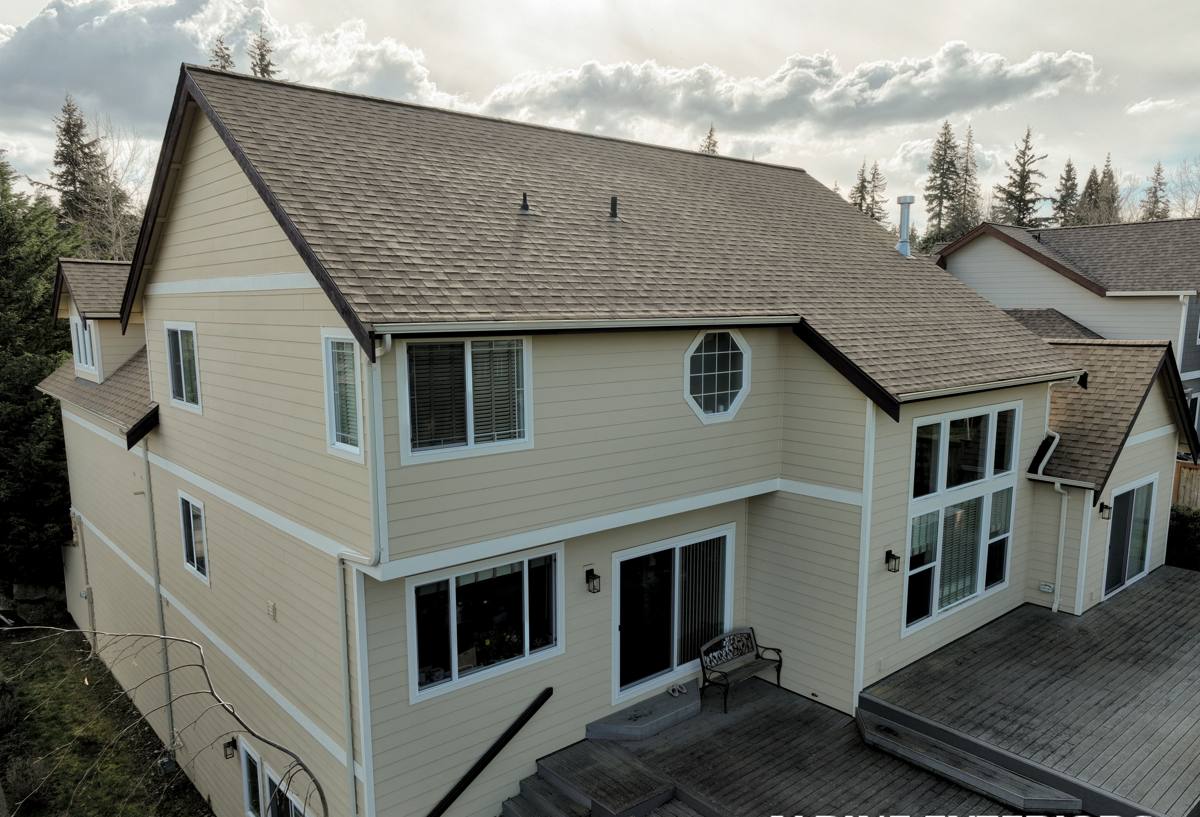
What Orcas Island's Climate Actually Does to a Roof
Salt Air and Corrosion
Metal fasteners, flashing, and drip edge take the brunt of salt exposure. Galvanized nails and low-grade flashing corrode faster near the water, and once a fastener starts rusting it loses its grip and its seal at the same time — that's a leak path even before you see a visible hole. On a repair, we replace corroded fasteners and flashing with materials rated for coastal exposure rather than just re-driving what's already failing.
Driving Rain
Wind off the water doesn't just drop rain straight down — it drives it sideways and up under laps, shingle edges, and flashing that would be perfectly fine in a calmer climate. Roofs here need underlayment, flashing laps, and sealant details that assume water will be pushed uphill at some point during a winter storm. A repair that only addresses the visible gap and ignores the wind-driven path behind it tends to fail again at the next big blow.
Moss, Lichen, and Organic Growth
Shade, moisture, and mild temperatures make Orcas Island close to ideal moss habitat, and moss does real mechanical damage — it holds moisture against the roofing material, lifts shingle edges, and works its way under laps and around fasteners over a season or two. Left unmanaged, moss growth is one of the most common reasons we get called out for a repair that turns out to be several smaller repairs once we're actually up there.
Signs a Roof Near Obstruction Pass Needs Repair Now
- Moss or thick lichen buildup, especially on north-facing or shaded slopes
- Granules collecting in gutters or at downspout outlets
- Curling, cupping, or lifted shingle edges after a windy stretch
- Rust streaking below metal flashing, vents, or fasteners
- Water stains on interior ceilings, especially near chimneys, skylights, or valleys
- Soft or spongy spots underfoot in an attic inspection
- Daylight visible through the roof deck from inside the attic
- Flashing that's visibly separated, bent, or missing sealant at joints
Any one of these on its own might just mean routine maintenance. Two or three together usually means active water intrusion somewhere in the system, and it's worth having it looked at before the next storm cycle rather than after.
What a Correct Repair Actually Involves
A roof repair that's done right starts with figuring out where water is actually getting in, which is often not directly above the stain or leak you can see from inside. Water can travel along rafters or sheathing for several feet before it drips somewhere visible, so a rushed repair that just patches the spot below the stain frequently misses the real entry point.
Our repair standard includes:
- Tracing the leak path from the interior symptom back to the actual roof-level failure
- Inspecting flashing at every penetration nearby — chimneys, vents, skylights, valleys — not just the obvious suspect
- Checking underlayment condition in the surrounding area, not just at the failure point
- Replacing corroded or failing fasteners with coastal-rated hardware
- Removing moss and organic debris from the repair area and treating it, not just covering it over
- Confirming proper shingle or panel overlap and exposure to shed wind-driven rain
- A final water test where conditions allow, so we're not guessing whether the fix worked
Our Process, Start to Finish
- Assessment. We inspect the roof from both the exterior and the attic where accessible, and we ask about when and where the problem shows up — that timing often points straight to the cause.
- Diagnosis and estimate. We explain what we found, what's actually causing it, and give a clear, honest estimate before any work starts. If it's a minor repair, we say so. If it's pointing toward a bigger issue, we say that too.
- Repair work. We address the root cause — flashing, fasteners, underlayment, or shingles — using materials suited to a marine climate, not whatever's cheapest to source.
- Cleanup and moss treatment. If moss or organic growth contributed to the failure, we clear it from the repair area and the surrounding roof so it doesn't undo the work within a season.
- Follow-up. We check our own work after the next significant rain where practical, especially on repairs made during drier months when driving rain wasn't there to test it immediately.
Repair, Partial Re-Roof, or Full Replacement?
Not every leak calls for the same scope of work. Roof age, how widespread the moss and granule loss are, and how many separate problem areas exist all factor into whether a targeted repair makes sense or whether it's time to look at replacing a section or the whole roof.
| Situation | Typical Approach | What to Expect |
|---|---|---|
| Single leak, roof otherwise sound, under 10-12 years old | Targeted repair | Localized flashing, fastener, or shingle work; smaller cost, quick turnaround |
| Multiple leak points, moderate moss, roof 12-20 years old | Repair now, plan replacement timeline | Repairs address immediate water intrusion; we'll flag remaining roof life honestly |
| Widespread granule loss, heavy moss, recurring leaks | Partial or full replacement | Repairs at this stage often become a cycle of chasing new leaks; replacement is usually the better long-term value |
| Roof over 20-25 years old with any active leak | Full replacement evaluation | Underlayment and decking are likely near end of life regardless of the surface material's condition |
We'll always tell you honestly which category a roof falls into. There's no benefit to us in talking a homeowner into a full replacement when a repair will genuinely hold, and no benefit in patching something that's going to keep leaking until the underlying roof is dealt with.
Materials We Use for Repairs Out Here
For repair work near the water, we favor corrosion-resistant fasteners and flashing, high-quality self-adhering underlayment at vulnerable areas like valleys and eaves, and sealants rated to stay flexible through Orcas Island's temperature swings and near-constant moisture. When a repair involves replacing shingles or panels, we match existing materials where the roof is otherwise in good shape, and we'll tell you plainly if a section is old enough that a perfect match isn't realistic — patchwork mismatches are cosmetic, not structural, but we'd rather set that expectation up front than surprise you later.
We don't push proprietary or unusually complex systems for straightforward repair work. The goal on a repair is a durable, properly integrated fix using materials with a solid track record in coastal Pacific Northwest conditions — not the newest product on the market with an unproven history against this kind of weather.
Why a Crew That Already Works Obstruction Pass Matters
Orcas Island is ferry-dependent, and San Juan County's permitting and building requirements have their own quirks compared to mainland Washington. A contractor who's already scheduled around ferry sailings, already knows which roofing details actually hold up against Sound-driven rain, and already understands how fast moss regrows in this particular microclimate is going to get your repair right the first time. That matters more here than in most places, because a crew making a special trip out for a callback isn't a quick fix — it's another ferry reservation and another wait.
We also know that homes tucked into tree cover near Obstruction Pass often need moss and debris cleared from gutters and roof valleys as part of the same visit, since a clogged gutter next to a fresh repair can undo the work by backing water up under the edge. Local knowledge like that isn't something you get from a general contractor passing through — it comes from working these specific conditions season after season.
Maintenance That Extends the Life of a Repair
- Clear moss and debris from roof valleys and gutters at least once, ideally twice, a year
- Trim back overhanging branches to reduce shade and moisture retention on the roof surface
- Keep gutters and downspouts flowing freely, especially heading into fall storms
- Have flashing around chimneys, skylights, and vents checked annually — these are the first places driving rain finds a way in
- Address small issues (a lifted shingle, a hairline gap at flashing) before winter storms turn them into active leaks
A repair is only as good as the maintenance around it. Roofs near Obstruction Pass that get regular moss removal and gutter clearing consistently outlast ones that don't, regardless of how well the original repair was done.
If you're dealing with a leak, moss buildup, or storm damage on a roof near Obstruction Pass, we're happy to take a look and give you a straight assessment — no pressure, no upsell. Fill out the form below for a free estimate and we'll walk you through exactly what we find and what it would take to fix it right.