 Orcas Island Siding
 Why Olga's Climate Is Hard on Siding
Olga sits on the east side of Orcas Island, facing Buck Bay and the wider marine waters of the San Juan Islands. That location brings a specific mix of punishment for exterior siding: salt-laden air moving off the water, wind-driven rain that hits walls sideways rather than falling straight down, and a wet, shaded season that runs long by mainland standards. Add in the tree cover common to Orcas Island properties — fir, cedar, and madrona casting shade across large parts of a home's exterior for much of the year — and you get conditions that stay damp far longer after a storm than a home would in a drier, more open setting.
Siding in this environment has to do three jobs at once: shed water fast, resist the slow biological growth that comes with shade and moisture, and hold up to salt exposure without corroding fasteners or trim. Wood-based products struggle with all three. Vinyl handles moisture fine but distorts with temperature swings and doesn't stop moss and algae from taking hold on its surface. Fiber cement, installed correctly, is built for exactly this kind of coastal-forest combination — which is why it's the only siding material we install on Orcas Island, including in Olga.
What "Moss Season" Actually Does to a Home
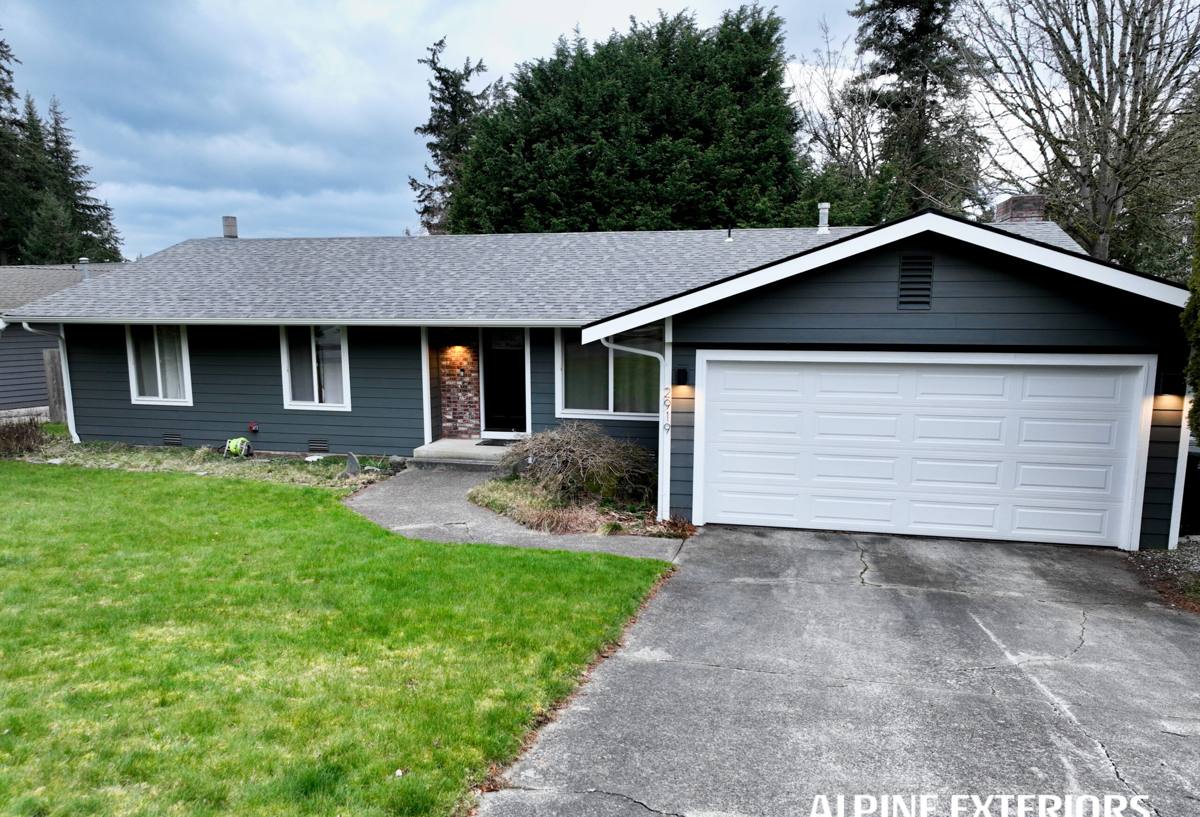
San Juan County's wet season isn't just about rainfall totals — it's about how long surfaces stay damp between storms. In shaded, low-airflow spots (north-facing walls, areas tucked behind trees, sections near ground level where splashback keeps the base of the wall wet), moss and algae get a foothold and don't let go. On absorbent siding materials, that growth isn't just cosmetic. Moss holds moisture directly against the wall surface, which accelerates rot in wood-based products and can work its way into seams and fastener points over years.
Fiber cement doesn't stop moss spores from landing on it — nothing does — but it doesn't feed the problem the way wood or wood-composite siding can. The material itself doesn't absorb and hold water, so growth stays a surface issue that washes or scrubs off rather than a moisture problem building underneath the paint or coating.
Where Olga Homes Typically See the Worst of It
- North- and east-facing walls that get the least direct sun and dry out slowest after rain
- Lower wall sections near grade, foundation plantings, or areas with poor splashback control
- Walls shaded by mature trees, especially where branches overhang and drop debris onto siding or into gutters
- Corners and trim intersections where wind-driven rain concentrates and lingers
Salt Air and Fastener Corrosion
Being close to the water means airborne salt settles on exterior surfaces continuously, not just during storms. Over years, that accelerates corrosion on anything metal — nail heads, trim flashing, hose bibs, light fixtures. Corroding fasteners are a real problem on siding jobs because a rusted nail head bleeds a stain down the face of the siding, and a fastener that's lost integrity can eventually let a board work loose.
This is one of the reasons fastener selection matters as much as the siding material itself. On a proper fiber cement install, we use fasteners rated for the exposure — corrosion-resistant, sized and spaced to the manufacturer's specification — rather than whatever's cheapest or fastest to run through a nail gun. It's a detail that doesn't show up in a walk-around inspection the week the job finishes, but it's the difference between siding that still looks clean in fifteen years and siding that's streaked with rust stains in five.
Why We Install Only James Hardie Fiber Cement
James Hardie's HardiePlank and related lines are engineered specifically for the water-and-moisture behavior that defines Pacific Northwest coastal climates. The material is a fiber cement composite — cellulose fiber, sand, and cement — that doesn't swell, rot, or delaminate when it gets wet, and doesn't provide the organic material that moss and mildew need to establish themselves the way wood siding does.
Hardie's factory-applied ColorPlus finish is the other half of the equation. Field-applied paint on any siding material is only as good as the prep, the weather during application, and the number of coats — variables that are hard to control on a job site. ColorPlus is baked on in a controlled factory environment with a finish warranty backing it, which matters directly here: a consistent, well-bonded factory finish resists the fading, chalking, and peeling that Olga's UV exposure combined with damp shoulder seasons will find in a weaker field-applied coat over time.
We don't install LP SmartSide, vinyl, Cemplank, Allura, primed spruce, or cedar. Some of those products perform reasonably well in the right setting. Our decision isn't that they're worthless — it's that, weighed against the moisture load, salt exposure, and shade this island throws at exterior walls, we don't think they hold up as reliably as Hardie fiber cement over the decades a homeowner expects siding to last. We'd rather stand behind one system we trust completely than offer several we'd have to caveat.
What a Correct Fiber Cement Install Involves in Olga
Fiber cement performs the way it's designed to only when it's installed to spec. A rushed or improperly detailed install can undercut even the best material. On every Olga job, that means:
Water Management First
- Correct weather-resistive barrier and flashing at every window, door, and penetration — this is what actually keeps bulk water out of the wall assembly, not the siding surface itself
- Proper rainscreen or drainage gap where conditions call for it, so moisture that does get behind the siding has somewhere to drain and dry
- Kick-out flashing at roof-to-wall intersections, which is a common miss on older installs and a frequent source of hidden rot
Fastening and Clearances
- Corrosion-resistant fasteners, set to Hardie's specified pattern and depth — not overdriven, which cracks the board's edge and creates a water entry point
- Minimum clearance from grade, roof lines, decks, and patios, so the bottom edge of the siding isn't sitting in a perpetually damp zone
- Proper caulking and sealant only where Hardie's install guide calls for it — sealing the wrong joints traps moisture instead of releasing it
Finish Details
- Factory-cut and factory-primed edges used wherever possible, since field-cut edges need to be sealed correctly to maintain the warranty and the moisture resistance
- Trim and corner details planned before the first board goes up, not improvised as the crew works around the house
Comparing Approaches: What Changes the Outcome
| Factor | Why It Matters in Olga's Climate |
|---|---|
| Weather-resistive barrier & flashing | The actual line of defense against wind-driven rain; siding is the second layer, not the first |
| Fastener type & spec | Salt air corrodes standard fasteners over time, causing staining and loosening boards |
| Clearance from grade/decks | Low clearance keeps the bottom courses damp, which is where rot and moss take hold first |
| Factory finish vs. field paint | ColorPlus resists fading and moisture intrusion better than most field-applied coatings in a wet climate |
| Crew's local experience | Crews unfamiliar with island conditions often under-detail flashing and clearances because they don't see the long-term failures firsthand |
Maintenance That Actually Matters Here
Fiber cement is low-maintenance compared to wood, but "low-maintenance" isn't "no-maintenance" — especially with Olga's tree cover and moisture. A short annual routine keeps a Hardie install performing the way it's supposed to:
- Rinse siding once or twice a year, focusing on shaded and north-facing walls where moss and algae collect fastest
- Keep gutters clear so overflow doesn't run down the face of the siding
- Trim back branches and vegetation that hold moisture against the wall or drop debris into corners
- Check caulking at trim joints and penetrations periodically — caulk is a maintenance item on any siding system and needs occasional renewal
- Address any impact damage (a dropped branch, equipment bump) promptly rather than letting a chip sit exposed
Why Hiring a Crew That Already Works Orcas Island Matters
Installing fiber cement correctly isn't unique knowledge — but installing it correctly for this island's specific combination of salt exposure, rainfall pattern, and shade is something you learn from doing it here repeatedly, not from a general install manual. A crew that mostly works drier, more open mainland sites can put up a technically adequate fiber cement job and still get the clearance, flashing, or fastener details wrong for what Olga actually throws at a house over a decade.
There's also the practical side of working on Orcas Island: material logistics, ferry scheduling, and weather windows all affect how a job gets sequenced. A crew that already works the island plans around that instead of losing days to it, and knows which details on a given lot — shade pattern, water exposure, wind direction — deserve extra attention before the first board goes up.
Get an Estimate for Your Olga Home
If you're planning a siding project in Olga, we're happy to take a look at your home, talk through what your specific exposure and shade conditions call for, and give you a straightforward estimate — no pressure, no upsell games. Use the form below to get started.