 Orcas Island Siding
 Why San Juan Island Siding Takes More Punishment Than Most
Homes on San Juan Island sit inside one of the more demanding exterior environments in San Juan County. The same marine setting that makes the island desirable — open water views, cooler summers, mild winters — also means siding is dealing with salt-laden air, wind-driven rain that gets pushed sideways into wall assemblies, and a long stretch of the year where shaded, damp exteriors barely dry out between storms. That combination is exactly what breaks down the wrong siding material years before it should fail.
Salt air corrodes exposed metal fasteners and accelerates the breakdown of cheaper coatings. Driving rain finds any gap in flashing or caulking and pushes moisture behind the cladding instead of letting it run off the face of the wall. And a long moss season means anything organic-prone — bare wood, some composite products, and even fiber cement with a weak finish — stays wet longer and gives moss and algae more time to take hold. None of this is unique to one property; it's the baseline condition for exterior work across the island.
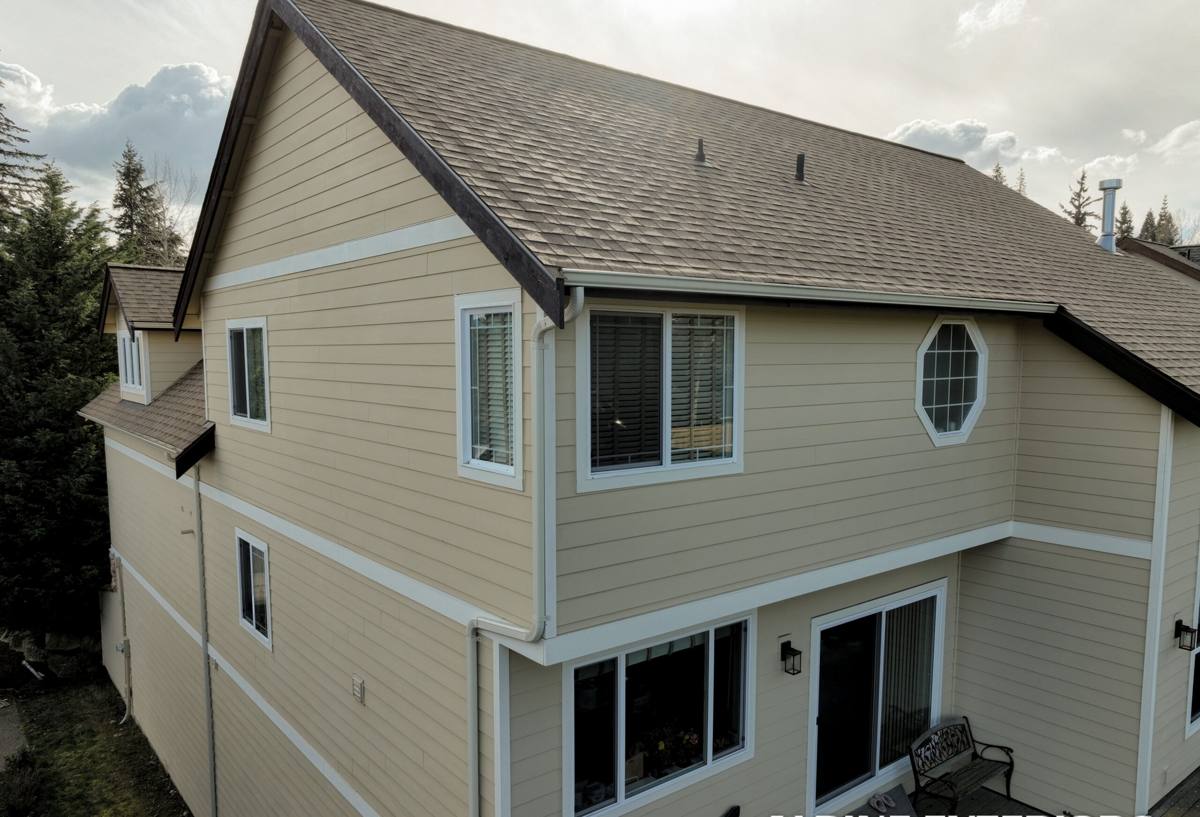
What San Juan Island Homes Actually Need From Their Siding
Given that environment, siding here needs to do three things well: shed water aggressively, resist the corrosive effect of salt air on fasteners and finishes, and hold its color and surface without constant re-coating. This is the reasoning behind why we install James Hardie fiber cement exclusively and don't offer vinyl, LP SmartSide, Cemplank, Allura, primed spruce, or cedar. Each of those alternatives has a real strength somewhere, but each also has a specific weak point — moisture absorption, coating longevity, or maintenance burden — that shows up faster in a marine climate like this one than it would somewhere drier and more sheltered.
James Hardie's fiber cement is non-combustible and dimensionally stable, meaning it doesn't swell, cup, or rot the way wood-based products can when they take on repeated moisture. Its factory-applied ColorPlus finish is baked on under controlled conditions rather than field-painted, which matters directly here: a finish that's fully cured before it ever reaches San Juan Island holds up to UV and salt exposure far better than a coating applied on-site in variable weather.
Climate-Engineered Product Lines
James Hardie makes region-specific HZ (HardieZone) products engineered for different climate stresses. For the Pacific Northwest's wet, marine conditions, the HZ5 line is formulated with moisture and freeze-thaw performance in mind — relevant on San Juan Island, where humidity stays elevated for long stretches and temperatures still dip enough in winter to matter. We spec HZ5 products for island work rather than a generic, one-size-fits-all version of the same siding.
What a Correct James Hardie Installation Involves
Fiber cement siding is only as good as the assembly behind it. A large share of the siding failures we see on inspection aren't the material's fault — they're installation shortcuts that let water in behind a product that was never designed to be a stand-alone water barrier.
Water Management Comes First
Before a single piece of siding goes up, the wall needs a correctly lapped weather-resistive barrier, properly integrated flashing at every window, door, and penetration, and rainscreen or drainage detailing where the wall assembly calls for it. On a site exposed to driving rain, this layer is what actually keeps water out — the siding is the second line of defense, not the first.
Clearance and Fastening
James Hardie's install specifications call for minimum clearances above rooflines, decks, and grade, correct fastener spacing and embedment, and factory-recommended nail or screw types that won't corrode prematurely in salt air. Skipping clearance requirements is one of the most common shortcuts we find on older installs — siding run too close to a roofline or deck surface traps moisture and accelerates failure at exactly the joint where it's hardest to inspect.
Joints, Caulking, and Trim
Butt joints, trim transitions, and penetrations need to be sealed with a caulk rated for the movement and exposure involved, not just whatever's on hand. On an install exposed to salt air and constant moisture cycling, an inferior sealant is often the first thing to fail, and it's usually where the water gets in.
Comparing Siding Options for San Juan Island's Climate
| Material | Moisture Behavior | Salt Air / Coastal Durability | Maintenance Over Time |
|---|---|---|---|
| James Hardie Fiber Cement (HZ5) | Dimensionally stable, doesn't swell or rot | Engineered for wet, coastal climates | Low — factory finish holds color for years |
| Vinyl | Sheds water but can warp/crack in temperature swings | Fasteners and seams can degrade near salt air | Low upfront, but limited repair options once faded or cracked |
| LP SmartSide (engineered wood) | More moisture-sensitive at cut edges and joints | Requires diligent sealing to prevent edge swelling | Moderate — edge and joint maintenance is critical |
| Cedar / Primed Wood | Absorbs moisture, prone to rot without upkeep | Salt air accelerates weathering of finish | High — regular refinishing needed |
Signs Your Current Siding Is Losing the Battle
- Soft or spongy spots when pressed, especially near the base of walls or below windows
- Persistent moss or algae growth that returns soon after cleaning
- Visible gaps, cracked caulking, or separated joints at trim and corners
- Paint that's chalking, peeling, or requiring re-coating more often than every several years
- Rust streaking from fasteners or trim hardware
- Warping, cupping, or bowing panels, particularly on walls facing prevailing wind and rain
Any one of these is worth a look. Several together usually mean the wall assembly, not just the surface, needs attention.
How Our Process Works for San Juan Island Projects
Working on the islands adds a layer of logistics that mainland jobs don't have — ferry scheduling, material staging, and making sure a crew and its equipment are fully set up before work starts rather than making repeat trips back and forth. We plan San Juan Island projects around that reality: materials are ordered and staged in advance, crew scheduling accounts for ferry timing, and the job is sequenced so that once we're on-site, work moves efficiently from tear-off through final trim without unnecessary gaps in weather protection.
Every project starts with an on-site assessment of the existing wall assembly, not just the visible siding — because on a home that's been exposed to years of coastal weather, what's happening behind the cladding matters as much as what's on the surface. From there we scope the water management details, confirm James Hardie product and color selection, and walk through what correct installation will look like for that specific home.
Maintenance That Actually Matters After Installation
James Hardie siding installed correctly is low-maintenance, not no-maintenance. On San Juan Island specifically, a few habits go a long way:
- Rinse siding periodically to clear salt residue and organic buildup before moss gets a foothold
- Keep gutters and downspouts clear so water isn't sheeting down wall surfaces
- Trim back vegetation that shades siding and keeps it damp longer than it should be
- Inspect caulking at joints and trim every year or two, since sealant is the first thing to wear in this climate
What Affects Cost on an Island Project
Pricing depends on the usual factors — square footage, number of stories, trim complexity, and whether there's existing damage to address behind the old siding — plus a few island-specific ones. Ferry logistics and material staging add planning time compared to a mainland job of the same size, and any hidden moisture damage found once old siding comes off can change scope. We give straightforward, honest estimates that reflect what a project actually needs, not a lowball number that grows once work starts.
Why Hiring a Crew That Already Works San Juan Island Matters
A contractor who's done this work on the island already understands the ferry logistics, has a feel for how exposed a given site is to wind and salt spray, and isn't learning those lessons on your home. That experience shows up in the small decisions — how clearances are handled near a windswept corner, which joints get extra attention, how staging is planned so the crew isn't stuck waiting on a ferry mid-project. It's the difference between a crew that's installed Hardie siding in this exact climate and one that's applying general instructions to conditions they haven't seen before.
If your San Juan Island home needs new siding or you're seeing early signs of wear, we're happy to take a look and give you a straightforward, no-pressure estimate — just fill out the form below.