 Orcas Island Siding
 Siding Repair Built for West Sound's Marine Climate
West Sound sits along one of Orcas Island's more exposed stretches of shoreline, and homes here take a different kind of beating than a house tucked into the interior of the island. Salt-laden air moves off the water and settles onto siding, trim, and fasteners year-round. Add San Juan County's long wet season, driving rain that comes in sideways during winter storms, and a moss season that can stretch from fall through spring, and you have a climate that finds every weak point in a home's exterior. Siding repair in this neighborhood isn't a cosmetic job — it's about catching what the marine environment has already started before it reaches the framing underneath.
We work on Orcas Island full-time, which means we see the same West Sound homes come up for maintenance year after year. That repeat exposure matters. A repair crew that only shows up once knows the general rules of siding repair. A crew that works this specific shoreline knows which elevations take the worst of the weather, which materials have failed here before, and what a correct fix actually looks like once the salt air and rain get involved.
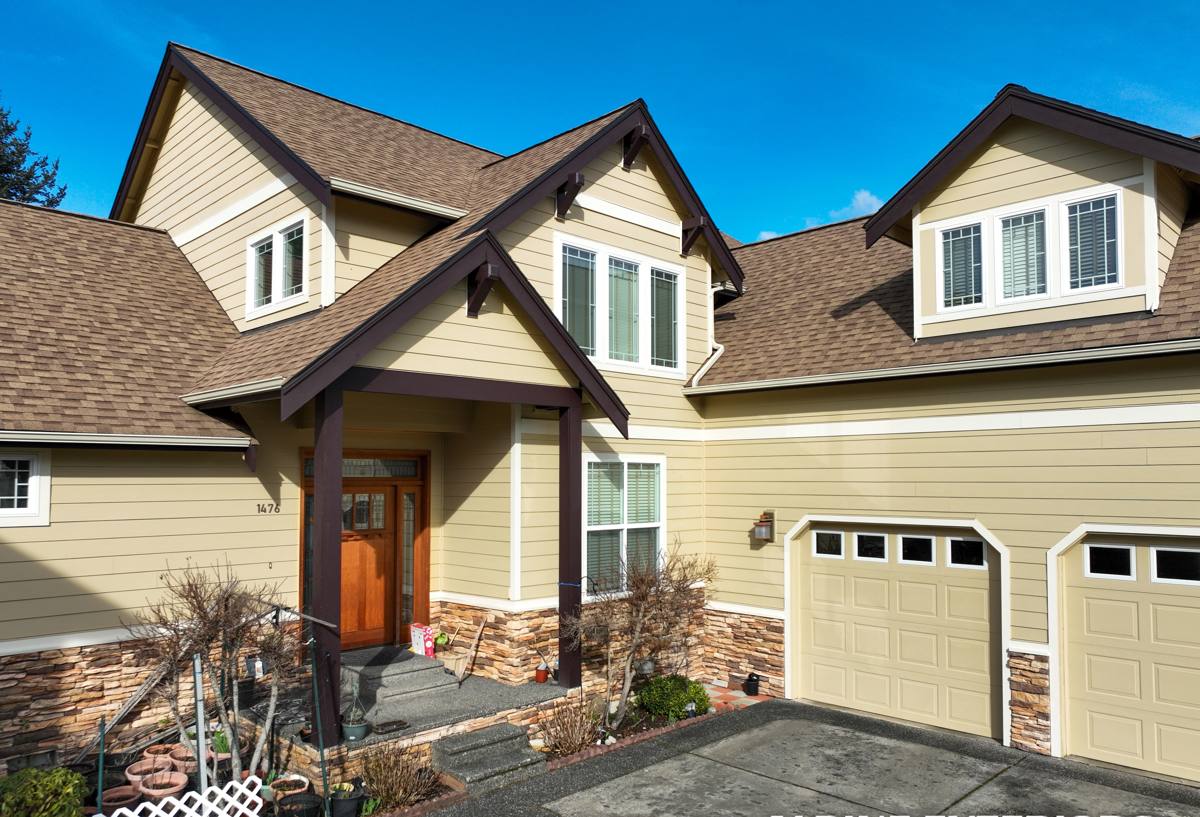
What West Sound's Climate Does to Siding
Salt Air and Corrosion
Airborne salt doesn't just sit on the surface of your siding — it works into fasteners, flashing, and any exposed metal trim. Over time this accelerates corrosion in ways that inland homes never have to deal with. Nails and screws that would last decades elsewhere can start failing years early this close to the water, and once a fastener lets go, the siding panel around it starts moving, which opens the door to water intrusion.
Driving Rain and Wind-Driven Moisture
West Sound's exposure means rain frequently arrives at an angle rather than falling straight down. Wind-driven rain finds gaps that would never see moisture in calmer conditions — poorly lapped seams, undersized J-channel, caulk joints that have shrunk and cracked. Once water gets behind the siding, it travels, so damage often shows up several feet from where the water actually entered.
Moss, Algae, and Prolonged Dampness
San Juan County's mild, wet winters are ideal for moss and algae growth, and a long moss season means siding surfaces can stay damp for extended stretches with little drying time between rain events. On absorbent or poorly finished materials, that constant moisture cycle leads to swelling, soft spots, and paint failure. Moss holding moisture against a wall is one of the most common early-stage problems we find on siding repair calls in this part of the island.
Signs a West Sound Home Needs Siding Repair
Most siding failures don't happen suddenly — they build slowly enough that homeowners don't notice until the damage has spread. Here's what we look for on an inspection:
- Soft or spongy spots when you press on the siding, especially near the bottom courses
- Visible gaps, cracks, or separation at seams and corners
- Peeling, bubbling, or chalky paint that keeps coming back after repainting
- Moss or dark streaking that persists even after cleaning
- Rust staining below fasteners or trim
- Warping, buckling, or panels that no longer sit flat against the wall
- Interior signs — musty smell, discoloration on interior walls near exterior corners
Any one of these on its own might be minor. Several together, especially on the same elevation, usually means water has been getting behind the siding for a while.
What a Correct Repair Actually Involves
A siding repair that only addresses the visible surface tends to fail again within a season or two, especially in a climate like West Sound's. A repair done right starts underneath the siding, not on top of it.
1. Remove and Inspect
We pull the damaged siding back far enough to see the water-resistive barrier, sheathing, and framing behind it. This is the step that gets skipped when a repair is rushed, and it's the step that tells us whether we're dealing with a surface problem or something that's already reached the structure.
2. Address the Water Path, Not Just the Symptom
If water got behind the siding, something let it in — a failed seam, missing flashing, a caulk joint that dried out, or a fastener that backed out. We fix the entry point, not just the panel that got wet. Replacing siding without correcting the water path just buys you the same repair again in a few years.
3. Repair or Replace Sheathing and Framing as Needed
Any rotted sheathing or framing gets cut out and replaced before new siding goes back on. Covering damaged wood with new siding hides the problem instead of solving it, and in a marine climate that hidden rot keeps spreading.
4. Correct Flashing and Water-Resistive Barrier Details
Flashing above windows, doors, and horizontal trim gets checked and corrected so water sheds outward instead of tracking back into the wall assembly. This is one of the most common places we find the original installation cut corners.
5. Reinstall with Proper Fastening and Clearances
New or replacement siding goes back on with corrosion-resistant fasteners, correct nailing patterns, and proper clearance from grade, decks, and roof lines — details that matter even more this close to the water.
6. Finish and Seal
Cut edges get properly sealed or factory-finished edges are used where possible, and joints are caulked with a product suited for a marine environment. A repair that leaves a cut edge unsealed is inviting the same failure right back.
Why We Repair With James Hardie Fiber Cement
When a repair calls for new material — whether it's a few boards or a full elevation — we use James Hardie fiber cement, and only James Hardie. We don't install vinyl, LP SmartSide, Cemplank, Allura, primed spruce, or cedar, and that's a deliberate standard, not a lack of options. Fiber cement is non-combustible, dimensionally stable, and holds up to sustained moisture exposure far better than wood-based or engineered-wood alternatives, which matters directly in a climate where dampness lingers for months at a time. Hardie's ColorPlus factory finish is baked on and warrantied against fading and peeling, which reduces one of the biggest long-term maintenance headaches on this coastline: repainting siding every few years because the coating failed before the substrate did.
Hardie's HZ5 product line is engineered specifically for climates with more moisture and freeze-thaw cycling, which fits the Pacific Northwest better than a one-size-fits-all product. When we're repairing an older section of siding, matching in with new Hardie board also gives the homeowner a natural upgrade path — the patched section performs as well as, or better than, the surrounding original material, instead of introducing a mismatched, shorter-lived patch.
Repair vs. Replacement: How We Help You Decide
Not every siding problem in West Sound calls for a full re-side, and not every "just patch it" request is the right call either. We walk homeowners through the actual condition of the wall before recommending either direction.
| Factor | Favors Repair | Favors Full Replacement |
|---|---|---|
| Extent of damage | Isolated to one or two elevations or sections | Recurring failures across multiple walls |
| Underlying structure | Sheathing and framing sound | Rot or moisture damage found in multiple areas |
| Age of existing siding | Newer material, isolated failure point | Original siding near or past expected service life |
| Material match | Hardie or compatible material already installed | Existing material is one we don't install or can't reliably match |
| Cause of failure | Single identifiable cause (impact, one bad seam) | Systemic issue — poor original flashing, wrong material for climate |
We'll tell you honestly when a repair is the right, cost-effective answer, and we'll tell you honestly when patching a failing system is just delaying a bigger job.
Our Process for West Sound Siding Repair
- Inspection: We walk the exterior, check every elevation exposed to weather and salt air, and probe any suspect areas by hand.
- Assessment and estimate: We explain what we found, what's causing it, and give a clear, honest estimate — repair or replacement, whichever actually fits.
- Scheduling around West Sound conditions: We plan work around the wet season and tidal exposure where relevant, so repairs go in during a stretch of workable weather rather than getting rushed between storms.
- The repair itself: Removal, inspection of what's underneath, structural correction if needed, and reinstallation with proper flashing and fastening.
- Final check: We confirm seams, caulking, and finish work are done to hold up against the next wet season, not just look good on the day we finish.
A Practical Maintenance Checklist for Homeowners
Between professional inspections, there's a lot a homeowner can check on their own to catch problems early:
- Walk the exterior once or twice a year, focusing on the sides that face open water or prevailing wind
- Press gently on siding near the ground and near window and door trim — soft spots mean trouble
- Rinse off moss and algae buildup before it has a chance to hold moisture against the wall for months
- Check caulk joints at trim, corners, and penetrations for cracking or gaps
- Look for rust streaking below nails, screws, or metal flashing
- Keep gutters clear so overflow doesn't run down the siding face
- Trim back vegetation that keeps a wall shaded and damp longer than the rest of the house
Why Hiring Local Experience Matters Here
West Sound's exposure isn't uniform across the island — a repair approach that works on a sheltered inland lot doesn't automatically hold up on a shoreline-facing wall. A crew that already works this neighborhood knows which elevations to check first, recognizes salt-driven corrosion and moss-related damage on sight, and doesn't have to relearn the local climate on your dime. That local knowledge is part of why we standardized on a fiber cement product engineered for this kind of weather in the first place, rather than offering whatever material happens to be cheapest to install.
If you're seeing soft spots, persistent moss, peeling paint, or any of the warning signs above on a West Sound home, we're happy to take a look. We offer free, no-pressure estimates, and we'll give you a straight answer on whether you need a repair, a partial re-side, or nothing more than a cleaning — use the form below to get in touch.